


This algebra 2 polynomial division test checks polynomial division and the remainder theorem in 45 minutes, with 9 questions for a total of 20 points.
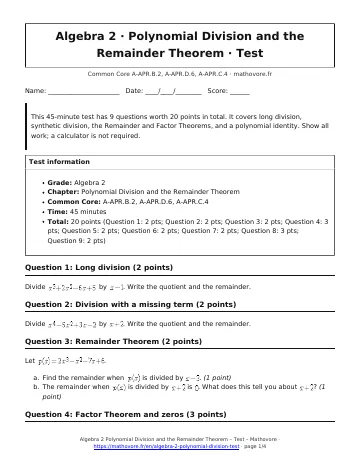
This 45-minute test has 9 questions worth 20 points in total. It covers long division, synthetic division, the Remainder and Factor Theorems, and a polynomial identity. Show all work; a calculator is not required.
- Grade: Algebra 2
- Chapter: Polynomial Division and the Remainder Theorem
- Common Core: A-APR.B.2, A-APR.D.6, A-APR.C.4
- Time: 45 minutes
- Total: 20 points (Question 1: 2 pts; Question 2: 2 pts; Question 3: 2 pts; Question 4: 3 pts; Question 5: 2 pts; Question 6: 2 pts; Question 7: 2 pts; Question 8: 3 pts; Question 9: 2 pts)
Algebra 2 Polynomial Division Test: questions 1–5
Question 1: Long division (2 points)
Divide \(x^{3}+2x^{2}-6x+5\) by \(x-1\). Write the quotient and the remainder.
Question 2: Division with a missing term (2 points)
Divide \(x^{4}-5x^{2}+3x-2\) by \(x+2\). Write the quotient and the remainder.
Question 3: Remainder Theorem (2 points)
Let \(p(x)=2x^{3}-x^{2}-7x+6\).
- Find the remainder when \(p(x)\) is divided by \(x-3\). (1 point)
- The remainder when \(p(x)\) is divided by \(x+2\) is \(0\). What does this tell you about \(x+2\)? (1 point)
Question 4: Factor Theorem and zeros (3 points)
The graph of \(f(x)=x^{3}-x^{2}-14x+24\) is shown.
- Show that \(x-2\) is a factor of \(f(x)\). (1 point)
- Write \(f(x)\) as a product of three linear factors. (1 point)
- State the x-intercepts of the graph. (1 point)
Question 5: Find k and factor (2 points)
The binomial \(x+3\) is a factor of \(p(x)=x^{3}+kx^{2}-5x+3\).
- Find \(k\). (1 point)
- Factor \(p(x)\) completely. (1 point)
Algebra 2 Polynomial Division Test: questions 6–9
Question 6: Function from a graph (2 points)
The graph of a cubic function \(f\) with leading coefficient \(1\) is shown.
- Write \(f(x)\) in factored form. (1 point)
- Find the remainder when \(f(x)\) is divided by \(x-5\). (1 point)
Question 7: Polynomial identity (2 points)
- Show that \((x^{2}+y^{2})^{2}=(x^{2}-y^{2})^{2}+(2xy)^{2}\) by expanding. (1 point)
- Use the identity with \(x=4\) and \(y=1\) to find the sides of a right triangle with legs \(x^{2}-y^{2}\) and \(2xy\). (1 point)
Question 8: Dimensions of a box (3 points)
The volume of a gift box is \(V(x)=x^{3}+10x^{2}+31x+30\) cubic inches. The length is \(x+5\) inches and the width is \(x+2\) inches.
- Find an expression for the height \(h\). (2 points)
- Find the volume when \(x=4\) from the dimensions. (1 point)
Question 9: Divide by 2x plus 1 (2 points)
Divide \(6x^{3}-x^{2}+6x+7\) by \(2x+1\). Write the quotient and the remainder.

How to use this algebra 2 polynomial division test
Take this algebra 2 polynomial division test without notes, then grade it with the test answer key out of 20 points.

See every chapter on the Algebra 2 math page.