
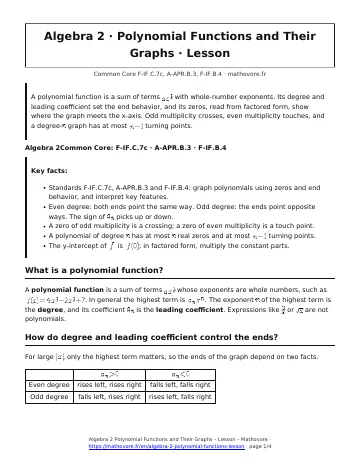
This algebra 2 polynomial functions lesson explains polynomial functions and their graphs in one printable page, with definitions, a method and a worked example.
A polynomial function is a sum of terms \(ax^{k}\) with whole-number exponents. Its degree and leading coefficient set the end behavior, and its zeros, read from factored form, show where the graph meets the x-axis. Odd multiplicity crosses, even multiplicity touches, and a degree-\(n\) graph has at most \(n-1\) turning points.
Algebra 2 Polynomial Functions Lesson: key facts
- Standards F-IF.C.7c, A-APR.B.3 and F-IF.B.4: graph polynomials using zeros and end behavior, and interpret key features.
- Even degree: both ends point the same way. Odd degree: the ends point opposite ways. The sign of \(a_{n}\) picks up or down.
- A zero of odd multiplicity is a crossing; a zero of even multiplicity is a touch point.
- A polynomial of degree \(n\) has at most \(n\) real zeros and at most \(n-1\) turning points.
- The y-intercept of \(f\) is \(f(0)\); in factored form, multiply the constant parts.
What is a polynomial function?
A polynomial function is a sum of terms \(a x^{k}\) whose exponents are whole numbers, such as \(f(x)=4x^{3}-2x^{2}+7\). In general the highest term is \(a_{n}x^{n}\). The exponent \(n\) of the highest term is the degree, and its coefficient \(a_{n}\) is the leading coefficient. Expressions like \(\frac{2}{x}\) or \(\sqrt{x}\) are not polynomials.
How do degree and leading coefficient control the ends?
For large \(|x|\), only the highest term matters, so the ends of the graph depend on two facts.
| \(a_{n} > 0\) | \(a_{n} < 0\) | |
|---|---|---|
| Even degree | rises left, rises right | falls left, falls right |
| Odd degree | falls left, rises right | rises left, falls right |
What do zeros and multiplicity tell you?
In factored form \(f(x)=a(x-r_{1})^{m_{1}}(x-r_{2})^{m_{2}}\), each \(r\) is a zero and each exponent \(m\) is its multiplicity. If \(m\) is odd the graph crosses the x-axis at \(r\); if \(m\) is even it touches the axis and turns around. The degree equals the sum of the multiplicities.
How many turning points can a graph have?
A polynomial of degree \(n\) has at most \(n-1\) turning points, where the graph changes from rising to falling or the reverse. A turning point is a relative maximum or relative minimum.
How do you sketch a graph from factored form?
- Find the zeros and their multiplicities.
- Use the degree and leading coefficient for the end behavior.
- Find the y-intercept \(f(0)\).
- Test one point in each interval to get the signs, then draw a smooth curve.
For \(f(x)=(x+2)(x-1)^{2}\): zeros \(-2\) (crosses) and \(1\) (touches); degree \(3\) with positive leading coefficient, so it falls left and rises right; \(f(0)=2\cdot 1=2\). Testing \(x=-3\) gives \(-16\), and \(x=2\) gives \(4\).
Polynomial Functions and Their Graphs: frequently asked questions
How do you find the degree of a polynomial in factored form?
Add the multiplicities of all the factors, counting each linear factor as degree 1. For example, \(x(x-2)^{2}(x+5)^{3}\) has degree \(1+2+3=6\).
What does multiplicity mean for a graph?
It tells how many times a factor repeats. An odd multiplicity makes the graph cross the x-axis, and an even multiplicity makes it touch the axis and turn around. A multiplicity of 3 flattens the graph at the zero.
How many zeros can a polynomial have?
A degree-\(n\) polynomial has at most \(n\) real zeros, counting multiplicity. An odd-degree polynomial always has at least one real zero because its ends go in opposite directions.
What is a turning point?
It is a point where the graph switches between rising and falling, so it is a relative maximum or minimum. A degree-\(n\) polynomial has at most \(n-1\) of them.
How do you find the zeros of a polynomial that is not factored?
Factor it first, using a common factor or grouping, then set each factor equal to zero. For example, \(x^{3}-9x=x(x-3)(x+3)\) has zeros \(0\), \(3\) and \(-3\).
How to use this algebra 2 polynomial functions lesson
Use this algebra 2 polynomial functions lesson before the worksheet, then check what you learned with the quiz.

See every chapter on the Algebra 2 math page.