


This algebra 2 radicals rational exponents worksheet gives 26 problems on radicals and rational exponents, ordered from easy to hard, with a separate answer key.
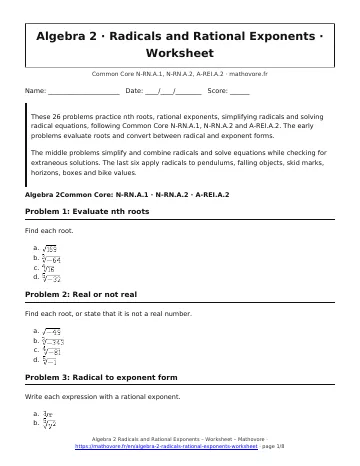
These 26 problems practice nth roots, rational exponents, simplifying radicals and solving radical equations, following Common Core N-RN.A.1, N-RN.A.2 and A-REI.A.2. The early problems evaluate roots and convert between radical and exponent forms.
The middle problems simplify and combine radicals and solve equations while checking for extraneous solutions. The last six apply radicals to pendulums, falling objects, skid marks, horizons, boxes and bike values.
Algebra 2 Radicals Rational Exponents Worksheet: problems 1–5
Problem 1: Evaluate nth roots
Find each root.
- \(\sqrt{169}\)
- \(\sqrt[3]{-64}\)
- \(\sqrt[4]{16}\)
- \(\sqrt[5]{-32}\)
Problem 2: Real or not real
Find each root, or state that it is not a real number.
- \(\sqrt{-49}\)
- \(\sqrt[3]{-343}\)
- \(\sqrt[4]{-81}\)
- \(\sqrt[5]{-1}\)
Problem 3: Radical to exponent form
Write each expression with a rational exponent.
- \(\sqrt[3]{x}\)
- \(\sqrt[5]{y^{2}}\)
- \((\sqrt[4]{z})^{3}\)
- \(\sqrt{7^{3}}\)
Problem 4: Exponent to radical form
Write each expression as a radical.
- \(5^{1/2}\)
- \(x^{2/3}\)
- \((3a)^{3/4}\)
- \(2m^{1/3}\)
Problem 5: Evaluate rational exponents
Evaluate each expression without a calculator.
- \(25^{1/2}\)
- \(64^{1/3}\)
- \(16^{3/4}\)
- \(8^{2/3}\)
- \(32^{3/5}\)
Algebra 2 Radicals Rational Exponents Worksheet: problems 6–10
Problem 6: Negative rational exponents
Evaluate each expression.
- \(9^{-1/2}\)
- \(27^{-2/3}\)
- \(16^{-3/4}\)
- \((\frac{1}{4})^{-3/2}\)
Problem 7: Simplify square roots
Write each radical in simplest form. The factor tree helps with part a.
- \(\sqrt{48}\)
- \(\sqrt{90}\)
- \(\sqrt{200}\)
- \(\sqrt{75}\)
Problem 8: Simplify higher roots
Write each radical in simplest form.
- \(\sqrt[3]{24}\)
- \(\sqrt[3]{250}\)
- \(\sqrt[3]{-54}\)
- \(\sqrt[4]{48}\)
Problem 9: Radicals with variables
Simplify. Assume every variable is positive.
- \(\sqrt{18x^{5}}\)
- \(\sqrt[3]{16y^{7}}\)
- \(\sqrt{50a^{3}b^{4}}\)
- \(\sqrt[3]{54m^{5}n^{9}}\)
Problem 10: Multiply radicals
Multiply and simplify.
- \(\sqrt{6}\cdot\sqrt{10}\)
- \(\sqrt[3]{4}\cdot\sqrt[3]{6}\)
- \((3\sqrt{2})(5\sqrt{14})\)
- \((2\sqrt{3})(\sqrt{6})\)
Algebra 2 Radicals Rational Exponents Worksheet: problems 11–15
Problem 11: Add and subtract radicals
Simplify each radical first, then combine like radicals.
- \(3\sqrt{12}+\sqrt{27}\)
- \(5\sqrt{8}-2\sqrt{18}\)
- \(\sqrt[3]{16}+\sqrt[3]{54}\)
- \(\sqrt{20}-\sqrt{45}+\sqrt{5}\)
Problem 12: Rationalize denominators
Rationalize the denominator and simplify.
- \(\frac{6}{\sqrt{3}}\)
- \(\frac{5}{\sqrt{10}}\)
- \(\frac{4}{\sqrt{7}-\sqrt{3}}\)
- \(\frac{3}{\sqrt[3]{2}}\)
Problem 13: Exponent properties
Simplify. Assume every variable is positive.
- \(x^{1/2}\cdot x^{1/3}\)
- \((y^{2/3})^{3/4}\)
- \(\frac{x^{5/4}}{x^{1/4}}\)
- \((8a^{3})^{2/3}\)
Problem 14: Change the index
Simplify each expression. Assume \(x\) is positive.
- \(\sqrt[6]{x^{4}}\)
- \(\sqrt[4]{9}\)
- \(\sqrt[3]{\sqrt{64}}\)
- \(\sqrt{\sqrt[3]{x^{12}}}\)
Problem 15: One-step radical equations
Solve each equation. The graph shows part c.
- \(\sqrt{x}=7\)
- \(\sqrt[3]{x}=-3\)
- \(\sqrt{x-4}=5\)
- \(\sqrt{2x+1}=9\)
Algebra 2 Radicals Rational Exponents Worksheet: problems 16–20
Problem 16: Check for extraneous solutions
Solve \(\sqrt{3x+4}=x\) and check every answer in the original equation.
Problem 17: Radical on the right
Solve \(x-2=\sqrt{x+4}\). Identify any extraneous solution.
Problem 18: Isolate the radical first
Solve each equation, or state that there is no solution.
- \(\sqrt{x+5}-3=4\)
- \(2\sqrt{x-1}+3=11\)
- \(\sqrt[3]{2x-5}+1=4\)
- \(\sqrt{x+7}+5=3\)
Problem 19: Rational exponent equations
Solve each equation. Check every answer.
- \(x^{3/2}=27\)
- \(x^{2/3}=16\)
- \(x^{1/4}=3\)
- \((x-1)^{2/3}=4\)
Problem 20: Equations with two radicals
Solve each equation and check.
- \(\sqrt{2x+3}=\sqrt{x+7}\)
- \(\sqrt[3]{x+4}=\sqrt[3]{3x-10}\)
- \(\sqrt{5x-1}=\sqrt{2x+8}\)
Algebra 2 Radicals Rational Exponents Worksheet: problems 21–25
Problem 21: Pendulum period
The period \(T\) (in seconds) of a pendulum of length \(L\) feet is \(T=2\pi\sqrt{\frac{L}{32}}\). Mei’s clock pendulum is \(8\) feet long.
- Find the exact period and round it to the nearest hundredth.
- Find the length with period \(2\pi\) seconds.
- Find the length with period \(4\pi\) seconds.
Problem 22: Free fall time
An object dropped from a height of \(h\) feet hits the ground after \(t=\sqrt{\frac{h}{16}}\) seconds. Liam drops a ball from a roof.
- Find the fall time from \(144\) feet.
- The ball takes \(2.5\) seconds. Find the height.
- Find the fall time from \(400\) feet.
Problem 23: Skid marks
Police estimate a car’s speed \(s\) (mph) from its skid distance \(d\) (feet) and the road’s friction factor \(f\) using \(s=\sqrt{30fd}\).
- Find the speed when \(f=0.75\) and \(d=40\).
- A car was going \(45\) mph on a road with \(f=0.6\). Find the skid distance.
- Find the exact speed, and the speed to the nearest hundredth, when \(f=0.8\) and \(d=30\).
Problem 24: Distance to the horizon
A lookout at height \(h\) feet can see \(d=\sqrt{1.5h}\) miles to the horizon.
- How far can Aisha see from a tower \(150\) feet high?
- How high must a tower be to see \(21\) miles?
- How far can a sailor see from a deck \(6\) feet above the water?
Problem 25: Cube-shaped box
A cube-shaped storage box holds \(250\) cubic inches. Ethan needs its edge length \(e\).
- Write the exact edge length in simplest radical form.
- Round the edge length to the nearest hundredth of an inch.
- Find the area of one face, exactly and rounded to the nearest hundredth.
Algebra 2 Radicals Rational Exponents Worksheet: problems 26–26
Problem 26: Bike value
Noah’s bike is worth \(V=900(0.64)^{t/2}\) dollars after \(t\) years.
- Find its value after \(1\) year.
- Find its value after \(3\) years.
- After how many years is it worth \(\$576\)?
- Find its value after \(5\) years, to the nearest cent.

How to use this algebra 2 radicals rational exponents worksheet
Print this algebra 2 radicals rational exponents worksheet as a PDF, solve every problem on paper, then compare with the answer key.

See every chapter on the Algebra 2 math page.