This geometry coordinate worksheet answer key solves all 25 problems of the coordinate geometry proofs worksheet step by step.
This answer key shows a complete worked solution for every problem on the coordinate geometry worksheet. Compare each step with your own work, check the slope and distance calculations, and note where a figure helps verify a result.
Geometry Coordinate Worksheet Answer Key: problems 1–5
Problem 1: Vertical distance
Both points have the same x-coordinate, so the segment is vertical. Its length is \(|4-(-6)|=10\).
The length is 10 units.
Problem 2: Distance with a 3-4-5 triangle
\(d=\sqrt{(4-1)^{2}+(6-2)^{2}}=\sqrt{9+16}=\sqrt{25}=5\).
The distance is 5 units.
Problem 3: Distance between two points
\(d=\sqrt{(4-(-2))^{2}+(7-(-1))^{2}}=\sqrt{36+64}=\sqrt{100}=10\).
The distance is 10 units.
Problem 4: Distance as a radical
\(d=\sqrt{(1-(-3))^{2}+(4-2)^{2}}=\sqrt{16+4}=\sqrt{20}=2\sqrt{5}\). Since \(\sqrt{5}\approx 2.236\), \(2\sqrt{5}\approx 4.47\).
\(2\sqrt{5}\approx 4.47\) units
Problem 5: Midpoint of a segment
\(M=(\frac{2+10}{2},\frac{8+(-4)}{2})=(6,2)\).
\(M=(6,2)\)
Geometry Coordinate Worksheet Answer Key: problems 6–10
Problem 6: Midpoint with fractions
\(M=(\frac{-5+2}{2},\frac{3+6}{2})=(-\frac{3}{2},\frac{9}{2})\).
\(M=(-\frac{3}{2},\frac{9}{2})=(-1.5,\,4.5)\)
Problem 7: Missing endpoint
Let \(B=(x,y)\). Then \(\frac{-2+x}{2}=3\) gives \(x=8\), and \(\frac{4+y}{2}=-1\) gives \(y=-6\).
\(B=(8,-6)\)
Problem 8: Slopes of two lines
Slope of \(a\): \(\frac{8-2}{4-1}=2\). Slope of \(b\): \(\frac{2-5}{6-0}=-\frac{1}{2}\). The slopes are not equal, but \(2\cdot(-\frac{1}{2})=-1\).
The lines are perpendicular.
Problem 9: Parallel line through a point
A parallel line has the same slope, 3. Point-slope form: \(y-(-1)=3(x-4)\), so \(y+1=3x-12\).
\(y=3x-13\)
Check: when \(x=4\), \(y=3(4)-13=-1\).
Problem 10: Perpendicular line through a point
The perpendicular slope is the opposite reciprocal of \(-\frac{2}{3}\), which is \(\frac{3}{2}\). Then \(y-2=\frac{3}{2}(x-6)\), so \(y=\frac{3}{2}x-9+2\).
\(y=\frac{3}{2}x-7\)
Check: when \(x=6\), \(y=9-7=2\).
Geometry Coordinate Worksheet Answer Key: problems 11–15
Problem 11: Point one third of the way
The fraction is \(\frac{1}{1+2}=\frac{1}{3}\). The run is \(12-0=12\) and the rise is \(14-2=12\). Move \(\frac{1}{3}(12)=4\) right and 4 up from \(A\).
\(P=(4,6)\)
Problem 12: Ratio 3 to 2
The fraction is \(\frac{3}{3+2}=\frac{3}{5}\). Run: \(4-(-6)=10\), so move \(\frac{3}{5}(10)=6\). Rise: \(-8-2=-10\), so move \(\frac{3}{5}(-10)=-6\). Then \((-6+6,\,2-6)=(0,-4)\).
\((0,-4)\)
Problem 13: Perimeter of a triangle
\(AB=6\) (horizontal) and \(BC=8\) (vertical). \(AC=\sqrt{6^{2}+8^{2}}=\sqrt{100}=10\). Perimeter: \(6+8+10=24\).
The perimeter is 24 units.
Problem 14: Area of a tilted rectangle
\(PQ=\sqrt{4^{2}+2^{2}}=\sqrt{20}=2\sqrt{5}\) and \(QR=\sqrt{(-1)^{2}+2^{2}}=\sqrt{5}\). Area \(=2\sqrt{5}\cdot\sqrt{5}=2\cdot 5=10\).
The area is 10 square units.
Check: slope of \(\overline{PQ}\) is \(\frac{1}{2}\) and slope of \(\overline{QR}\) is \(-2\); their product is \(-1\), so the angle at \(Q\) is right.
Problem 15: Area of a triangle
\(\overline{AB}\) is horizontal, so the base is \(6-(-2)=8\). The height is the vertical distance from \(C\) to the line \(y=1\): \(7-1=6\). Area \(=\frac{1}{2}(8)(6)=24\).
The area is 24 square units.
Geometry Coordinate Worksheet Answer Key: problems 16–20
Problem 16: Classify a triangle by sides
\(AB=6\). \(AC=\sqrt{3^{2}+5^{2}}=\sqrt{34}\). \(BC=\sqrt{(-3)^{2}+5^{2}}=\sqrt{34}\). Two sides are equal, and \(\sqrt{34}\approx 5.83\neq 6\).
The triangle is isosceles but not equilateral.
Problem 17: Right angle with slopes
Slope of \(\overline{PQ}\): \(\frac{3-1}{5-1}=\frac{1}{2}\). Slope of \(\overline{QR}\): \(\frac{7-3}{3-5}=-2\). Product: \(\frac{1}{2}\cdot(-2)=-1\), so \(\overline{PQ}\perp\overline{QR}\).
\(PQ=\sqrt{20}\) and \(QR=\sqrt{(-2)^{2}+4^{2}}=\sqrt{20}\). Area \(=\frac{1}{2}\sqrt{20}\cdot\sqrt{20}=10\).
The right angle is at \(Q\) and the area is 10 square units.
Problem 18: Prove a parallelogram
Midpoint of \(\overline{AC}\): \((\frac{1+8}{2},\frac{1+6}{2})=(4.5,\,3.5)\). Midpoint of \(\overline{BD}\): \((\frac{6+3}{2},\frac{2+5}{2})=(4.5,\,3.5)\).
The diagonals share a midpoint, so they bisect each other and ABCD is a parallelogram.
Check: from \(A\) to \(B\) and from \(D\) to \(C\) the move is 5 right and 1 up.
Problem 19: Prove a rhombus
Each side has a 3 by 4 change: \(AB=\sqrt{3^{2}+4^{2}}=5\), \(BC=5\), \(CD=5\), \(DA=5\). Four equal sides make a rhombus.
The diagonals lie on the x-axis and the y-axis, so they are perpendicular and cut the figure into four right triangles with legs 3 and 4. Each has area \(\frac{1}{2}(3)(4)=6\), so the area is \(4\cdot 6=24\).
It is a rhombus with area 24 square units.
Problem 20: Walk to the library
(a) \(SL=\sqrt{12^{2}+5^{2}}=\sqrt{169}=13\) blocks, and \(13\times 0.1=1.3\) miles.
(b) \((\frac{2+14}{2},\frac{3+8}{2})=(8,\,5.5)\).
(a) 1.3 miles. (b) The bench is at \((8,5.5)\).
Geometry Coordinate Worksheet Answer Key: problems 21–25
Problem 21: Ranger station on a trail
Move \(\frac{2}{5}(15)=6\) right and \(\frac{2}{5}(20)=8\) up: \(R=(6,8)\).
Whole trail: \(\sqrt{15^{2}+20^{2}}=\sqrt{625}=25\) units. The remaining \(\frac{3}{5}\) is \(15\) units, or \(15\times 0.1=1.5\) miles. Check: \(RC=\sqrt{9^{2}+12^{2}}=15\).
\(R=(6,8)\); the station is 1.5 miles from the campsite.
Problem 22: Garden fence cost
\(AB=8\) ft and \(BC=6\) ft.
(a) \(2(8+6)=28\) ft.
(b) \(28\times 4.50=126\).
(c) \(8\times 6=48\) square feet.
(d) \(AC=\sqrt{8^{2}+6^{2}}=10\) ft.
(a) 28 ft. (b) $126.00. (c) 48 square feet. (d) 10 ft.
Problem 23: Isosceles trapezoid park
Slopes: \(AB\) is 0 and \(DC\) is 0, so \(AB\parallel DC\). \(\text{Slope }AD=\frac{4}{2}=2\) and \(\text{slope }BC=\frac{4}{-2}=-2\), so the other pair is not parallel. Exactly one pair of parallel sides makes a trapezoid.
Legs: \(AD=\sqrt{2^{2}+4^{2}}=\sqrt{20}\) and \(BC=\sqrt{(-2)^{2}+4^{2}}=\sqrt{20}\). Equal legs make it isosceles.
Area: a 4 by 4 rectangle (16) plus two right triangles with legs 2 and 4 (each 4) is 24 square units. Each square unit is \(10\times 10=100\) square yards, so the area is \(24\times 100\) = 2,400 square yards.
It is an isosceles trapezoid with area 2,400 square yards.
Problem 24: Split a triangle
(a) Fraction \(\frac{1}{3}\) of the run 12 is 4, so \(D=(4,0)\).
(b) \(\overline{AB}\) lies on the x-axis (horizontal) and \(\overline{CD}\) lies on the line \(x=4\) (vertical), so they are perpendicular.
(c) Base \(12\), height \(CD=9\): area \(\frac{1}{2}(12)(9)=54\).
(d) \(AD=4\), \(CD=9\), \(AC=\sqrt{4^{2}+9^{2}}=\sqrt{97}\approx 9.85\). Perimeter \(4+9+9.85=22.85\).
(a) \(D=(4,0)\). (c) 54 square units. (d) about 22.85 units.
Problem 25: Drone flight
(a) \(PL=\sqrt{(8-(-4))^{2}+(14-(-2))^{2}}=\sqrt{144+256}=\sqrt{400}=20\) units, and \(20\times 10=200\) yards.
(b) \((\frac{-4+8}{2},\frac{-2+14}{2})=(2,\,6)\).
(a) 200 yards. (b) The photo point is \((2,6)\).
How to use this geometry coordinate worksheet answer key
Read this geometry coordinate worksheet answer key after trying each problem yourself, and redo any problem you missed.

Printable PDF · Worksheet Answer Key
Geometry Coordinate Geometry Proofs worksheet answer key
Download the PDF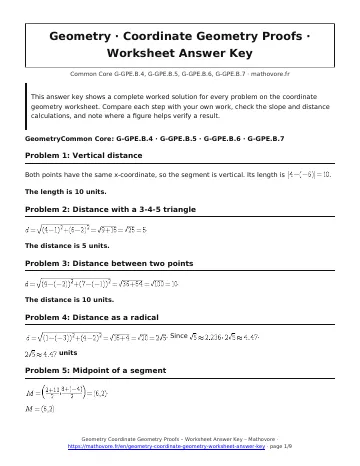
See every chapter on the Geometry math page.