
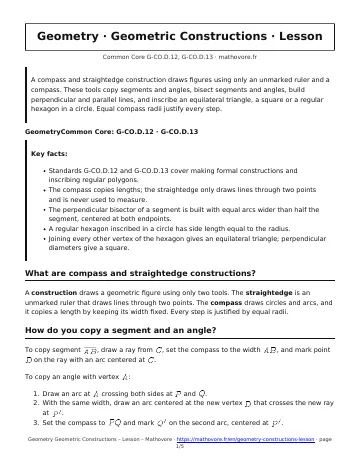
This geometry constructions lesson explains geometric constructions in one printable page, with definitions, a method and a worked example.
A compass and straightedge construction draws figures using only an unmarked ruler and a compass. These tools copy segments and angles, bisect segments and angles, build perpendicular and parallel lines, and inscribe an equilateral triangle, a square or a regular hexagon in a circle. Equal compass radii justify every step.
Geometry Constructions Lesson: key facts
- Standards G-CO.D.12 and G-CO.D.13 cover making formal constructions and inscribing regular polygons.
- The compass copies lengths; the straightedge only draws lines through two points and is never used to measure.
- The perpendicular bisector of a segment is built with equal arcs wider than half the segment, centered at both endpoints.
- A regular hexagon inscribed in a circle has side length equal to the radius.
- Joining every other vertex of the hexagon gives an equilateral triangle; perpendicular diameters give a square.
What are compass and straightedge constructions?
A construction draws a geometric figure using only two tools. The straightedge is an unmarked ruler that draws lines through two points. The compass draws circles and arcs, and it copies a length by keeping its width fixed. Every step is justified by equal radii.
How do you copy a segment and an angle?
To copy segment \(\overline{AB}\), draw a ray from \(C\), set the compass to the width \(AB\), and mark point \(D\) on the ray with an arc centered at \(C\).
To copy an angle with vertex \(A\):
- Draw an arc at \(A\) crossing both sides at \(P\) and \(Q\).
- With the same width, draw an arc centered at the new vertex \(D\) that crosses the new ray at \(P^{\prime}\).
- Set the compass to \(PQ\) and mark \(Q^{\prime}\) on the second arc, centered at \(P^{\prime}\).
- Draw ray \(DQ^{\prime}\). The triangles are congruent by SSS.
How do you construct a perpendicular bisector?
Open the compass wider than half of \(AB\). Arcs of the same radius centered at \(A\) and \(B\) cross at \(P\) and \(Q\). Line \(PQ\) meets \(AB\) at its midpoint \(M\) at a right angle.
Quadrilateral \(APBQ\) has four congruent sides, so it is a rhombus. The diagonals of a rhombus are perpendicular and bisect each other, so \(PQ\) is the perpendicular bisector of \(AB\).
How do you bisect an angle?
Draw an arc centered at the vertex \(B\) that crosses the sides at \(P\) and \(Q\). Equal arcs centered at \(P\) and \(Q\) cross at \(R\), and ray \(BR\) bisects the angle.
How do you construct perpendicular and parallel lines?
For a perpendicular from a point \(P\) to line \(l\), draw an arc at \(P\) crossing \(l\) at \(X\) and \(Y\), then bisect \(XY\). For a parallel through \(P\), draw a line through \(P\) crossing \(l\) at \(Q\), then copy the angle at \(Q\) to \(P\) as a corresponding angle.
How do you inscribe an equilateral triangle, a square and a hexagon in a circle?
Set the compass to the radius. Starting at any point \(A\) on the circle, step around it six times . The six points form a regular hexagon, because each triangle with the center \(O\) is equilateral. Joining every other point gives an inscribed equilateral triangle.
For a square, draw a diameter \(AC\), construct its perpendicular bisector to find \(B\) and \(D\) on the circle, and join \(ABCD\).
Worked example. To build an equilateral triangle on \(\overline{AB}\), draw an arc centered at \(A\) with radius \(AB\), then an arc centered at \(B\) with the same radius. They cross at \(C\). Since \(AC=AB\) and \(BC=AB\), all three sides are equal.
Geometric Constructions: frequently asked questions
Why can’t you use a ruler or protractor in a construction?
A construction proves that a figure can be built from basic geometric rules alone. Measuring with marked tools would only show that the figure looks right. Equal compass radii give a logical reason for each step.
How wide should the compass be to bisect a segment?
Wider than half of the segment. If the radius is too small, the two arcs never cross. Any width greater than half the segment works, as long as it stays the same for both arcs.
Why does the hexagon construction use the radius of the circle?
The radius makes each triangle formed by the center and two neighboring points equilateral. Each central angle is therefore 60 degrees, and six of them make 360 degrees, so the sixth step returns to the start.
How do you construct a 45 degree angle?
Construct a perpendicular to make a 90 degree angle, then bisect it. In the same way, bisecting the 60 degree angle of an equilateral triangle gives 30 degrees.
How can you check that a construction is correct?
Look for equal radii and congruent triangles that justify each step. You can also measure afterward as a quick check, for example that a perpendicular bisector meets the segment at 90 degrees.
How to use this geometry constructions lesson
Use this geometry constructions lesson before the worksheet, then check what you learned with the quiz.

See every chapter on the Geometry math page.