This geometry triangle theorems worksheet answer key solves all 26 problems of the triangle theorems and points of concurrency worksheet step by step.
Each answer shows the theorem used, the algebra, and a check. When a problem asks for a center, compare your result with the figure: the centroid, incenter, and acute-triangle orthocenter always fall inside the triangle.
Geometry Triangle Theorems Worksheet Answer Key: problems 1–5
Problem 1: Find the third angle
The angles add up to \(180^{\circ}\): \(m\angle C=180-52-67=61^{\circ}\). Check: \(52+67+61=180\). Answer: \(61^{\circ}\).
Problem 2: Acute angles of a right triangle
\(m\angle B=180-90-35=55^{\circ}\). The acute angles of a right triangle add up to \(90^{\circ}\): \(35+55=90\). Answer: \(55^{\circ}\).
Problem 3: Base angles of an isosceles triangle
The base angles are congruent. They share \(180-40=140^{\circ}\), so each is \(140: 2=70^{\circ}\). Check: \(40+70+70=180\). Answer: \(70^{\circ}\) each.
Problem 4: Angle sum with variables
Set the sum equal to 180: \((x+10)+(2x-5)+(3x+7)=180\). Combine: \(6x+12=180\). Subtract 12: \(6x=168\). Divide: \(x=28\).
The angles are \(28+10=38^{\circ}\), \(2(28)-5=51^{\circ}\), and \(3(28)+7=91^{\circ}\). Check: \(38+51+91=180\). Answer: \(x=28\); \(38^{\circ}\), \(51^{\circ}\), \(91^{\circ}\).
Problem 5: Use the exterior angle
The exterior angle equals the sum of the remote interior angles: \(41+67=108^{\circ}\).
Check: the interior angle at C is \(180-41-67=72^{\circ}\), and \(180-72=108\). Answer: \(108^{\circ}\).
Geometry Triangle Theorems Worksheet Answer Key: problems 6–10
Problem 6: Missing remote angle
The exterior angle equals the sum of the remote angles: \(75+x=128\), so \(x=128-75=53^{\circ}\). Check: the adjacent interior angle is \(180-128=52^{\circ}\), and \(75+53+52=180\). Answer: \(53^{\circ}\).
Problem 7: Exterior angle with variables
Exterior angle \(=\) sum of remote angles: \(6x-4=(2x+10)+(3x+6)\). Simplify: \(6x-4=5x+16\). Subtract \(5x\): \(x-4=16\). Add 4: \(x=20\).
Exterior angle: \(6(20)-4=116^{\circ}\). Remote angles: \(50^{\circ}\) and \(66^{\circ}\), and \(50+66=116\). Answer: \(x=20\); \(116^{\circ}\).
Problem 8: Isosceles triangle with variables
Base angles are congruent: \(3x+4=5x-16\). Subtract \(3x\): \(4=2x-16\). Add 16: \(20=2x\), so \(x=10\).
Each base angle is \(3(10)+4=34^{\circ}\). Then \(m\angle A=180-34-34=112^{\circ}\). Answer: \(x=10\); base angles \(34^{\circ}\); \(m\angle A=112^{\circ}\).
Problem 9: Equal angles, equal sides
By the converse of the Isosceles Triangle Theorem, the sides opposite equal angles are congruent. \(\overline{QR}\) is opposite \(\angle P\) and \(\overline{PR}\) is opposite \(\angle Q\), so \(PR=QR\).
\(2x+1=4x-13\) gives \(14=2x\), so \(x=7\). \(PR=2(7)+1=15\text{ cm}\) and \(QR=4(7)-13=15\text{ cm}\). \(m\angle R=180-58-58=64^{\circ}\). Answer: \(x=7\), \(PR=15\text{ cm}\), \(m\angle R=64^{\circ}\).
Problem 10: Midsegment length
The midsegment is half the length of the parallel side: \(DE=\frac{1}{2}(26)=13\). Answer: \(DE=13\).
Geometry Triangle Theorems Worksheet Answer Key: problems 11–15
Problem 11: Midsegment with variables
\(BC=2\cdot DE\), so \(7x+2=2(4x-3)\). Distribute: \(7x+2=8x-6\). Subtract \(7x\): \(2=x-6\). Add 6: \(x=8\).
\(DE=4(8)-3=29\text{ in}\) and \(BC=7(8)+2=58\text{ in}\). Check: \(2\times 29=58\). Answer: \(x=8\), \(DE=29\text{ in}\), \(BC=58\text{ in}\).
Problem 12: Midsegment on a grid
\(D=(\frac{2+(-2)}{2},\frac{8+0}{2})=(0,4)\) and \(E=(\frac{2+10}{2},\frac{8+0}{2})=(6,4)\).
\(\overline{DE}\) is horizontal (both \(y\)-coordinates are 4) and \(\overline{BC}\) lies on the \(x\)-axis, so they are parallel. \(DE=6-0=6\) and \(BC=10-(-2)=12\), so \(DE=\frac{1}{2}BC\). Answer: \(D(0,4)\), \(E(6,4)\); parallel; \(6=\frac{1}{2}(12)\).
Problem 13: Segments of a median
The centroid is \(\frac{2}{3}\) of the way from the vertex: \(AG=\frac{2}{3}(21)=14\). The rest is \(GD=21-14=7\). Check: \(AG=2\cdot GD\). Answer: \(AG=14\), \(GD=7\).
Problem 14: Centroid with variables
\(BG=2\cdot GD\), so \(5x-1=2(2x+1)\). Distribute: \(5x-1=4x+2\). Subtract \(4x\): \(x-1=2\). Add 1: \(x=3\).
\(BG=5(3)-1=14\) and \(GD=2(3)+1=7\), so \(BD=14+7=21\text{ in}\). Answer: \(x=3\), \(BG=14\text{ in}\), \(BD=21\text{ in}\).
Problem 15: Centroid on a grid
The centroid has the average of the vertex coordinates.
\(x=\frac{1+7+4}{3}=\frac{12}{3}=4\) and \(y=\frac{2+2+8}{3}=\frac{12}{3}=4\). Answer: \((4,4)\).
Geometry Triangle Theorems Worksheet Answer Key: problems 16–20
Problem 16: Name the center
- Centroid.
- Circumcenter, the center of the circumscribed circle.
- Incenter, the center of the inscribed circle.
- Orthocenter.
Problem 17: Circumcenter of a right triangle
In a right triangle the circumcenter is the midpoint of the hypotenuse \(\overline{BC}\): \((\frac{12+0}{2},\frac{0+5}{2})=(6,2.5)\).
The hypotenuse is \(\sqrt{12^{2}+5^{2}}=13\), and the radius is half of it, \(6.5\). Check: \(\sqrt{6^{2}+2.5^{2}}=\sqrt{42.25}=6.5\). Answer: circumcenter \((6,2.5)\), radius \(6.5\).
Problem 18: Circumcenter by perpendicular bisectors
\(\overline{AB}\) is horizontal with midpoint \((3,0)\), so its perpendicular bisector is \(x=3\).
\(\overline{AC}\) has midpoint \((1,3)\) and slope \(\frac{6}{2}=3\), so the perpendicular slope is \(-\frac{1}{3}\): \(y-3=-\frac{1}{3}(x-1)\).
At \(x=3\): \(y=3-\frac{1}{3}(2)=\frac{7}{3}\). Check: the squared distance to A is \(3^{2}+(\frac{7}{3})^{2}=\frac{130}{9}\), and to C is \(1^{2}+(\frac{11}{3})^{2}=\frac{130}{9}\). Answer: \((3,\frac{7}{3})\).
Problem 19: Incenter and inscribed circle
- Area \(=\frac{1}{2}(5)(12)=30\text{ ft}^{2}\). Semiperimeter \(s=\frac{5+12+13}{2}=15\text{ ft}\).
- \(30=r\cdot15\), so \(r=2\text{ ft}\).
- The incenter is equidistant from all three sides, so each distance is 2 ft.
Problem 20: Angles at the incenter
I lies on the angle bisectors of \(\angle A\) and \(\angle B\). So \(m\angle BAI=\frac{50}{2}=25^{\circ}\) and \(m\angle ABI=\frac{70}{2}=35^{\circ}\).
In \(\triangle ABI\): \(m\angle AIB=180-25-35=120^{\circ}\). Answer: \(25^{\circ}\), \(35^{\circ}\), \(120^{\circ}\).
Geometry Triangle Theorems Worksheet Answer Key: problems 21–25
Problem 21: Where to put the fountain
The fountain is the circumcenter. The perpendicular bisector of the Oak-Elm segment is \(x=6\).
The Oak-Pine segment has midpoint \((2,4)\) and slope \(2\), so its perpendicular bisector has slope \(-\frac{1}{2}\): \(y-4=-\frac{1}{2}(x-2)\). At \(x=6\): \(y=4-2=2\). The fountain is at \((6,2)\).
Distance to the Oak: \(\sqrt{6^{2}+2^{2}}=\sqrt{40}\), which is about 6.3 yd. Pine: \(\sqrt{(4-6)^{2}+(8-2)^{2}}=\sqrt{40}\), the same. Answer: \((6,2)\), about 6.3 yd from each tree.
Problem 22: Largest circle in a triangle
The largest circle is the inscribed circle. Since \(9^{2}+12^{2}=225=15^{2}\), the triangle is a right triangle with area \(\frac{1}{2}(9)(12)=54\text{ ft}^{2}\).
\(s=\frac{9+12+15}{2}=18\), and \(54=r\cdot18\) gives \(r=3\text{ ft}\). The diameter is \(2\times 3=6\). Answer: 6 ft.
Problem 23: Balance point of a triangle
A uniform triangle balances at its centroid, the average of the vertices.
\(x=\frac{0+12+3}{3}=5\) and \(y=\frac{0+0+9}{3}=3\). Answer: \((5,3)\), 5 inches right and 3 inches up from the lower left corner.
Problem 24: Roof gable angles
- \(180-110=70\), shared by two congruent base angles: \(70: 2=35^{\circ}\).
- Exterior angle at B: \(180-35=145^{\circ}\). Check: remote angles are \(110\) and \(35\), and \(110+35=145\). The exterior angle is \(145^{\circ}\).
Problem 25: Midsegment triangle perimeter
Each side of \(\triangle DEF\) is a midsegment, half as long as the parallel side of \(\triangle ABC\): \(DE=\frac{1}{2}(18)=9\) (parallel to \(\overline{CA}\)), \(EF=\frac{1}{2}(14)=7\) (parallel to \(\overline{AB}\)), and \(DF=\frac{1}{2}(22)=11\) (parallel to \(\overline{BC}\)).
Perimeter of \(\triangle DEF\): \(9+7+11=27\text{ in}\). Perimeter of \(\triangle ABC\): \(14+22+18=54\text{ in}\). Answer: 27 in, exactly half of 54 in.
Geometry Triangle Theorems Worksheet Answer Key: problems 26–26
Problem 26: Orthocenter on a grid
The altitude from C to the horizontal side \(\overline{AB}\) is vertical: \(x=2\).
\(\overline{BC}\) has slope \(\frac{6-0}{2-8}=-1\), so the altitude from A has slope \(1\): \(y=x\). At \(x=2\), \(y=2\). The orthocenter is \((2,2)\).
Check: the altitude from B should be perpendicular to \(\overline{AC}\), which has slope \(3\). The slope from B to H is \(\frac{2-0}{2-8}=-\frac{1}{3}\), and \(3\times (-\frac{1}{3})=-1\). Answer: \((2,2)\).
How to use this geometry triangle theorems worksheet answer key
Read this geometry triangle theorems worksheet answer key after trying each problem yourself, and redo any problem you missed.

Printable PDF · Worksheet Answer Key
Geometry Triangle Theorems and Points of Concurrency worksheet answer key
Download the PDF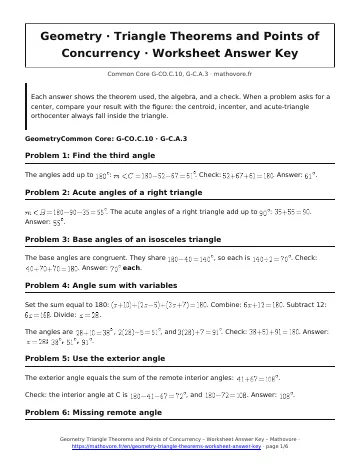
See every chapter on the Geometry math page.