
Key takeaway: This algebra 1 transformations functions lesson shows how f(x)+k, f(x+k) and k·f(x) change a parent graph. Outside changes move the graph up or down, while inside changes slide it left or right in the opposite direction you might expect. The lesson also covers absolute value, piecewise and step functions, in line with F-BF.B.3. Every rule comes with a small example you can sketch.
A transformation changes a parent function’s graph in a predictable way. Adding k outside, f(x)+k, shifts the graph up or down. Replacing x with x+k shifts it left or right. Multiplying by k, k·f(x), stretches, shrinks or flips it. Absolute value, piecewise and step functions combine these ideas.
Algebra 1 Transformations Functions Lesson: key facts
- Standards F-BF.B.3 and F-IF.C.7b: describe how f(x)+k, f(x+k) and kf(x) change a graph, and graph absolute value, piecewise-defined and step functions.
- Outside changes act on y and are intuitive; inside changes act on x and work backward: x – 4 moves right 4.
- The graph of a|x – h| + k has its vertex at (h, k) and opens up when a > 0 and down when a < 0.
- On a piecewise graph, a closed circle includes the endpoint and an open circle excludes it.
- A step function has horizontal pieces and jumps, like a price charged per box or per hour or part of an hour.
What is a transformation of a function?
A transformation changes the graph of a parent function in a predictable way. Algebra 1 uses three parent functions: linear \(f(x)=x\), quadratic \(f(x)=x^{2}\) and absolute value \(f(x)=|x|\). Each change to the equation causes one matching change in the graph.
| New function | Effect on the graph |
|---|---|
| \(f(x)+k\) | Vertical shift: up \(k\) units if \(k>0\), down \(|k|\) units if \(k < 0\) |
| \(f(x+k)\) | Horizontal shift: left \(k\) units if \(k>0\), right \(|k|\) units if \(k < 0\) |
| \(k\cdot f(x)\) | Vertical stretch if \(|k|>1\), shrink if \(0 < |k| < 1\), flip over the x-axis if \(k < 0\) |
How does f(x + k) move a graph?
A number added inside the parentheses changes the input before the function acts, so the shift is horizontal and works backward. For \(f(x)=|x|\), the function \(f(x-4)=|x-4|\) equals 0 when \(x=4\), so its vertex moves to \((4,0)\): 4 units right. Likewise \(|x+2|\) equals 0 at \(x=-2\), so it moves 2 units left.
What does k times f(x) do?
Multiplying the output by \(k\) scales every y-value. For \(f(x)=|x|\), the point \((1,1)\) becomes \((1,2)\) on \(2|x|\), \((2,1)\) on \(\frac{1}{2}|x|\) and \((1,-1)\) on \(-|x|\). Points on the x-axis never move, because \(k\cdot 0=0\).
How do you graph an absolute value function?
Write the function as \(g(x)=a|x-h|+k\). The vertex is \((h,k)\). The graph opens up if \(a>0\) and down if \(a < 0\), and its two branches have slopes \(a\) and \(-a\).
- Plot the vertex \((h,k)\).
- Move 1 unit right and \(a\) units up (down if \(a\) is negative) to plot a second point.
- Mirror that point across the vertical line \(x=h\).
- Draw two rays from the vertex through these points.
Worked example. Graph \(g(x)=-2|x+1|+3\). Here \(h=-1\), \(k=3\) and \(a=-2\). The vertex is \((-1,3)\). One unit right gives \((0,1)\), and its mirror is \((-2,1)\).
What are piecewise and step functions?
A piecewise function uses a different rule on each part of its domain. For example, \(f(x)=x+2\) when \(x < 1\), and \(f(x)=4-2x\) when \(x\ge 1\). At the boundary, a closed circle marks a point that belongs to the graph and an open circle marks a point that does not.
A step function is a piecewise function whose pieces are horizontal segments. It models prices that jump, such as $4 for each box of up to 6 cookies. The cost of 7 cookies is \(\$8\), not \(\$4.67\).
Transformations, Absolute Value and Piecewise Functions: frequently asked questions
Why does f(x – 3) move the graph to the right?
The output f(x – 3) reaches a given value when the input is 3 larger than before. The vertex of (x – 3)^2 occurs when x – 3 = 0, which is x = 3, so every point shifts 3 units right.
What is the difference between f(x) + k and f(x + k)?
f(x) + k adds k to every output and shifts the graph vertically. f(x + k) adds k to every input and shifts the graph horizontally in the opposite direction. For f(x) = x^2 and k = 3, the vertex moves to (0, 3) in the first case and to (-3, 0) in the second.
How do you find the vertex of an absolute value function?
Write the function as a|x – h| + k. The vertex is the point (h, k). For y = 3|x + 5| – 2, h = -5 and k = -2, so the vertex is (-5, -2).
What does an open circle mean on a piecewise graph?
An open circle means the graph approaches that point but does not include it. The value at that x-coordinate is given by another piece, usually shown with a closed circle.
How is a step function different from a linear function?
A linear function changes steadily and has a graph that is one connected line. A step function stays constant on an interval and then jumps, so its graph looks like stairs and has gaps between pieces.
Why does f(x+3) move a graph left?
A point of \(f(x)\) at \(x=0\) appears in \(f(x+3)\) at \(x=-3\), because only then does \(x+3\) equal 0. So the whole picture slides three units left. In contrast, \(f(x)+3\) adds to every output, so the graph rises by 3. For \(f(x)=x^{2}\), the first move gives vertex \((-3,0)\) and the second gives \((0,3)\).
How do you read an absolute value equation?
In \(a|x-h|+k\), the vertex is \((h,k)\). For \(g(x)=-|x-3|+5\), the vertex is \((3,5)\), and the negative sign opens the V downward, so 5 is a maximum. To find x-intercepts, solve \(|x-3|=5\), which gives 8 and \(-2\).
What goes wrong with transformations of functions?
Students often say \(y=(x+3)^{2}\) and \(y=x^{2}+3\) match. However, the first has vertex \((-3,0)\) and the second \((0,3)\). Another common slip is moving the graph right for \(x+4\). Remember that inside signs work backward.
How do piecewise and step functions behave?
A piecewise rule uses different formulas on different intervals. An open circle shows an excluded endpoint, and a closed circle shows an included one. A garage fee that rounds up to the next hour is a step function.
What should you practice after this lesson?
Sketch one parent graph and apply a shift, a flip and a stretch in turn. Then label the vertex after each move. After that, try the worksheet and test every point you plot in the new equation.

Printable PDF · Lesson
Algebra 1 Transformations, Absolute Value and Piecewise Functions lesson
Download the PDF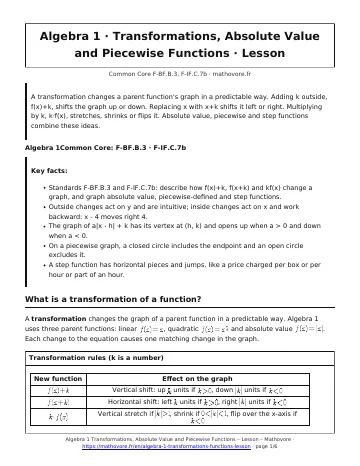
- Transformations, Absolute Value and Piecewise Functions worksheet (24 problems)
- Transformations, Absolute Value and Piecewise Functions quiz (10 questions)
- Transformations, Absolute Value and Piecewise Functions test (45 minutes)
- Previous lesson: Solving Quadratic Equations
- Next lesson: Statistics: Center, Spread and Data Displays
See every chapter on the Algebra 1 math page.