Key takeaway: This algebra 1 units quantities test has eight questions worth 20 points. Students convert units, build a product of fractions, define variables for a courier fee, and judge accuracy on a poster. Every answer needs units, and every step should be shown.
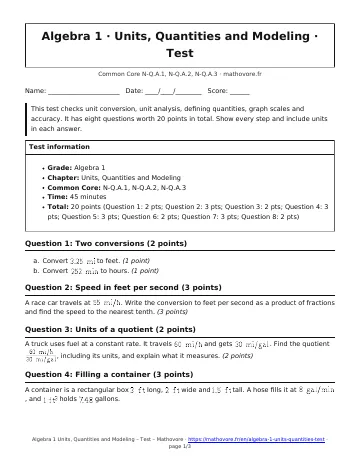
This test checks unit conversion, unit analysis, defining quantities, graph scales and accuracy. It has eight questions worth 20 points in total. Show every step and include units in each answer.
- Grade: Algebra 1
- Chapter: Units, Quantities and Modeling
- Common Core: N-Q.A.1, N-Q.A.2, N-Q.A.3
- Time: 45 minutes
- Total: 20 points (Question 1: 2 pts; Question 2: 3 pts; Question 3: 2 pts; Question 4: 3 pts; Question 5: 3 pts; Question 6: 2 pts; Question 7: 3 pts; Question 8: 2 pts)
Algebra 1 Units Quantities Test: questions 1–5
1. Two conversions (2 points)
- Convert \(3.25\text{ mi}\) to feet. (1 point)
- Convert \(252\text{ min}\) to hours. (1 point)
2. Speed in feet per second (3 points)
A race car travels at \(55\text{ mi/h}\). Write the conversion to feet per second as a product of fractions and find the speed to the nearest tenth. (3 points)
3. Units of a quotient (2 points)
A truck uses fuel at a constant rate. It travels \(60\text{ mi/h}\) and gets \(30\text{ mi/gal}\). Find the quotient \(\frac{60\text{ mi/h}}{30\text{ mi/gal}}\), including its units, and explain what it measures. (2 points)
4. Filling a container (3 points)
A container is a rectangular box \(3\text{ ft}\) long, \(2\text{ ft}\) wide and \(1.5\text{ ft}\) tall. A hose fills it at \(8\text{ gal/min}\), and \(1\text{ ft}^{3}\) holds \(7.48\) gallons.
- Find the volume in cubic feet. (1 point)
- Find the capacity in gallons. (1 point)
- Find the filling time in minutes, to the nearest tenth. (1 point)
5. Scale of a graph (3 points)
The graph shows enrollment at Lincoln High School, in students, over five school years (Year 1 is 2020).
- Find the increase from Year 1 to Year 5. (1 point)
- Find what percent of the graph’s vertical axis height this increase covers. (1 point)
- Find what percent it would cover if the vertical axis ran from 0 to 1250, and state which graph makes the change look larger. (1 point)
Algebra 1 Units Quantities Test: questions 6–8
6. Defining a quantity (2 points)
A courier charges \(\$20\) plus \(\$0.50\) per mile. Define variables with units and write an equation for the cost (1 point), then find the cost of an \(18\)-mile delivery (1 point).
7. Accuracy of a poster (3 points)
A rectangular poster measures \(24.5\text{ in}\) by \(18.2\text{ in}\), each measured to the nearest tenth.
- Find the area and report it with an appropriate level of accuracy. (2 points)
- Write an inequality for the actual width \(w\). (1 point)
8. Trip planning (2 points)
Sofia’s car gets \(25\text{ mi/gal}\) and gas costs \(\$4.00\) per gallon. Find the gas needed for a \(350\text{-mile}\) trip, the cost of that gas, and the cost per mile. (2 points)

Which topics fill the algebra 1 units quantities test?
Question 1 converts 3.25 miles to feet and 252 minutes to hours. Question 2 asks for 55 mi/h as feet per second, written as a product of fractions. Next, question 4 fills a box that is 3 ft by 2 ft by 1.5 ft with a hose, which is worth 3 points.
How should you pace the test?
Give about eight minutes to questions 1 to 3. Then give questions 4, 5 and 7 more time, because each has several parts. Question 5 reads enrollment from a graph, and question 7 multiplies 24.5 by 18.2 and asks for a fair level of accuracy.
Which errors lose points?
- Leaving out the unit in the final answer.
- Flipping a conversion factor.
- Reporting too many digits for a measured product.
How can you prepare?
Write the unit chain for three everyday rates. Then estimate each answer before computing it. Finally, practice one graph with a broken scale and explain what the axis choice hides.

See every chapter on the Algebra 1 math page.