


This algebra 1 quadratic functions worksheet gives 24 problems on graphing quadratic functions, ordered from easy to hard, with a separate answer key.
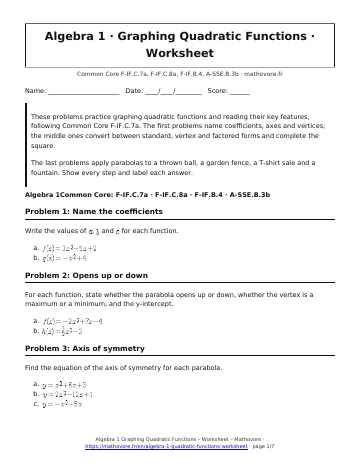
These problems practice graphing quadratic functions and reading their key features, following Common Core F-IF.C.7a. The first problems name coefficients, axes and vertices; the middle ones convert between standard, vertex and factored forms and complete the square.
The last problems apply parabolas to a thrown ball, a garden fence, a T-shirt sale and a fountain. Show every step and label each answer.
Algebra 1 Quadratic Functions Worksheet: problems 1–5
Problem 1: Name the coefficients
Write the values of \(a\), \(b\) and \(c\) for each function.
- \(f(x)=3x^{2}-5x+2\)
- \(g(x)=-x^{2}+4\)
Problem 2: Opens up or down
For each function, state whether the parabola opens up or down, whether the vertex is a maximum or a minimum, and the y-intercept.
- \(f(x)=-2x^{2}+7x-4\)
- \(h(x)=\frac{1}{2}x^{2}-3\)
Problem 3: Axis of symmetry
Find the equation of the axis of symmetry for each parabola.
- \(y=x^{2}+8x+3\)
- \(y=2x^{2}-12x+1\)
- \(y=-x^{2}+5x\)
Problem 4: Vertex from standard form
Find the vertex of each parabola.
- \(y=x^{2}-6x+5\)
- \(y=-2x^{2}+8x-3\)
Problem 5: Read vertex form
Give the vertex, the axis of symmetry, and the maximum or minimum value of each function.
- \(y=2(x-3)^{2}+1\)
- \(y=-(x+2)^{2}+5\)
Algebra 1 Quadratic Functions Worksheet: problems 6–10
Problem 6: Zeros from factored form
The function \(y=(x+2)(x-6)\) is in factored form. Find its x-intercepts, its axis of symmetry and its vertex.
Problem 7: Complete a table
Complete the table for \(y=x^{2}-4x+1\). Then name the vertex and the axis of symmetry.
| x | -1 | 0 | 1 | 2 | 3 | 4 | 5 |
|---|---|---|---|---|---|---|---|
| y | ? | ? | ? | ? | ? | ? | ? |
Problem 8: Read a graph
Use the graph to name the vertex, the axis of symmetry, the x-intercepts, the y-intercept, and the range of the function.
Problem 9: Effect of a
The equations \(y=x^{2}\), \(y=2x^{2}\) and \(y=\frac{1}{2}x^{2}\) are graphed below. Match each equation to its curve. Then describe how the graph of \(y=-2x^{2}\) differs from curve B.
Problem 10: Intercepts from standard form
Find the x-intercepts and the y-intercept of \(y=x^{2}-5x+6\).
Algebra 1 Quadratic Functions Worksheet: problems 11–15
Problem 11: Maximum or minimum value
Does \(f(x)=-x^{2}+6x-5\) have a maximum or a minimum? Find the value and where it occurs. Then find the zeros.
Problem 12: Factored to standard form
Write \(y=(x-3)(x+5)\) in standard form. Then find its vertex.
Problem 13: Complete the square
Rewrite \(y=x^{2}+8x+7\) in vertex form by completing the square. State the vertex.
Problem 14: No x-intercepts
Complete the square for \(y=x^{2}-10x+30\). Find the minimum value and explain why the graph has no x-intercepts.
Problem 15: Leading coefficient 2
Write \(y=2x^{2}-12x+10\) in vertex form. Then find the zeros.
Algebra 1 Quadratic Functions Worksheet: problems 16–20
Problem 16: Increasing and decreasing
The graph of \(f(x)=-x^{2}+4x\) is shown. State the interval where \(f\) is increasing, the interval where it is decreasing, and the interval where \(f(x) > 0\).
Problem 17: Equation from a graph
The graph shows a parabola with vertex \((1, 4)\) that passes through \((3, 0)\). Write its equation in vertex form, then in standard form.
Problem 18: Compare two functions
Function \(f\) is \(f(x)=x^{2}-6x+11\). Function \(g\) is given by the table. Which function has the lower minimum value?
| x | 0 | 1 | 2 | 3 | 4 |
|---|---|---|---|---|---|
| g(x) | 5 | 2 | 1 | 2 | 5 |
Problem 19: Three forms, one parabola
Show that \(y=(x-3)^{2}-4\) and \(y=(x-1)(x-5)\) are both equal to \(y=x^{2}-6x+5\). Then tell which form shows the vertex, which shows the zeros, and which shows the y-intercept.
Problem 20: Equation from zeros and a point
A parabola has x-intercepts at 2 and 8 and passes through \((5, -9)\). Write its equation in factored form and in standard form. Find the vertex.
Algebra 1 Quadratic Functions Worksheet: problems 21–24
Problem 21: Thrown ball
Maya throws a ball upward from a balcony. Its height in feet after \(t\) seconds is \(h(t)=-16t^{2}+32t+6\).
- How high is the ball at \(t=0\)?
- When does it reach its highest point, and how high is that?
- At what other time is the ball again at the height from part (a)?
Problem 22: Garden fence
Diego has 40 feet of fence for a rectangular garden. One side is a wall, so only three sides need fence. Let \(x\) be the length of each of the two sides that touch the wall.
- Write a function \(A(x)\) for the area.
- Find the value of \(x\) that gives the largest area.
- Find that area and the dimensions of the garden.
Problem 23: T-shirt sale
The school store sells 100 T-shirts at \(\$12\) each. For every \(\$1\) the price goes up, the store sells 5 fewer shirts. With \(x\) dollars of increase, the revenue is \(R(x)=(12+x)(100-5x)\).
- Write \(R(x)\) in standard form.
- What price gives the greatest revenue?
- Find the greatest revenue and the number of shirts sold.
Problem 24: Fountain arc
A stream of water from a fountain follows \(y=-\frac{1}{4}x^{2}+2x\), where \(x\) is the horizontal distance and \(y\) is the height, both in feet.
- Find the greatest height of the water.
- How far from the nozzle does the water land?
- Find the height at \(x=2\), and another distance at which the water has that same height.

How to use this algebra 1 quadratic functions worksheet
Print this algebra 1 quadratic functions worksheet as a PDF, solve every problem on paper, then compare with the answer key.

See every chapter on the Algebra 1 math page.