



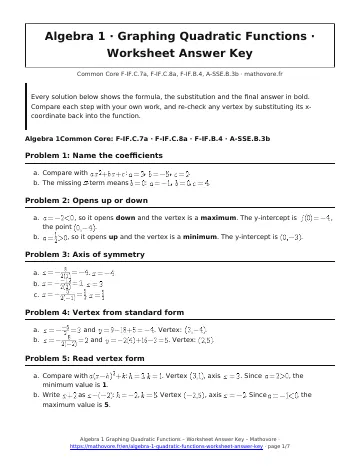
Every solution below shows the formula, the substitution and the final answer in bold. Compare each step with your own work, and re-check any vertex by substituting its x-coordinate back into the function.
Problem 1: Name the coefficients
- Compare with \(ax^{2}+bx+c\): \(a=3\), \(b=-5\), \(c=2\).
- The missing \(x\)-term means \(b=0\): \(a=-1\), \(b=0\), \(c=4\).
Problem 2: Opens up or down
- \(a=-2 < 0\), so it opens down and the vertex is a maximum. The y-intercept is \(f(0)=-4\), the point \((0, -4)\).
- \(a=\frac{1}{2} > 0\), so it opens up and the vertex is a minimum. The y-intercept is \((0, -3)\).
Problem 3: Axis of symmetry
- \(x=-\frac{8}{2(1)}=-4\). \(x=-4\)
- \(x=-\frac{-12}{2(2)}=3\). \(x=3\)
- \(x=-\frac{5}{2(-1)}=\frac{5}{2}\). \(x=\frac{5}{2}\)
Problem 4: Vertex from standard form
- \(x=-\frac{-6}{2}=3\) and \(y=9-18+5=-4\). Vertex: \((3, -4)\).
- \(x=-\frac{8}{2(-2)}=2\) and \(y=-2(4)+16-3=5\). Vertex: \((2, 5)\).
Problem 5: Read vertex form
- Compare with \(a(x-h)^{2}+k\): \(h=3\), \(k=1\). Vertex \((3, 1)\), axis \(x=3\). Since \(a=2 > 0\), the minimum value is 1.
- Write \(x+2\) as \(x-(-2)\): \(h=-2\), \(k=5\). Vertex \((-2, 5)\), axis \(x=-2\). Since \(a=-1 < 0\), the maximum value is 5.
Problem 6: Zeros from factored form
Set each factor to 0: \(x+2=0\) gives \(x=-2\), and \(x-6=0\) gives \(x=6\). The x-intercepts are \((-2, 0)\) and \((6, 0)\).
The axis is halfway between them: \(x=\frac{-2+6}{2}=2\).
At \(x=2\): \(y=(4)(-4)=-16\). Vertex: \((2, -16)\).
Problem 7: Complete a table
Substitute each value. For example, \(x=-1\): \(1+4+1=6\), and \(x=2\): \(4-8+1=-3\).
| x | -1 | 0 | 1 | 2 | 3 | 4 | 5 |
|---|---|---|---|---|---|---|---|
| y | 6 | 1 | -2 | -3 | -2 | 1 | 6 |
The lowest value is \(-3\) at \(x=2\), and the values repeat on both sides of it. Vertex: \((2, -3)\). Axis: \(x=2\).
Problem 8: Read a graph
Reading the graph:
- Vertex: \((1, -4)\), the lowest point.
- Axis of symmetry: \(x=1\).
- x-intercepts: \((-1, 0)\) and \((3, 0)\).
- y-intercept: \((0, -3)\).
- The graph never goes below \(-4\), so the range is \(y\ge -4\).
Problem 9: Effect of a
Test the point with \(x=2\): \(y=x^{2}\) gives 4, \(y=2x^{2}\) gives 8, and \(y=\frac{1}{2}x^{2}\) gives 2.
Curve C passes through \((2, 4)\), curve B through \((1, 2)\) (so \(y=2x^{2}\)), and curve A through \((2, 2)\). So A is \(y=\frac{1}{2}x^{2}\), B is \(y=2x^{2}\), C is \(y=x^{2}\).
The graph of \(y=-2x^{2}\) has the same width as B but opens down, because \(a\) is negative.
Problem 10: Intercepts from standard form
At \(x=0\), \(y=6\): the y-intercept is \((0, 6)\).
Set \(y=0\) and factor: \(x^{2}-5x+6=(x-2)(x-3)=0\), so \(x=2\) or \(x=3\). The x-intercepts are \((2, 0)\) and \((3, 0)\).
Problem 11: Maximum or minimum value
Since \(a=-1 < 0\), the parabola opens down, so there is a maximum. The axis is \(x=-\frac{6}{2(-1)}=3\), and \(f(3)=-9+18-5=4\). The maximum value is 4, at \(x=3\).
Zeros: \(-(x^{2}-6x+5)=-(x-1)(x-5)=0\), so \(x=1\) and \(x=5\).
Problem 12: Factored to standard form
Multiply: \(x^{2}+5x-3x-15=\) \(x^{2}+2x-15\).
The axis is \(x=-\frac{2}{2}=-1\), which is halfway between the zeros 3 and \(-5\). At \(x=-1\): \(y=(-4)(4)=-16\). Vertex: \((-1, -16)\).
Problem 13: Complete the square
Half of 8 is 4, and \(4^{2}=16\). Add and subtract 16:
\(y=(x^{2}+8x+16)-16+7=(x+4)^{2}-9\).
Vertex form: \(y=(x+4)^{2}-9\). Vertex: \((-4, -9)\).
Problem 14: No x-intercepts
Half of \(-10\) is \(-5\), and \((-5)^{2}=25\). So \(y=(x^{2}-10x+25)-25+30=(x-5)^{2}+5\).
The vertex is \((5, 5)\), so the minimum value is 5. The parabola opens up and its lowest point is above the x-axis, so it never reaches \(y=0\).
Problem 15: Leading coefficient 2
Factor 2 from the first two terms: \(y=2(x^{2}-6x)+10\). Add and subtract 9 inside: \(y=2(x^{2}-6x+9)-18+10=2(x-3)^{2}-8\).
Vertex form: \(y=2(x-3)^{2}-8\), vertex \((3, -8)\).
Zeros: \(2(x-3)^{2}=8\), so \((x-3)^{2}=4\) and \(x-3=\pm 2\). The zeros are \(x=1\) and \(x=5\).
Problem 16: Increasing and decreasing
The vertex is \((2, 4)\), the peak of the graph.
- Increasing: \(x < 2\).
- Decreasing: \(x > 2\).
- \(f(x) > 0\): the graph is above the x-axis between the zeros 0 and 4, so \(0 < x < 4\).
Problem 17: Equation from a graph
Start with \(y=a(x-1)^{2}+4\). Substitute \((3, 0)\): \(0=a(2)^{2}+4\), so \(4a=-4\) and \(a=-1\).
Vertex form: \(y=-(x-1)^{2}+4\). Expand: \(-(x^{2}-2x+1)+4=\) \(-x^{2}+2x+3\).
Problem 18: Compare two functions
For \(f\): the axis is \(x=3\) and \(f(3)=9-18+11=2\). The minimum value of \(f\) is 2.
For \(g\): the values 5, 2, 1, 2, 5 are symmetric around \(x=2\), so the lowest value is \(g(2)=1\).
Since \(1 < 2\), function \(g\) has the lower minimum.
Problem 19: Three forms, one parabola
Expand the vertex form: \((x-3)^{2}-4=x^{2}-6x+9-4=x^{2}-6x+5\).
Expand the factored form: \((x-1)(x-5)=x^{2}-5x-x+5=x^{2}-6x+5\).
All three match. Vertex form shows the vertex \((3, -4)\); factored form shows the zeros 1 and 5; standard form shows the y-intercept 5.
Problem 20: Equation from zeros and a point
Factored form: \(y=a(x-2)(x-8)\). Substitute \((5, -9)\): \(-9=a(3)(-3)=-9a\), so \(a=1\).
Factored: \(y=(x-2)(x-8)\). Standard: \(y=x^{2}-10x+16\).
The axis is halfway between 2 and 8, \(x=5\), and \(y=-9\) there. Vertex: \((5, -9)\).
Problem 21: Thrown ball
- \(h(0)=6\). 6 feet.
- \(t=-\frac{32}{2(-16)}=1\), and \(h(1)=-16+32+6=22\). At 1 second, at 22 feet.
- The graph is symmetric about \(t=1\), and 0 is one second before it, so the other time is \(t=2\). Check: \(h(2)=-64+64+6=6\). At 2 seconds.
Problem 22: Garden fence
- The third side is \(40-2x\), so \(A(x)=x(40-2x)=-2x^{2}+40x\).
- The axis is \(x=-\frac{40}{2(-2)}=10\). \(x=10\) feet.
- \(A(10)=10(40-20)=200\). The garden is 10 ft by 20 ft, with area 200 square feet.
Problem 23: T-shirt sale
- \(1200-60x+100x-5x^{2}=\) \(-5x^{2}+40x+1200\).
- \(x=-\frac{40}{2(-5)}=4\), so the price is \(12+4=\) \(\$16\).
- Shirts sold: \(100-5(4)=80\). Revenue: \(16\times 80=1280\). 80 shirts, \(\$1{,}280\). Check with the formula: \(-80+160+1200=1280\).
Problem 24: Fountain arc
- \(x=-\frac{2}{2(-1/4)}=4\) and \(y=-4+8=4\). 4 feet, at \(x=4\).
- Solve \(y=0\): \(-\frac{1}{4}x(x-8)=0\), so \(x=0\) or \(x=8\). The water lands 8 feet from the nozzle.
- \(y(2)=-1+4=3\), so 3 feet. By symmetry about \(x=4\), the mirror point is \(x=6\); check \(y(6)=-9+12=3\). \(x=6\).
See every chapter on the Algebra 1 math page.