



This 45-minute test has 8 questions worth 20 points. It covers intercepts, vertex and symmetry, intervals of increase and decrease, end behavior, average rate of change and comparing functions. Show your work and include units where a question has a context. No calculator is needed.
- Grade: Algebra 1
- Chapter: Key Features of Graphs and Rate of Change
- Common Core: F-IF.B.4, F-IF.B.6, F-IF.C.9
- Time: 45 minutes
- Total: 20 points (Question 1: 3 pts; Question 2: 3 pts; Question 3: 2 pts; Question 4: 2 pts; Question 5: 2 pts; Question 6: 3 pts; Question 7: 2 pts; Question 8: 3 pts)
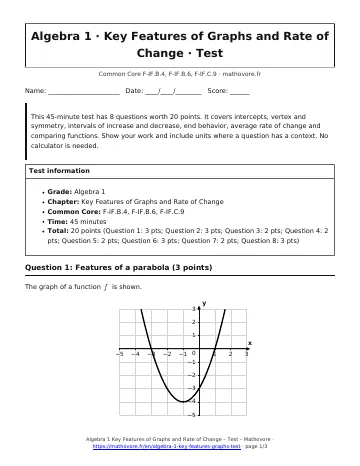
Question 1: Features of a parabola (3 points)
The graph of a function \(f\) is shown.
- Find the \(x\)-intercepts. (1 point)
- Find the \(y\)-intercept. (1 point)
- Find the vertex and tell whether it is a maximum or a minimum. (1 point)
Question 2: Increasing and decreasing (3 points)
Use the graph of \(f\).
- Give the intervals where \(f\) is increasing. (1 point)
- Give the intervals where \(f\) is decreasing. (1 point)
- State the relative minimum value and the \(x\)-value where it occurs. (1 point)
Question 3: End behavior (2 points)
Describe the end behavior.
- \(f(x)=-x^{2}+4\): what happens to \(f(x)\) as \(x\) gets very large? (1 point)
- \(g(x)=2^{x}\): what happens to \(g(x)\) as \(x\) gets very negative? (1 point)
Question 4: Symmetry of a parabola (2 points)
Let \(f(x)=x^{2}-8x+10\). Find the equation of the axis of symmetry (1 point) and the coordinates of the vertex (1 point).
Question 5: Average rate of change (2 points)
Find the average rate of change of \(f(x)=x^{2}+x\) from \(x=1\) to \(x=4\).
Question 6: Biking distance (3 points)
The graph shows the distance Noah biked, in miles, \(t\) hours after he started.
- Find the average rate of change from \(t=0\) to \(t=2\), with units. (1 point)
- Find the average rate of change from \(t=2\) to \(t=4\), with units. (1 point)
- During which of the two intervals was Noah faster? Explain. (1 point)
Question 7: Compare two functions (2 points)
Function \(f\) is \(f(x)=4x-5\). Function \(g\) is given by the table.
| \(x\) | 0 | 1 | 2 | 3 |
|---|---|---|---|---|
| \(g(x)\) | 3 | 5 | 7 | 9 |
- Which function has the greater rate of change? (1 point)
- Which function has the greater value when \(x=10\)? (1 point)
Question 8: Ball height (3 points)
A ball’s height in feet after \(t\) seconds is \(h(t)=-16t^{2}+32t+6\).
- Find the maximum height and the time when it happens. (1 point)
- Find \(h(0)\) and explain what it means. (1 point)
- Find the average rate of change from \(t=0\) to \(t=1\), with units. (1 point)

See every chapter on the Algebra 1 math page.