


This algebra 1 expressions worksheet answer key solves all 24 problems of the interpreting expressions and real numbers worksheet step by step.
Each solution shows the reasoning, including the interpretation of every part of an expression and the justification for every rational or irrational classification. Compare your work step by step and revisit the lesson on any item you missed.
Algebra 1 Expressions Worksheet Answer Key: problems 1–5
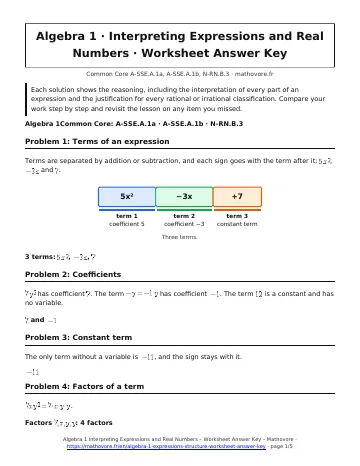
Problem 1: Terms of an expression
Terms are separated by addition or subtraction, and each sign goes with the term after it: \(5x^{2}\), \(-3x\) and \(7\).
3 terms: \(5x^{2}\), \(-3x\), \(7\)
Problem 2: Coefficients
\(7y^{3}\) has coefficient \(7\). The term \(-y=-1\cdot y\) has coefficient \(-1\). The term \(12\) is a constant and has no variable.
\(7\) and \(-1\)
Problem 3: Constant term
The only term without a variable is \(-11\), and the sign stays with it.
\(-11\)
Problem 4: Factors of a term
\(7xy^{2}=7\cdot x\cdot y\cdot y\).
Factors \(7, x, y, y\): 4 factors
Problem 5: Sum or product
\(3(x+2)\) is a product of the factors \(3\) and \((x+2)\). In \(3(x+2)+5x\), the plus sign between \(3(x+2)\) and \(5x\) splits it into two terms.
Product; terms \(3(x+2)\) and \(5x\)
Algebra 1 Expressions Worksheet Answer Key: problems 6–10
Problem 6: Cost expression
\(12\) is the price of one ticket, \(5\) is the one-time service fee, and \(12t\) is the cost of the tickets alone.
\(t=1\): \(12+5=17\). \(t=2\): \(24+5=29\). \(t=3\): \(36+5=41\).
\(\$17\), \(\$29\), \(\$41\)
Problem 7: Evaluating P(1 + r)^n
\(500(1.04)^{3}=500\times 1.124864=562.432\).
\(\$562.43\)
Problem 8: Growth factor
Multiplying by \(1.04\) gives \(100\%+4\%=104\%\) of the old balance: the original amount plus \(4\%\) of it.
\(900\times 1.04=936\).
\(\$936\)
Problem 9: Reading a growth model
The starting amount is \(1200\) (when \(t=0\), \(A=1200\)). The growth factor is \(1.05=1+0.05\), so the rate is \(5\%\) per year.
\(A=1200(1.05)^{2}=1200\times 1.1025=1323\).
\(\$1,200\); \(5\%\); \(\$1,323.00\)
Problem 10: Growth or decay
The factor \(0.92< 1\), so this is decay. \(0.92=1-0.08\), so the value drops \(8\%\) each year.
\(V=800(0.92)^{2}=800\times 0.8464=677.12\).
Decay, \(8\%\) per year, \(\$677.12\)
Algebra 1 Expressions Worksheet Answer Key: problems 11–15
Problem 11: Factors of an expression
The expression is a product of the factors \((x+4)\) and \((x-1)\). The terms of \(x+4\) are \(x\) and \(4\). The terms of \(x-1\) are \(x\) and \(-1\).
Factors \((x+4)\) and \((x-1)\)
Problem 12: Rational or irrational
\(\sqrt{49}=7\) is rational. \(\sqrt{20}\) is not a perfect square root, so it is irrational. \(\frac{22}{7}\) is a fraction, so it is rational. \(0.\overline{3}=\frac{1}{3}\) is rational. \(\frac{\pi}{2}\) is irrational. \(\sqrt{\frac{9}{4}}=\frac{3}{2}\) is rational.
Irrational: \(\sqrt{20}\) and \(\frac{\pi}{2}\); the rest are rational
Problem 13: Sum of rationals
\(\frac{15}{20}+\frac{12}{20}=\frac{27}{20}\), a quotient of two integers.
\(\frac{27}{20}\), rational
Problem 14: Rational plus irrational
A rational number plus an irrational number is irrational. \(\sqrt{2}\approx 1.414\), so \(5+\sqrt{2}\approx 6.414\).
Irrational, about \(6.414\)
Problem 15: A nonzero rational times an irrational
\(3\sqrt{5}\) is a nonzero rational times an irrational, so it is irrational. \(0\cdot\sqrt{5}=0\), which is rational, because the rule requires the rational factor to be nonzero.
\(3\sqrt{5}\) irrational; \(0\cdot\sqrt{5}=0\) rational
Algebra 1 Expressions Worksheet Answer Key: problems 16–20
Problem 16: Product of irrationals
\(\sqrt{2}\cdot\sqrt{8}=\sqrt{16}=4\), which is rational. \(\sqrt{3}\cdot\sqrt{5}=\sqrt{15}\), and \(15\) is not a perfect square, so it is irrational.
First rational (4); second irrational
Problem 17: Sum of irrationals
\((3+\sqrt{5})+(3-\sqrt{5})=6\), which is rational because the irrational parts cancel. \(\sqrt{2}+\sqrt{2}=2\sqrt{2}\), a nonzero rational times an irrational, so it is irrational.
First rational (6); second irrational
Problem 18: Why the sum is irrational
Suppose \(q+s=t\) were rational. Then \(s=t-q\), a difference of two rational numbers, which is rational. That contradicts \(s\) being irrational, so \(q+s\) is irrational.
Assuming a rational sum forces \(s\) to be rational, a contradiction
Problem 19: A square's perimeter
Side \(=\sqrt{50}=\sqrt{25\cdot 2}=5\sqrt{2}\text{ in}\), irrational.
Perimeter \(=4\cdot 5\sqrt{2}=20\sqrt{2}\approx 28.28\text{ in}\), a nonzero rational times an irrational, so irrational.
\(5\sqrt{2}\text{ in}\); \(20\sqrt{2}\approx 28.28\text{ in}\); both irrational
Problem 20: A circle's circumference
\(C=2\pi\cdot\frac{3}{2}=3\pi\approx 9.42\text{ ft}\), a nonzero rational times \(\pi\), so irrational.
If \(r=\frac{4}{\pi}\), then \(2\pi r=2\pi\cdot\frac{4}{\pi}=8\), which is rational, because \(r\) is itself irrational.
\(3\pi\text{ ft}\), irrational; \(r=\frac{4}{\pi}\) gives \(8\)
Algebra 1 Expressions Worksheet Answer Key: problems 21–24
Problem 21: A sale price
\(0.75=1-0.25\) is the factor for a \(25\%\) discount, \(0.75p\) is the discounted price, and \(5\) is the coupon amount subtracted afterward.
\(0.75(64)-5=48-5=43\).
\(\$43\)
Problem 22: Investment growth
The factor is \(1+0.035=1.035\), so the balance is \(2000(1.035)^{n}\).
For \(n=4\): \(2000\times 1.147523\approx 2295.05\). Interest: \(2295.05-2000=295.05\).
\(2000(1.035)^{n}\); \(\$2,295.05\); \(\$295.05\) interest
Problem 23: Sums that are rational
(a) \(3+4=7\), rational. (b) \(\sqrt{12}=2\sqrt{3}\), so the sum is \(3\sqrt{3}\), irrational. (c) The sum is \(0\), rational. (d) Rational plus irrational is irrational.
(a) and (c)
Problem 24: Two accounts
A is multiplied by \(1.03\) each year (it grows \(3\%\) of its current balance). B adds the same \(\$40\) each year.
\(n=10\): \(A=1000(1.03)^{10}\approx 1343.92\) and \(B=1400\), so B is larger.
\(n=20\): \(A\approx 1806.11\) and \(B=1800\), so A is now larger.
B leads at 10 years, A leads at 20 years
How to use this algebra 1 expressions worksheet answer key
Read this algebra 1 expressions worksheet answer key after trying each problem yourself, and redo any problem you missed.

See every chapter on the Algebra 1 math page.