


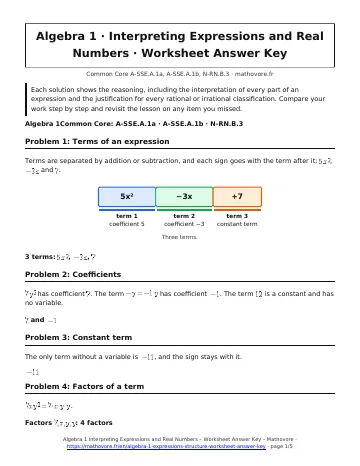
Problem 1: Terms of an expression
Terms are separated by addition or subtraction, and each sign goes with the term after it: \(5x^{2}\), \(-3x\) and \(7\).
3 terms: \(5x^{2}\), \(-3x\), \(7\)
Problem 2: Coefficients
\(7y^{3}\) has coefficient \(7\). The term \(-y=-1\cdot y\) has coefficient \(-1\). The term \(12\) is a constant and has no variable.
\(7\) and \(-1\)
Problem 3: Constant term
The only term without a variable is \(-11\), and the sign stays with it.
\(-11\)
Problem 4: Factors of a term
\(7xy^{2}=7\cdot x\cdot y\cdot y\).
Factors \(7, x, y, y\): 4 factors
Problem 5: Sum or product
\(3(x+2)\) is a product of the factors \(3\) and \((x+2)\). In \(3(x+2)+5x\), the plus sign between \(3(x+2)\) and \(5x\) splits it into two terms.
Product; terms \(3(x+2)\) and \(5x\)
Problem 6: Cost expression
\(12\) is the price of one ticket, \(5\) is the one-time service fee, and \(12t\) is the cost of the tickets alone.
\(t=1\): \(12+5=17\). \(t=2\): \(24+5=29\). \(t=3\): \(36+5=41\).
\(\$17\), \(\$29\), \(\$41\)
Problem 7: Evaluating P(1 + r)^n
\(500(1.04)^{3}=500\times 1.124864=562.432\).
\(\$562.43\)
Problem 8: Growth factor
Multiplying by \(1.04\) gives \(100\%+4\%=104\%\) of the old balance: the original amount plus \(4\%\) of it.
\(900\times 1.04=936\).
\(\$936\)
Problem 9: Reading a growth model
The starting amount is \(1200\) (when \(t=0\), \(A=1200\)). The growth factor is \(1.05=1+0.05\), so the rate is \(5\%\) per year.
\(A=1200(1.05)^{2}=1200\times 1.1025=1323\).
\(\$1,200\); \(5\%\); \(\$1,323.00\)
Problem 10: Growth or decay
The factor \(0.92< 1\), so this is decay. \(0.92=1-0.08\), so the value drops \(8\%\) each year.
\(V=800(0.92)^{2}=800\times 0.8464=677.12\).
Decay, \(8\%\) per year, \(\$677.12\)
Problem 11: Factors of an expression
The expression is a product of the factors \((x+4)\) and \((x-1)\). The terms of \(x+4\) are \(x\) and \(4\). The terms of \(x-1\) are \(x\) and \(-1\).
Factors \((x+4)\) and \((x-1)\)
Problem 12: Rational or irrational
\(\sqrt{49}=7\) is rational. \(\sqrt{20}\) is not a perfect square root, so it is irrational. \(\frac{22}{7}\) is a fraction, so it is rational. \(0.\overline{3}=\frac{1}{3}\) is rational. \(\frac{\pi}{2}\) is irrational. \(\sqrt{\frac{9}{4}}=\frac{3}{2}\) is rational.
Irrational: \(\sqrt{20}\) and \(\frac{\pi}{2}\); the rest are rational
Problem 13: Sum of rationals
\(\frac{15}{20}+\frac{12}{20}=\frac{27}{20}\), a quotient of two integers.
\(\frac{27}{20}\), rational
Problem 14: Rational plus irrational
A rational number plus an irrational number is irrational. \(\sqrt{2}\approx 1.414\), so \(5+\sqrt{2}\approx 6.414\).
Irrational, about \(6.414\)
Problem 15: A nonzero rational times an irrational
\(3\sqrt{5}\) is a nonzero rational times an irrational, so it is irrational. \(0\cdot\sqrt{5}=0\), which is rational, because the rule requires the rational factor to be nonzero.
\(3\sqrt{5}\) irrational; \(0\cdot\sqrt{5}=0\) rational
Problem 16: Product of irrationals
\(\sqrt{2}\cdot\sqrt{8}=\sqrt{16}=4\), which is rational. \(\sqrt{3}\cdot\sqrt{5}=\sqrt{15}\), and \(15\) is not a perfect square, so it is irrational.
First rational (4); second irrational
Problem 17: Sum of irrationals
\((3+\sqrt{5})+(3-\sqrt{5})=6\), which is rational because the irrational parts cancel. \(\sqrt{2}+\sqrt{2}=2\sqrt{2}\), a nonzero rational times an irrational, so it is irrational.
First rational (6); second irrational
Problem 18: Why the sum is irrational
Suppose \(q+s=t\) were rational. Then \(s=t-q\), a difference of two rational numbers, which is rational. That contradicts \(s\) being irrational, so \(q+s\) is irrational.
Assuming a rational sum forces \(s\) to be rational, a contradiction
Problem 19: A square's perimeter
Side \(=\sqrt{50}=\sqrt{25\cdot 2}=5\sqrt{2}\text{ in}\), irrational.
Perimeter \(=4\cdot 5\sqrt{2}=20\sqrt{2}\approx 28.28\text{ in}\), a nonzero rational times an irrational, so irrational.
\(5\sqrt{2}\text{ in}\); \(20\sqrt{2}\approx 28.28\text{ in}\); both irrational
Problem 20: A circle's circumference
\(C=2\pi\cdot\frac{3}{2}=3\pi\approx 9.42\text{ ft}\), a nonzero rational times \(\pi\), so irrational.
If \(r=\frac{4}{\pi}\), then \(2\pi r=2\pi\cdot\frac{4}{\pi}=8\), which is rational, because \(r\) is itself irrational.
\(3\pi\text{ ft}\), irrational; \(r=\frac{4}{\pi}\) gives \(8\)
Problem 21: A sale price
\(0.75=1-0.25\) is the factor for a \(25\%\) discount, \(0.75p\) is the discounted price, and \(5\) is the coupon amount subtracted afterward.
\(0.75(64)-5=48-5=43\).
\(\$43\)
Problem 22: Investment growth
The factor is \(1+0.035=1.035\), so the balance is \(2000(1.035)^{n}\).
For \(n=4\): \(2000\times 1.147523\approx 2295.05\). Interest: \(2295.05-2000=295.05\).
\(2000(1.035)^{n}\); \(\$2,295.05\); \(\$295.05\) interest
Problem 23: Sums that are rational
(a) \(3+4=7\), rational. (b) \(\sqrt{12}=2\sqrt{3}\), so the sum is \(3\sqrt{3}\), irrational. (c) The sum is \(0\), rational. (d) Rational plus irrational is irrational.
(a) and (c)
Problem 24: Two accounts
A is multiplied by \(1.03\) each year (it grows \(3\%\) of its current balance). B adds the same \(\$40\) each year.
\(n=10\): \(A=1000(1.03)^{10}\approx 1343.92\) and \(B=1400\), so B is larger.
\(n=20\): \(A\approx 1806.11\) and \(B=1800\), so A is now larger.
B leads at 10 years, A leads at 20 years
See every chapter on the Algebra 1 math page.