This grade 8 pythagorean worksheet answer key solves all 23 problems of the the pythagorean theorem worksheet step by step.
Every solution shows the equation, the squaring step and the square root. Rounded answers are written to the nearest tenth. If a result differs, recompute the squares first, because most errors come from squaring or from choosing the wrong side as the hypotenuse.
Grade 8 Pythagorean Worksheet Answer Key: problems 1–5
Problem 1: Hypotenuse of a 6-8 triangle
\(6^{2}+8^{2}=c^{2}\), so \(36+64=100\) and \(c=\sqrt{100}=10\). The hypotenuse is 10 in.
Problem 2: Hypotenuse of a 5-12 triangle
\(5^{2}+12^{2}=25+144=169\), so \(c=\sqrt{169}=13\). The hypotenuse is 13 ft.
Problem 3: Find the missing leg
The hypotenuse is 17, so \(x^{2}+8^{2}=17^{2}\). Then \(x^{2}=289-64=225\) and \(x=15\).
The missing leg is 15 yd.
Problem 4: Missing leg of a 7-25 triangle
\(7^{2}+b^{2}=25^{2}\), so \(b^{2}=625-49=576\) and \(b=24\). The other leg is 24 in.
Problem 5: Legs 9 and 12
\(9^{2}+12^{2}=81+144=225\), so \(c=15\). The hypotenuse is 15 in.
Grade 8 Pythagorean Worksheet Answer Key: problems 6–10
Problem 6: Hypotenuse that is not whole
\(4^{2}+7^{2}=16+49=65\), so \(c=\sqrt{65}\). Since \(8^{2}=64\) and \(9^{2}=81\), the value is a little more than 8.
\(c=\sqrt{65}\approx 8.06\), so the hypotenuse is about 8.1 ft.
Problem 7: Leg that is not whole
\(9^{2}+b^{2}=13^{2}\), so \(b^{2}=169-81=88\). Then \(b=\sqrt{88}\approx 9.38\).
The other leg is about 9.4 in.
Problem 8: Squares on the sides
Each square has area equal to its side squared, so \(a^{2}=36\) and \(b^{2}=64\). By the theorem, \(c^{2}=36+64=100\).
The square on the hypotenuse has area 100 square units, and the hypotenuse is \(\sqrt{100}=\)10 units.
Problem 9: Area proof with numbers
- \(17^{2}=289\) square inches.
- Each triangle has area \(\frac{1}{2}\cdot 5\cdot 12=30\), so four triangles have area \(4\cdot 30=120\).
- \(289-120=169\) square inches.
- \(\sqrt{169}=13\) in.
The tilted square has side 13 in, which is the hypotenuse of the 5-12 triangle.
Problem 10: Explain the proof
The large square has area \((a+b)^{2}=a^{2}+2ab+b^{2}\).
It is also made of four triangles with area \(\frac{1}{2}ab\) each, which total \(2ab\), plus the tilted square with area \(c^{2}\). So the area is \(2ab+c^{2}\).
Both expressions describe the same area: \(a^{2}+2ab+b^{2}=2ab+c^{2}\). Subtracting \(2ab\) from both sides gives \(a^{2}+b^{2}=c^{2}\).
Grade 8 Pythagorean Worksheet Answer Key: problems 11–15
Problem 11: Converse: 9, 12, 15
The longest side is 15. Check: \(9^{2}+12^{2}=81+144=225\) and \(15^{2}=225\).
The sums are equal, so by the converse the triangle is a right triangle.
Problem 12: Converse: 7, 10, 12
The longest side is 12. Check: \(7^{2}+10^{2}=49+100=149\), but \(12^{2}=144\).
Since \(149\neq 144\), the triangle is not a right triangle.
Problem 13: Which sets are right triangles?
- \(64+225=289=17^{2}\). Right triangle.
- \(36+49=85\), but \(10^{2}=100\). Not right.
- \(400+441=841=29^{2}\). Right triangle.
- \(121+144=265\), but \(18^{2}=324\). Not right.
Parts (a) and (c) form right triangles.
Problem 14: Perimeter and area
Hypotenuse: \(10^{2}+24^{2}=100+576=676\), so \(c=26\).
Perimeter: \(10+24+26=\)60 in. Area: \(\frac{1}{2}\cdot 10\cdot 24=\)120 square inches.
Problem 15: Diagonal of a square
The diagonal is the hypotenuse of a right triangle with both legs 9: \(d^{2}=9^{2}+9^{2}=81+81=162\).
\(d=\sqrt{162}\approx 12.73\), so the diagonal is about 12.7 in.
Grade 8 Pythagorean Worksheet Answer Key: problems 16–20
Problem 16: Height of an isosceles triangle
The height meets the base at its midpoint, so each half of the base is 6 in. Then \(6^{2}+h^{2}=10^{2}\), so \(h^{2}=100-36=64\) and \(h=8\).
Height: 8 in. Area: \(\frac{1}{2}\cdot 12\cdot 8=\)48 square inches.
Problem 17: Diagonal of a prism
First find the diagonal of the base: \(x^{2}=8^{2}+6^{2}=64+36=100\), so \(x=10\).
Then \(d^{2}=10^{2}+24^{2}=100+576=676\), so \(d=26\). The space diagonal is 26 in.
Problem 18: Ladder against a house
\(7^{2}+h^{2}=25^{2}\), so \(h^{2}=625-49=576\) and \(h=24\).
The ladder reaches 24 ft up the wall.
Problem 19: TV screen diagonal
\(d^{2}=24^{2}+18^{2}=576+324=900\), so \(d=30\).
This is a 30-inch TV.
Problem 20: Little League throw
The throw is the diagonal of the square: \(d^{2}=60^{2}+60^{2}=3600+3600=7200\).
\(d=\sqrt{7200}\approx 84.85\), so the throw is about 84.9 ft.
Grade 8 Pythagorean Worksheet Answer Key: problems 21–23
Problem 21: Is the corner square?
Check the converse: \(60^{2}+80^{2}=3600+6400=10000\) and \(100^{2}=10000\).
The sums are equal, so the corner is a right angle.
Problem 22: Walk east and north
\(d^{2}=0.9^{2}+1.2^{2}=0.81+1.44=2.25\), so \(d=1.5\).
Jamal is 1.5 mi from his start.
Problem 23: Longest rod in a box
The longest rod fits along the space diagonal. Base diagonal: \(x^{2}=12^{2}+9^{2}=144+81=225\), so \(x=15\).
Space diagonal: \(d^{2}=15^{2}+8^{2}=225+64=289\), so \(d=17\).
The diagonal is exactly 17 in., so the 17-in. rod just fits (diagonally, corner to corner).
How to use this grade 8 pythagorean worksheet answer key
Read this grade 8 pythagorean worksheet answer key after trying each problem yourself, and redo any problem you missed.

Printable PDF · Worksheet Answer Key
Grade 8 The Pythagorean Theorem worksheet answer key
Download the PDF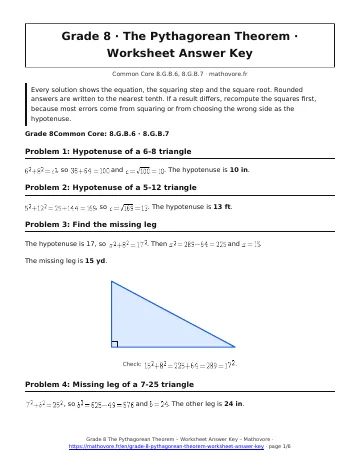
See every chapter on the Grade 8 math page.