


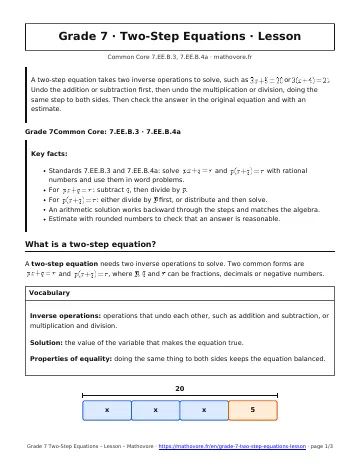
A two-step equation takes two inverse operations to solve, such as \(3x+5=20\) or \(3(x+4)=21\). Undo the addition or subtraction first, then undo the multiplication or division, doing the same step to both sides. Then check the answer in the original equation and with an estimate.
Key facts:
- Standards 7.EE.B.3 and 7.EE.B.4a: solve \(px+q=r\) and \(p(x+q)=r\) with rational numbers and use them in word problems.
- For \(px+q=r\): subtract \(q\), then divide by \(p\).
- For \(p(x+q)=r\): either divide by \(p\) first, or distribute and then solve.
- An arithmetic solution works backward through the steps and matches the algebra.
- Estimate with rounded numbers to check that an answer is reasonable.
What is a two-step equation?
A two-step equation needs two inverse operations to solve. Two common forms are \(px+q=r\) and \(p(x+q)=r\), where \(p\), \(q\) and \(r\) can be fractions, decimals or negative numbers.
Inverse operations: operations that undo each other, such as addition and subtraction, or multiplication and division.
Solution: the value of the variable that makes the equation true.
Properties of equality: doing the same thing to both sides keeps the equation balanced.
How do you solve px + q = r?
- Undo the addition or subtraction: subtract \(q\) from both sides.
- Undo the multiplication: divide both sides by \(p\). If \(p\) is a fraction, multiply by its reciprocal.
- Check by substituting the answer into the original equation.
Worked example. Solve \(3x+5=20\). Subtract 5: \(3x=15\). Divide by 3: \(x=5\). Check: \(3(5)+5=20\). With a fraction, \(\frac{2}{3}x-4=6\) becomes \(\frac{2}{3}x=10\), and multiplying by \(\frac{3}{2}\) gives \(x=15\).
How do you solve p(x + q) = r?
There are two correct paths. You can divide both sides by \(p\) first, or distribute \(p\) first. For \(3(x+4)=21\): dividing gives \(x+4=7\), so \(x=3\). Distributing gives \(3x+12=21\), then \(3x=9\), so \(x=3\). Both methods agree.
How do you know an answer is reasonable?
An arithmetic solution works backward through the story. For \(3x+5=20\), start at 20, subtract 5 to get 15, then divide by 3 to get 5. This is exactly the same work as the algebra. Estimation catches big mistakes: to solve \(2.9x+3.1=18\), round to \(3x+3=18\), so \(3x=15\) and \(x\approx 5\). The exact solution is \(x=14.9: 2.9\approx 5.14\), which agrees.
Two-Step Equations: frequently asked questions
What is the first step in solving a two-step equation?
Undo the addition or subtraction first. In \(5x-8=27\), add 8 to both sides to get \(5x=35\). Then divide by 5 to find \(x=7\).
Why do we do the same thing to both sides?
An equation is like a balanced scale. Doing the same operation on both sides keeps the two sides equal, so the solution does not change.
How do I solve an equation like 4(x + 3) = 36?
Divide both sides by 4 to get \(x+3=9\), then subtract 3 to find \(x=6\). You can also distribute to get \(4x+12=36\) and solve from there. Both give 6.
How do I solve an equation with a fraction coefficient?
Multiply both sides by the reciprocal of the fraction after undoing the addition or subtraction. For \(\frac{2}{3}x=10\), multiply by \(\frac{3}{2}\) to get \(x=15\).
How can I check my answer?
Substitute it into the original equation and see if both sides match. You can also estimate with rounded numbers to see whether the answer is about the right size.
See every chapter on the Grade 7 math page.