



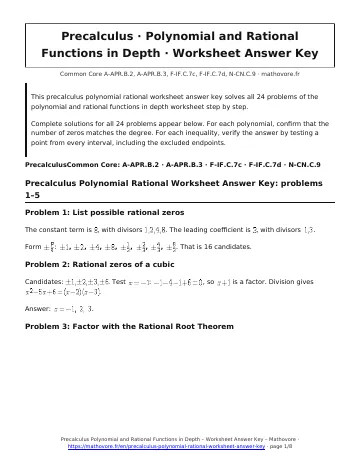
This precalculus polynomial rational worksheet answer key solves all 24 problems of the polynomial and rational functions in depth worksheet step by step.
Complete solutions for all 24 problems appear below. For each polynomial, confirm that the number of zeros matches the degree. For each inequality, verify the answer by testing a point from every interval, including the excluded endpoints.
Precalculus Polynomial Rational Worksheet Answer Key: problems 1–5
Problem 1: List possible rational zeros
The constant term is \(8\), with divisors \(1,2,4,8\). The leading coefficient is \(3\), with divisors \(1,3\).
Form \(\pm\frac{p}{q}\): \(\pm 1\), \(\pm 2\), \(\pm 4\), \(\pm 8\), \(\pm\frac{1}{3}\), \(\pm\frac{2}{3}\), \(\pm\frac{4}{3}\), \(\pm\frac{8}{3}\). That is 16 candidates.
Problem 2: Rational zeros of a cubic
Candidates: \(\pm 1,\pm 2,\pm 3,\pm 6\). Test \(x=-1\): \(-1-4-1+6=0\), so \(x+1\) is a factor. Division gives \(x^{2}-5x+6=(x-2)(x-3)\).
Answer: \(x=-1,\ 2,\ 3\).
Problem 3: Factor with the Rational Root Theorem
- The constant term \(3\) has divisors \(1,3\); the leading coefficient \(4\) has divisors \(1,2,4\). Candidates: \(\pm 1\), \(\pm 3\), \(\pm\frac{1}{2}\), \(\pm\frac{3}{2}\), \(\pm\frac{1}{4}\), \(\pm\frac{3}{4}\)
- Group: \(4x^{2}(x-3)-(x-3)=(x-3)(4x^{2}-1)=(x-3)(2x-1)(2x+1)\). Zeros: \(3,\ \frac{1}{2},\ -\frac{1}{2}\). Factored form: \(P(x)=(x-3)(2x-1)(2x+1)\)
Problem 4: Counting zeros
- Add the exponents: \(2+3+2=7\). Degree: \(7\)
- \(x=1\) (multiplicity 2), \(x=-4\) (multiplicity 3), \(x=i\) and \(x=-i\) (multiplicity 1 each). That is \(2+3+1+1=7\) zeros, as the Fundamental Theorem of Algebra predicts.
- The real zeros are \(1\) and \(-4\). Answer: 2
Problem 5: Complex zeros of a cubic
Factor by grouping: \(x^{2}(x-2)+4(x-2)=(x-2)(x^{2}+4)\). Then \(x-2=0\) gives \(x=2\), and \(x^{2}+4=0\) gives \(x=\pm 2i\).
Answer: \(2,\ 2i,\ -2i\).
Precalculus Polynomial Rational Worksheet Answer Key: problems 6–10
Problem 6: Build a polynomial from zeros
Complex zeros of a real polynomial come in conjugate pairs, so \(2+i\) is also a zero. The pair gives \((x-(2-i))(x-(2+i))=x^{2}-4x+5\).
Multiply: \((x-3)(x^{2}-4x+5)=x^{3}-4x^{2}+5x-3x^{2}+12x-15\). Answer: \(x^{3}-7x^{2}+17x-15\).
Problem 7: Use a given complex zero
The conjugate \(1-2i\) is also a zero. Its quadratic factor is \((x-1)^{2}+4=x^{2}-2x+5\).
Divide: \((x^{4}-2x^{3}+6x^{2}-2x+5): (x^{2}-2x+5)=x^{2}+1\), so the remaining zeros are \(\pm i\).
Answer: \(1-2i,\ i,\ -i\).
Problem 8: End behavior of polynomials
- Odd degree, negative leading coefficient: \(f(x)\to\infty\) as \(x\to-\infty\) and \(f(x)\to-\infty\) as \(x\to\infty\)
- Even degree, positive leading coefficient: \(f(x)\to\infty\) at both ends
- Odd degree, positive leading coefficient: \(f(x)\to-\infty\) as \(x\to-\infty\) and \(f(x)\to\infty\) as \(x\to\infty\)
Problem 9: Zeros and multiplicity from a graph
- The graph touches the axis and turns at \(x=-3\), so its multiplicity is even (at least 2). It crosses at \(x=1\) and \(x=2\), so those multiplicities are odd (at least 1).
- Least degree: \(2+1+1=4\). Answer: 4
- Both ends rise on an even-degree graph, so the leading coefficient is positive. (The graph is \(h(x)=\frac{(x+3)^{2}(x-1)(x-2)}{6}\), and \(h(0)=3\).)
Problem 10: Asymptotes of a rational function
The denominator \(x^{2}-4=(x-2)(x+2)\) is zero at \(x=\pm 2\) and the numerator is not zero there, so the vertical asymptotes are \(x=2\) and \(x=-2\).
The degrees are equal, so the horizontal asymptote is the ratio of leading coefficients: \(y=3\).
Precalculus Polynomial Rational Worksheet Answer Key: problems 11–15
Problem 11: Slant asymptote by division
Divide: \(x^{2}+3x-1=(x-1)(x+4)+3\), so \(f(x)=x+4+\frac{3}{x-1}\).
As \(|x|\) grows, \(\frac{3}{x-1}\to 0\). The slant asymptote is \(y=x+4\).
Problem 12: Slant asymptote with a negative remainder term
Divide: \((x+2)(2x-9)=2x^{2}-5x-18\), so \(2x^{2}-5x+3=(x+2)(2x-9)+21\) and \(f(x)=2x-9+\frac{21}{x+2}\).
Slant asymptote: \(y=2x-9\). Vertical asymptote: \(x=-2\).
Problem 13: Analyze a rational graph
- The denominator is zero at \(x=1\). Domain: \((-\infty,1)\) ∪ \((1,\infty)\)
- Vertical asymptote: \(x=1\). Divide: \(x^{2}-4=(x-1)(x+1)-3\), so \(f(x)=x+1-\frac{3}{x-1}\) and the slant asymptote is \(y=x+1\)
- Set the numerator to zero: \(x^{2}=4\), so x-intercepts \((-2,0)\) and \((2,0)\). Also \(f(0)=\frac{-4}{-1}=4\), so y-intercept \((0,4)\)
Problem 14: Quadratic inequality
Factor: \((x-3)(x+2) > 0\). Critical numbers: \(-2\) and \(3\). Test \(x=0\): \(-6\) is negative, so the middle interval fails; the outer intervals work.
Answer: \((-\infty,-2)\) ∪ \((3,\infty)\).
Problem 15: Cubic inequality
Critical numbers: \(-1,\ 2,\ 4\). At \(x=0\) the product is \((1)(-2)(-4)=8\), positive, so the signs run \(-,+,-,+\) from left to right.
The product is \(\le 0\) where it is negative or zero. Answer: \((-\infty,-1]\) ∪ \([2,4]\).
Precalculus Polynomial Rational Worksheet Answer Key: problems 16–20
Problem 16: Inequality with a repeated factor
The factor \((x-2)^{2}\) is never negative and equals \(0\) at \(x=2\). So the sign depends on \(x+1\), except that \(x=2\) gives exactly \(0\).
Answer: \(x \le -1\) or \(x=2\).
Problem 17: Rational inequality with zero on one side
Critical numbers: \(1\) (numerator zero, included) and \(-3\) (denominator zero, excluded).
Answer: \((-\infty,-3)\) ∪ \([1,\infty)\).
Problem 18: Rational inequality with a constant on the right
Do not multiply by \(x-1\) because its sign changes. Subtract: \(\frac{2x}{x-1}-3=\frac{2x-3x+3}{x-1}=\frac{3-x}{x-1} < 0\), which is the same as \(\frac{x-3}{x-1} > 0\).
Check \(x=0\): \(0 < 3\) is true, and \(x=2\): \(4 < 3\) is false. Answer: \((-\infty,1)\) ∪ \((3,\infty)\).
Problem 19: Gift box volume
- \(x(x+3)(x+4)=60\) expands to \(x^{3}+7x^{2}+12x=60\). Answer: \(x^{3}+7x^{2}+12x-60=0\)
- Test \(x=2\): \(8+28+24-60=0\). So \(x=2\) is a real solution.
- Divide by \(x-2\) to get \(x^{2}+9x+30\). Its discriminant is \(81-120=-39\), so the other zeros are \(\frac{-9\pm i\sqrt{39}}{2}\), which are not real lengths. The dimensions are 2 ft by 5 ft by 6 ft.
Problem 20: Average cost
- Divide: \(A(x)=20+\frac{1500}{x}\), so the horizontal asymptote is \(y=20\): with huge production the average cost per box approaches $20.
- \(A(100)=\frac{2000+1500}{100}=35\). Answer: $35
- \(\frac{20x+1500}{x} \le 25\) with \(x > 0\) gives \(20x+1500 \le 25x\), so \(1500 \le 5x\) and \(x \ge 300\). Answer: at least 300 boxes
Precalculus Polynomial Rational Worksheet Answer Key: problems 21–24
Problem 21: Profit model
- \(P(x)=-x(x^{2}-14x+40)=-x(x-4)(x-10)\). Answer: \(-x(x-4)(x-10)\)
- Critical numbers \(0,\ 4,\ 10\). On \(0 < x < 4\) the factors give \(-(+)(-)(-)\) which is negative; on \(4 < x < 10\) it is positive; on \(x > 10\) it is negative. Answer: \(4 < x < 10\)
- \(P(6)=-6(2)(-4)=48\). Answer: $48 thousand
Problem 22: Polynomial with an imaginary zero
The conjugate \(-3i\) is also a zero, giving \((x-3i)(x+3i)=x^{2}+9\). Also \((x-2)(x+1)=x^{2}-x-2\).
Multiply: \((x^{2}-x-2)(x^{2}+9)=x^{4}-x^{3}+7x^{2}-9x-18\). Answer: \(x^{4}-x^{3}+7x^{2}-9x-18\).
Even degree and positive leading coefficient, so the graph rises at both ends.
Problem 23: Rational inequality with a quadratic
Factor: \(\frac{(x-3)(x+2)}{x-1} \ge 0\). Critical numbers: \(-2\) (included), \(1\) (excluded) and \(3\) (included).
Answer: \([-2,1)\) ∪ \([3,\infty)\).
Problem 24: Roller coaster height
Test the divisors of \(6\): \(h(1)=1-6+11-6=0\), so \((x-1)\) is a factor. Division gives \(x^{2}-5x+6=(x-2)(x-3)\), so \(h(x)=(x-1)(x-2)(x-3)\).
Signs: negative on \([0,1)\), positive on \((1,2)\), negative on \((2,3)\), positive on \((3,4]\). Check: \(h(0)=-6\) and \(h(2.5)=-0.375\).
Answer: \([0,1)\) ∪ \((2,3)\), that is 0 up to 100 feet and 200 to 300 feet.
How to use this precalculus polynomial rational worksheet answer key
Read this precalculus polynomial rational worksheet answer key after trying each problem yourself, and redo any problem you missed.

See every chapter on the Precalculus math page.