
Key takeaway: This precalculus functions review worksheet answer key lays out the working and the final form for each of the 24 problems. Domains appear in interval notation, and each inverse comes with a short composition check. When your answer looks different, test one input in both forms. Many correct answers are equivalent but written differently.
Every problem from the functions worksheet is solved step by step below. Check the domain after each composition and verify each inverse by substituting a point, because those are the two places where most errors happen.
Precalculus Functions Review Worksheet Answer Key: problems 1–5
1. Evaluate function notation
- \(f(3)=3(9)-6+1=22\), so \(22\)
- \(f(-2)=3(4)+4+1=17\), so \(17\)
- \(f(a+1)=3(a^{2}+2a+1)-2a-2+1=3a^{2}+4a+2\), so \(3a^{2}+4a+2\)
2. Domain with square roots
- \(2x-6 \ge 0\) gives \(2x \ge 6\) and \(x \ge 3\). Domain: \([3,\infty)\)
- \(10-5x \ge 0\) gives \(-5x \ge -10\); dividing by \(-5\) reverses the inequality, so \(x \le 2\). Domain: \((-\infty,2]\)
3. Domain with denominators
- \(x^{2}-9=0\) when \(x=3\) or \(x=-3\), so those two values are excluded. Domain: \((-\infty,-3)\) ∪ \((-3,3)\) ∪ \((3,\infty)\)
- \(x^{2}+4 \ge 4\) is never zero, so every real number works. Domain: \((-\infty,\infty)\)
4. Domain with several restrictions
- \(x+4 \ge 0\) gives \(x \ge -4\), and \(x \neq 2\) removes a zero denominator. Domain: \([-4,2)\) ∪ \((2,\infty)\)
- The logarithm needs \(5-x > 0\), so \(x < 5\). Domain: \((-\infty,5)\)
5. Domain and range from a graph
- The graph runs from \(x=-1\) (included) to \(x=3\) (excluded). Domain: \([-1,3)\)
- The lowest height is \(0\) (at the closed point) and the peak is \(4\). Range: \([0,4]\)
- The graph is \(-(x-1)^{2}+4\). Solve \(-(x-1)^{2}+4=3\): \((x-1)^{2}=1\), so \(x=0\) or \(x=2\). Answer: \(x=0\) and \(x=2\)
Precalculus Functions Review Worksheet Answer Key: problems 6–10
6. Composition from tables
- \(g(1)=3\) and \(f(3)=1\), so \(1\)
- \(f(3)=1\) and \(g(1)=3\), so \(3\)
- \(f(1)=2\) and \(f(2)=4\), so \(4\)
- \(g(4)=2\) and \(g(2)=1\), so \(1\)
7. Composition of polynomials
- \(f(g(x))=(3x-2)^{2}+1=9x^{2}-12x+4+1\), so \(9x^{2}-12x+5\)
- \(g(f(x))=3(x^{2}+1)-2\), so \(3x^{2}+1\)
- \(g(2)=4\) and \(f(4)=17\). Check: \(9(4)-24+5=17\). Answer: \(17\)
8. Composition from a mapping diagram
- Follow each arrow twice: \(1 \to 3 \to 9\), \(2 \to 5 \to 25\), \(3 \to 7 \to 49\). Answers: \(9, 25, 49\)
- The outputs of \(g\) rise by 2 each step from \(3\), so \(g(x)=2x+1\). The outputs of \(f\) are squares, so \(f(x)=x^{2}\). Then \(f(g(x))=(2x+1)^{2}\); check \((2\cdot 3+1)^{2}=49\).
9. Domain of a composition (roots)
- \(f(g(x))=\sqrt{x-5}\) needs \(x-5 \ge 0\). Domain: \([5,\infty)\)
- \(g(f(x))=\sqrt{x}-5\) needs \(x \ge 0\). Domain: \([0,\infty)\)
10. Domain of a composition (rational)
- \(f(g(x))=\frac{1}{x+2}\), and \(x+2 \neq 0\). Domain: \((-\infty,-2)\) ∪ \((-2,\infty)\)
- \(g(f(x))=\frac{1}{x}+2=\frac{2x+1}{x}\), and \(x \neq 0\). Domain: \((-\infty,0)\) ∪ \((0,\infty)\)
Precalculus Functions Review Worksheet Answer Key: problems 11–15
11. Decompose a function
- The inside is \(2x+5\): \(g(x)=2x+5\), \(f(x)=x^{4}\)
- The inside is \(x-3\): \(g(x)=x-3\), \(f(x)=\frac{1}{x^{2}}\)
- The inside is \(x^{2}+9\): \(g(x)=x^{2}+9\), \(f(x)=\sqrt{x}\). (Other correct splits exist.)
12. Inverse of a linear function
- Swap: \(x=5y-3\), so \(y=\frac{x+3}{5}\). Answer: \(f^{-1}(x)=\frac{x+3}{5}\)
- Swap: \(x=-\frac{2}{3}y+4\), so \(-\frac{2}{3}y=x-4\) and \(y=-\frac{3}{2}(x-4)=6-\frac{3}{2}x\). Answer: \(g^{-1}(x)=6-\frac{3}{2}x\). Check: \(g(6)=0\) and \(g^{-1}(0)=6\).
13. Inverse of a rational function
Swap: \(x=\frac{2y+1}{y-3}\). Then \(xy-3x=2y+1\), so \(y(x-2)=3x+1\).
Answer: \(f^{-1}(x)=\frac{3x+1}{x-2}\). Check: \(f(4)=9\) and \(f^{-1}(9)=\frac{28}{7}=4\).
The domain of \(f\) excludes \(x=3\); the domain of \(f^{-1}\) excludes \(x=2\), which is the range of \(f\). Domain of \(f\): \(x \neq 3\); range: \(y \neq 2\).
14. Verify inverse functions
- \(f(g(x))=(\sqrt[3]{x-4})^{3}+4=x\) and \(g(f(x))=\sqrt[3]{x^{3}+4-4}=x\). Yes, inverses.
- \(f(g(x))=\frac{1}{2}(2x+3)-3=x-\frac{3}{2}\), which is not \(x\). Not inverses; the true inverse is \(2x+6\).
15. Inverse values from a graph
- \((2,1)\) is on the graph, so \(f(2)=1\)
- The output \(3\) comes from \(x=4\), so \(f^{-1}(3)=4\)
- The output \(-1\) comes from \(x=0\), so \(f^{-1}(-1)=0\)
- The output \(7\) comes from \(x=6\), so \(f^{-1}(7)=6\)
Precalculus Functions Review Worksheet Answer Key: problems 16–20
16. Inverse values from tables
- The output \(0\) occurs at \(x=2\) and the output \(-2\) at \(x=3\). Answers: \(f^{-1}(0)=2\) and \(f^{-1}(-2)=3\)
- \(f(1)=3\) and \(f^{-1}(3)=1\), so \(1\)
- \(g(1)=4\) and \(g(3)=4\): two inputs share one output, so reversing the table would give two answers for \(4\). \(g\) is not one-to-one.
17. Horizontal line test
Graph A rises everywhere, so every horizontal line meets it once: invertible. A horizontal line at \(y=1\) meets the parabola in graph B twice, and one at \(y=0.3\) meets graph C three times . Only graph A has an inverse function.
18. Restrict a domain: vertex form
- The graph fails the horizontal line test: \(f(1)=4\) and \(f(5)=4\).
- Swap: \(x=(y-3)^{2}\). On the restricted domain \(y \ge 3\), so \(y-3=\sqrt{x}\). Answer: \(f^{-1}(x)=3+\sqrt{x}\), domain \([0,\infty)\), range \([3,\infty)\)
- \(f^{-1}(16)=3+\sqrt{16}=7\). Check: \(f(7)=16\). Answer: \(7\)
19. Restrict a domain: complete the square
Complete the square: \(f(x)=(x+2)^{2}-4\). Swap: \(x=(y+2)^{2}-4\), so \((y+2)^{2}=x+4\). Since \(y \ge -2\), \(y+2=\sqrt{x+4}\).
Answer: \(f^{-1}(x)=-2+\sqrt{x+4}\), domain \([-4,\infty)\) (the range of \(f\)), range \([-2,\infty)\). Check: \(f(1)=5\) and \(f^{-1}(5)=-2+3=1\).
20. Temperature conversion
- Swap and solve: \(C=\frac{5}{9}(F-32)\) gives \(F-32=\frac{9}{5}C\). Answer: \(F(C)=\frac{9}{5}C+32\)
- \(F(37)=\frac{9}{5}(37)+32=66.6+32=98.6\). Answer: \(98.6^{\circ}\text{F}\)
- \(C(F(C))=\frac{5}{9}(\frac{9}{5}C+32-32)=\frac{5}{9}\cdot\frac{9}{5}C=C\). Verified.
Precalculus Functions Review Worksheet Answer Key: problems 21–24
21. Coupon and discount order
- \(d(60)=48\) and \(c(48)=43\); \(c(60)=55\) and \(d(55)=44\). Answers: $43 and $44
- \(c(d(p))=0.8p-5\) and \(d(c(p))=0.8(p-5)=0.8p-4\). Answers: \(0.8p-5\) and \(0.8p-4\)
- Taking the discount first and the coupon second gives the lower price. The difference is \((0.8p-4)-(0.8p-5)=1\), so it saves $1 at every price.
22. Taxi fare inverse
- Solve \(F=2.50+1.80m\) for \(m\): \(m=\frac{F-2.50}{1.80}\). It converts a fare into the number of miles ridden.
- \(m(20.50)=\frac{18.00}{1.80}=10\). Answer: 10 miles
- \(m(11.50)=\frac{9.00}{1.80}=5\). Answer: 5 miles
23. Growing ripple
- \(A(r(t))=\pi(3t)^{2}\). Answer: \(9\pi t^{2}\)
- \(9\pi(4)^{2}=144\pi\approx 452.4\). Answer: 452.4 square feet
- \(9\pi t^{2}=81\pi\) gives \(t^{2}=9\), and \(t > 0\), so \(t=3\) seconds
24. Inverse of a composition
- \(f(g(x))=2(x-4)+1=2x-7\). Swap: \(x=2y-7\), so the inverse is \(\frac{x+7}{2}\)
- \(f^{-1}(x)=\frac{x-1}{2}\) and \(g^{-1}(x)=x+4\). Then \(g^{-1}(f^{-1}(x))=\frac{x-1}{2}+4=\frac{x+7}{2}\). Answer: \(\frac{x+7}{2}\)
- They match. The inverse of \(f(g(x))\) undoes \(f\) first and then \(g\): \(g^{-1}(f^{-1}(x))\).
What are the domain and evaluation answers?
Problem 1 gives 22, 17 and \(3a^{2}+4a+2\). For problem 2, the domains are \([3,\infty)\) and \((-\infty,2]\). Problem 3 excludes 3 and \(-3\) for the first function, while \(\frac{1}{x^{2}+4}\) accepts every real number. In problem 4, the answers are \([-4,2)\cup(2,\infty)\) and \((-\infty,5)\).
Which composition results should you verify?
Problem 7 yields \(f(g(x))=9x^{2}-12x+5\) and \(g(f(x))=3x^{2}+1\). In problem 9, \(f(g(x))=\sqrt{x-5}\) has domain \([5,\infty)\), whereas \(g(f(x))=\sqrt{x}-5\) has domain \([0,\infty)\). Problem 10 gives \(\frac{1}{x+2}\) with \(x\ne -2\), and \(\frac{1}{x}+2\) with \(x\ne 0\). Likewise, problem 24 produces \(2x-7\).
How do the inverse and applied answers look?
Problem 12 gives \(f^{-1}(x)=\frac{x+3}{5}\). Problem 13 gives \(f^{-1}(x)=\frac{3x+1}{x-2}\). In problem 19, completing the square leads to \(f^{-1}(x)=-2+\sqrt{x+4}\) with domain \([-4,\infty)\). The temperature rule inverts to \(F=\frac{9}{5}C+32\). Taking the discount first in problem 21 gives \(0.8p-5\), whereas the coupon first gives \(0.8p-4\), so the order matters.
Which habit makes the key worth reading?
Pick two answers you missed, then hide the solution and rebuild each from the first line. Check each inverse by composing both ways. Finally, write one sentence explaining why the domain looks the way it does.

Printable PDF · Worksheet Answer Key
Precalculus Functions: Domain, Range, Composition and Inverses worksheet answer key
Download the PDF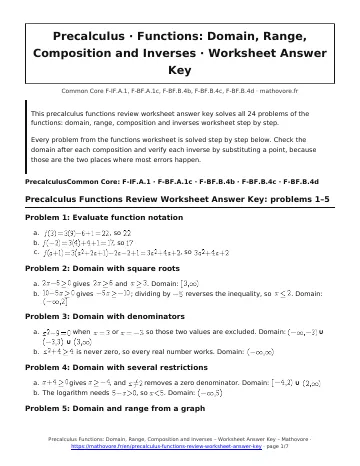
See every chapter on the Precalculus math page.