


Every solution below shows each step and a check by substitution, so compare your method as well as your final answer. Final answers are in bold. If your answer differs, substitute it into the original equation and see which side comes out wrong.
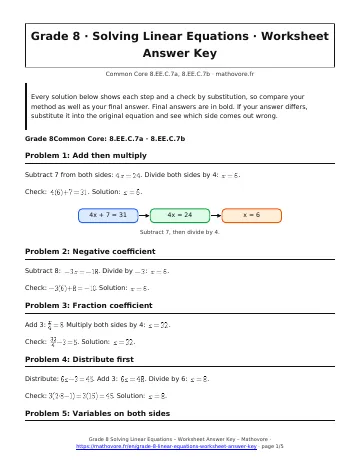
Problem 1: Add then multiply
Subtract 7 from both sides: \(4x=24\). Divide both sides by 4: \(x=6\).
Check: \(4(6)+7=31\). Solution: \(x=6\).
Problem 2: Negative coefficient
Subtract 8: \(-3x=-18\). Divide by \(-3\): \(x=6\).
Check: \(-3(6)+8=-10\). Solution: \(x=6\).
Problem 3: Fraction coefficient
Add 3: \(\frac{x}{4}=8\). Multiply both sides by 4: \(x=32\).
Check: \(\frac{32}{4}-3=5\). Solution: \(x=32\).
Problem 4: Distribute first
Distribute: \(6x-3=45\). Add 3: \(6x=48\). Divide by 6: \(x=8\).
Check: \(3(2\cdot 8-1)=3(15)=45\). Solution: \(x=8\).
Problem 5: Variables on both sides
Subtract \(3x\) from both sides: \(2x+4=16\). Subtract 4: \(2x=12\). Divide by 2: \(x=6\).
Check: \(5(6)+4=34\) and \(3(6)+16=34\). Solution: \(x=6\).
Problem 6: Collect the x terms
Subtract \(4x\): \(3x-2=13\). Add 2: \(3x=15\). Divide by 3: \(x=5\).
Check: \(7(5)-2=33\) and \(4(5)+13=33\). Solution: \(x=5\).
Problem 7: Variable with a negative
Add \(2x\) to both sides: \(9=3x+21\). Subtract 21: \(-12=3x\). Divide by 3: \(x=-4\).
Check: \(9-2(-4)=17\) and \(-4+21=17\). Solution: \(x=-4\).
Problem 8: Distribute and collect
Distribute: \(4x-12=2x+6\). Subtract \(2x\): \(2x-12=6\). Add 12: \(2x=18\). Divide by 2: \(x=9\).
Check: \(4(9-3)=24\) and \(2(9)+6=24\). Solution: \(x=9\).
Problem 9: Combine like terms
Distribute: \(3x+2x-8=17\). Combine like terms: \(5x-8=17\). Add 8: \(5x=25\). Divide by 5: \(x=5\).
Check: \(3(5)+2(1)=17\). Solution: \(x=5\).
Problem 10: Fraction equation
Subtract 1: \(\frac{2}{3}x=8\). Multiply by \(\frac{3}{2}\): \(x=8\times \frac{3}{2}=12\).
Check: \(\frac{2}{3}(12)+1=9\). Solution: \(x=12\).
Problem 11: Fractions on both sides
Subtract \(\frac{1}{4}x\): \(\frac{1}{4}x-3=2\). Add 3: \(\frac{1}{4}x=5\). Multiply by 4: \(x=20\).
Check: \(\frac{1}{2}(20)-3=7\) and \(\frac{1}{4}(20)+2=7\). Solution: \(x=20\).
Problem 12: Decimal equation
Subtract \(0.1x\): \(0.3x+1.5=4.8\). Subtract 1.5: \(0.3x=3.3\). Divide by 0.3: \(x=11\).
Check: \(0.4(11)+1.5=5.9\) and \(0.1(11)+4.8=5.9\). Solution: \(x=11\).
Problem 13: Fraction times parentheses
Multiply both sides by \(\frac{4}{3}\): \(x-8=12\). Add 8: \(x=20\).
Check: \(\frac{3}{4}(20-8)=\frac{3}{4}(12)=9\). Solution: \(x=20\).
Problem 14: No solution
Subtract \(4x\) from both sides: \(6=9\). This statement is false for every value of \(x\).
No solution.
Problem 15: Infinitely many
Distribute: \(3x+6=3x+6\). Subtract \(3x\): \(6=6\). This statement is true for every value of \(x\).
Infinitely many solutions. Any number works.
Problem 16: Sort the equations
- \(5x-5=2x+10\), so \(3x=15\) and \(x=5\). One solution, \(x=5\).
- Subtract \(7x\): \(-3=2\), which is false. No solution.
- \(8x+6=8x+6\), which is always true. Infinitely many solutions.
Problem 17: Gym memberships
Jamal: \(15+4v\). Sofia: \(9+6v\). Set them equal: \(15+4v=9+6v\).
Subtract \(4v\): \(15=9+2v\). Subtract 9: \(6=2v\). So \(v=3\).
Cost: \(15+4(3)=27\). After 3 visits, both cost $27.
Problem 18: Taxi rates
Cab A: \(3.5+2m\). Cab B: \(2+2.5m\). Set equal: \(3.5+2m=2+2.5m\).
Subtract \(2m\): \(3.5=2+0.5m\). Subtract 2: \(1.5=0.5m\). Divide by 0.5: \(m=3\).
Fare: \(3.5+2(3)=9.5\). At 3 miles, both cost $9.50.
Problem 19: Rectangle perimeter
Perimeter \(=2(\text{length}+\text{width})\): \(2(2x+3+x)=48\). Combine: \(2(3x+3)=48\), so \(6x+6=48\).
Subtract 6: \(6x=42\). Divide by 6: \(x=7\).
Width \(=7\) ft, length \(=2(7)+3=17\) ft. Check: \(2(17+7)=48\). Answer: \(x=7\), 17 ft by 7 ft.
Problem 20: Saving up
Aisha: \(40+12w\). Diego: \(100+7w\). Set equal: \(40+12w=100+7w\).
Subtract \(7w\): \(40+5w=100\). Subtract 40: \(5w=60\). Divide by 5: \(w=12\).
Amount: \(40+12(12)=184\). After 12 weeks, each has $184.
Problem 21: Number puzzle
Let \(n\) be the number: \(3(n+4)=5n-6\). Distribute: \(3n+12=5n-6\).
Subtract \(3n\): \(12=2n-6\). Add 6: \(18=2n\). Divide by 2: \(n=9\).
Check: \(3(13)=39\) and \(5(9)-6=39\). The number is 9.
Problem 22: Burning candles
Candle A: \(12-0.5h\). Candle B: \(9-0.25h\). Set equal: \(12-0.5h=9-0.25h\).
Add \(0.5h\): \(12=9+0.25h\). Subtract 9: \(3=0.25h\). Divide by 0.25: \(h=12\).
Height: \(12-0.5(12)=6\). After 12 hours, both are 6 inches tall.
See every chapter on the Grade 8 math page.