



Every one of the twenty solutions below shows each step and a check by substitution, so compare your method as well as your final answer. Final answers are in bold. If your answer differs, substitute it into the original equation and see which side comes out wrong.
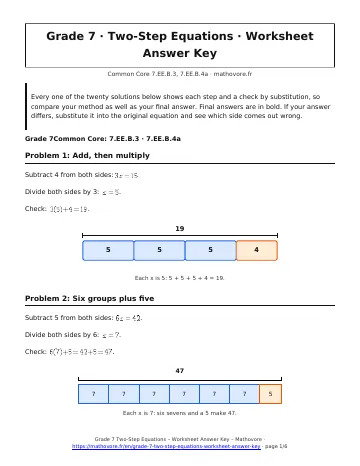
Problem 1: Add, then multiply
Subtract 4 from both sides: \(3x=15\).
Divide both sides by 3: \(x=5\).
Check: \(3(5)+4=19\).
Problem 2: Six groups plus five
Subtract 5 from both sides: \(6x=42\).
Divide both sides by 6: \(x=7\).
Check: \(6(7)+5=42+5=47\).
Problem 3: Subtract, then divide
Add 8 to both sides: \(5x=35\).
Divide both sides by 5: \(x=7\).
Check: \(5(7)-8=35-8=27\).
Problem 4: Divide, then subtract
Add 2 to both sides: \(\frac{x}{5}=8\).
Multiply both sides by 5: \(x=40\).
Check: \(\frac{40}{5}-2=8-2=6\).
Problem 5: A division step
Subtract 3 from both sides: \(\frac{x}{4}=7\).
Multiply both sides by 4: \(x=28\).
Check: \(\frac{28}{4}+3=7+3=10\).
Problem 6: Below zero
Subtract 14 from both sides: \(3x=-12\).
Divide both sides by 3: \(x=-4\).
Check: \(3(-4)+14=-12+14=2\).
Problem 7: A negative solution
Subtract 7 from both sides: \(2x=-6\).
Divide both sides by 2: \(x=-3\).
Check: \(2(-3)+7=-6+7=1\).
Problem 8: Two negatives
Add 7 to both sides: \(-5x=25\).
Divide both sides by \(-5\): \(x=-5\).
Check: \(-5(-5)-7=25-7=18\).
Problem 9: A negative coefficient
Subtract 5 from both sides: \(-3x=-15\).
Divide both sides by \(-3\): \(x=5\).
Check: \(-3(5)+5=-15+5=-10\).
Problem 10: Decimal coefficient
Subtract 2.4 from both sides: \(0.6x=5.4\).
Divide both sides by 0.6: \(x=9\).
Check: \(0.6(9)+2.4=5.4+2.4=7.8\).
Problem 11: Parentheses
Dividing first: \(x+3=9\), so \(x=6\).
Distributing first: \(4x+12=36\), then \(4x=24\), so \(x=6\).
Both methods give the same answer. Check: \(4(6+3)=4(9)=36\).
Problem 12: Decimal in parentheses
Divide both sides by 5: \(x-2.5=4\).
Add 2.5 to both sides: \(x=6.5\).
Check: \(5(6.5-2.5)=5(4)=20\).
Problem 13: Fraction coefficient
Add 2 to both sides: \(\frac{3}{4}x=9\).
Multiply both sides by the reciprocal \(\frac{4}{3}\): \(x=9\times \frac{4}{3}=12\). So \(x=12\).
Check: \(\frac{3}{4}(12)-2=9-2=7\).
Problem 14: Estimate, then solve
Estimate: with \(x=4\), \(2.5(4)+1.5=11.5\), which is a little more than 11. So \(x\) is a little less than 4.
Exact solution: subtract 1.5 to get \(2.5x=9.5\), then divide by 2.5: \(x=3.8\).
Check: \(2.5(3.8)+1.5=9.5+1.5=11\). The answer 3.8 is a little less than 4, as predicted.
Problem 15: Saving for a bike
Equation: \(45+8w=93\).
Subtract 45: \(8w=48\). Divide by 8: \(w=6\) weeks.
Check: \(45+8(6)=45+48=93\).
Problem 16: Rectangle perimeter
Divide both sides by 2: \(x+6=20\).
Subtract 6 from both sides: \(x=14\).
Arithmetic: half the perimeter is \(40: 2=20\), and \(20-6=14\). The steps match the algebra.
Check: \(2(14+6)=2(20)=40\). The length is \(14\text{ in}\).
Problem 17: Movie night
Each friend spends \(t+2\), so \(3(t+2)=27\).
Divide by 3: \(t+2=9\). Subtract 2: \(t=7\). A ticket costs \(\$7\).
Check: \(3(7+2)=3(9)=27\).
Problem 18: Taxi ride
Equation: \(3.50+2.25m=14.75\).
Subtract 3.50: \(2.25m=11.25\). Divide by 2.25: \(m=5\) miles.
Check: \(3.50+2.25(5)=3.50+11.25=14.75\).
Problem 19: Warming up
Equation: \(-3+2.5h=12\).
Add 3 to both sides: \(2.5h=15\). Divide by 2.5: \(h=6\) hours.
Check: \(-3+2.5(6)=-3+15=12\).
Problem 20: Diego's number
(a) Work backward: \(55: 5=11\), then \(11-6=5\).
(b) \(5(x+6)=55\). Divide by 5: \(x+6=11\). Subtract 6: \(x=5\).
(c) Both solutions use the same steps in the same order: divide by 5, then subtract 6. The algebra writes each step as an equation. Check: \((5+6)\cdot 5=55\).
See every chapter on the Grade 7 math page.