



This grade 5 conversions test answer key gives the full solution and the scoring guide for each of the 9 test questions on converting units and line plots.
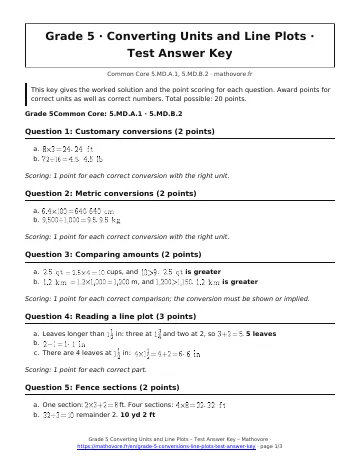
This key gives the worked solution and the point scoring for each question. Award points for correct units as well as correct numbers. Total possible: 20 points.
Grade 5 Conversions Test Answer Key: questions 1–5
Question 1: Customary conversions (2 points)
- \(8 \times 3 = 24\). \(24\text{ ft}\)
- \(72 : 16 = 4.5\). \(4.5\text{ lb}\)
Scoring: 1 point for each correct conversion with the right unit.
Question 2: Metric conversions (2 points)
- \(6.4 \times 100 = 640\). \(640\text{ cm}\)
- \(9{,}500 : 1{,}000 = 9.5\). \(9.5\text{ kg}\)
Scoring: 1 point for each correct conversion with the right unit.
Question 3: Comparing amounts (2 points)
- \(2.5\text{ qt}\) \(= 2.5 \times 4 = 10\) cups, and \(10 > 9\). \(2.5\text{ qt}\) is greater
- \(1.2\text{ km}\) \(= 1.2 \times 1{,}000 = 1{,}200\) m, and \(1{,}200 > 1{,}150\). \(1.2\text{ km}\) is greater
Scoring: 1 point for each correct comparison; the conversion must be shown or implied.
Question 4: Reading a line plot (3 points)
- Leaves longer than \(1\frac{1}{2}\) in: three at \(1\frac{3}{4}\) and two at 2, so \(3 + 2 = 5\). 5 leaves
- \(2 – 1 = 1\). \(1\text{ in}\)
- There are 4 leaves at \(1\frac{1}{2}\) in: \(4 \times 1\frac{1}{2} = 4 + 2 = 6\). \(6\text{ in}\)
Scoring: 1 point for each correct part.
Question 5: Fence sections (2 points)
- One section: \(2 \times 3 + 2 = 8\) ft. Four sections: \(4 \times 8 = 32\). \(32\text{ ft}\)
- \(32 : 3 = 10\) remainder 2. 10 yd 2 ft
Scoring: 1 point for each correct part. Allow credit in part (b) from a correct part (a) value.
Grade 5 Conversions Test Answer Key: questions 6–9
Question 6: Sharing juice equally (3 points)
- \(\frac{1}{2} + \frac{1}{2} + \frac{3}{4} + \frac{3}{4} + 1 + 1 = 4\frac{1}{2}\). \(4\frac{1}{2}\text{ qt}\)
- \(4\frac{1}{2} : 6 = \frac{9}{2} \times \frac{1}{6} = \frac{3}{4}\). \(\frac{3}{4}\text{ qt}\)
- \(\frac{3}{4} \times 4 = 3\). \(3\text{ c}\)
Scoring: 1 point for each correct part.
Question 7: Making a line plot (2 points)
- Two X marks above \(\frac{1}{4}\), three above \(\frac{1}{2}\), one above \(\frac{3}{4}\), and one above 1.
The completed line plot. - \(3 + 1 + 1 = 5\). 5 pieces
Scoring: 1 point for a line plot with all 7 X marks in the correct places; 1 point for part (b).
Question 8: Cooler for the team (2 points)
- \(5 \times 16 = 80\). 80 cups
- Used: \(16 \times 3 = 48\) cups. Left: \(80 – 48 = 32\) cups, and \(32 : 16 = 2\). 2 gallons
Scoring: 1 point for each correct part.
Question 9: Bike path (2 points)
- \(3.2 \times 1{,}000 = 3{,}200\) m. \(3{,}200 – 1{,}850 = 1{,}350\). \(1{,}350\text{ m}\)
- \(1{,}350 : 1{,}000 = 1.35\). \(1.35\text{ km}\)
Scoring: 1 point for each correct part.
Scoring summary
20 points: add the points of every question of this grade 5 conversions test answer key.
How to use this grade 5 conversions test answer key
Use this grade 5 conversions test answer key to score the test fairly and to see which skills need more practice.

See every chapter on the Grade 5 math page.