Key takeaway: This geometry volume formulas worksheet answer key presents every formula, substitution and result across the 23 problems. Also, exact answers appear in terms of pi, and rounded values follow. Then lay each step beside your paper to locate the first slip. Finally, check that every volume uses cubic units.
Every worked solution shows the formula, the substitution and the final answer in bold, with exact answers in terms of \(\pi\) and rounded values. Compare each step with your own work to find where a mistake started.
Geometry Volume Formulas Worksheet Answer Key: problems 1–5
1. Circumference from the radius
\(C=2\pi r=2\pi(7)=14\pi\). Then \(14\pi\approx 43.98\).
The circumference is \(14\pi\approx 43.98\text{ cm}\).
2. Circumference from the diameter
\(C=\pi d=\pi(18)=18\pi\approx 56.55\).
The circumference is \(18\pi\approx 56.55\text{ in}\).
3. Radius from the circumference
\(C=2\pi r\), so \(25.12=2(3.14)r=6.28r\). Divide both sides by 6.28: \(r=4\).
Check: \(2(3.14)(4)=25.12\).
The radius is \(4\text{ m}\).
4. Area of a circle
\(A=\pi r^{2}=\pi(9)^{2}=81\pi\approx 254.47\).
The area is \(81\pi\approx 254.47\text{ ft}^{2}\).
5. Area from the diameter
The radius is \(14: 2=7\text{ in}\). Then \(A=\pi(7)^{2}=49\pi\approx 153.94\).
The area is \(49\pi\approx 153.94\text{ in}^{2}\).
Geometry Volume Formulas Worksheet Answer Key: problems 6–10
6. Radius from the area
\(\pi r^{2}=144\pi\), so \(r^{2}=144\) and \(r=12\) (a length is positive).
Then \(C=2\pi(12)=24\pi\approx 75.40\).
The radius is \(12\text{ cm}\) and the circumference is \(24\pi\text{ cm}\).
7. Sectors into a parallelogram
(a) \(C=2\pi(10)=20\pi\text{ cm}\).
(b) The base is half the circumference: \(\frac{20\pi}{2}=10\pi\text{ cm}\).
(c) The height is the radius, \(10\text{ cm}\). Area \(=10\pi\times 10=100\pi\approx 314.16\text{ cm}^{2}\). This matches \(\pi r^{2}=\pi(10)^{2}\).
Answers: \(20\pi\text{ cm}\); \(10\pi\text{ cm}\); \(100\pi\text{ cm}^{2}\).
8. Volume of a cylinder
\(V=\pi r^{2}h=\pi(4)^{2}(10)=160\pi\approx 502.65\).
The volume is \(160\pi\approx 502.65\text{ cm}^{3}\).
9. Height of a cylinder
\(225\pi=\pi(5)^{2}h=25\pi h\). Divide both sides by \(25\pi\): \(h=9\).
Check: \(\pi(25)(9)=225\pi\).
The height is \(9\text{ in}\).
10. Equal stacks of coins
(a) Height \(=6\times 0.3=1.8\text{ cm}\) for each stack.
(b) Volume \(=\) area \(\times \) height \(=5\times 1.8=9\text{ cm}^{3}\) for each stack.
(c) At every level, both stacks have a cross section with area \(5\text{ cm}^{2}\), and both are \(1.8\text{ cm}\) tall. By Cavalieri's principle the volumes are equal.
Answers: \(1.8\text{ cm}\); \(9\text{ cm}^{3}\); same cross-sectional areas and heights.
Geometry Volume Formulas Worksheet Answer Key: problems 11–15
11. Volume of a pyramid
The base area is \(B=6\times 6=36\text{ m}^{2}\). Then \(V=\frac{1}{3}Bh=\frac{1}{3}(36)(9)=108\).
The volume is \(108\text{ m}^{3}\).
12. Rectangular pyramid
\(B=8\times 5=40\text{ ft}^{2}\). Then \(V=\frac{1}{3}(40)(12)=160\).
The volume is \(160\text{ ft}^{3}\).
13. Volume of a cone
\(V=\frac{1}{3}\pi r^{2}h=\frac{1}{3}\pi(9)(7)=21\pi\approx 65.97\).
The volume is \(21\pi\approx 65.97\text{ in}^{3}\).
14. Height of a cone
\(100\pi=\frac{1}{3}\pi(5)^{2}h=\frac{25\pi}{3}h\). Multiply by 3: \(300\pi=25\pi h\). Divide by \(25\pi\): \(h=12\).
The height is \(12\text{ cm}\).
15. Volume of a sphere
\(V=\frac{4}{3}\pi r^{3}=\frac{4}{3}\pi(216)=288\pi\approx 904.78\).
The volume is \(288\pi\approx 904.78\text{ cm}^{3}\).
Geometry Volume Formulas Worksheet Answer Key: problems 16–20
16. Volume of a hemisphere
A hemisphere is half a sphere: \(V=\frac{1}{2}\cdot\frac{4}{3}\pi(5)^{3}=\frac{2}{3}\pi(125)=\frac{250\pi}{3}\approx 261.80\).
The bowl holds \(\frac{250\pi}{3}\approx 261.80\text{ in}^{3}\).
17. Cone compared with cylinder
Cylinder: \(\pi(4)^{2}(9)=144\pi\approx 452.39\text{ cm}^{3}\).
Cone: \(\frac{1}{3}\pi(16)(9)=48\pi\approx 150.80\text{ cm}^{3}\).
\(\frac{48\pi}{144\pi}=\frac{1}{3}\).
Answer: cylinder \(144\pi\text{ cm}^{3}\), cone \(48\pi\text{ cm}^{3}\), cone \(=\frac{1}{3}\) of cylinder.
18. Grain bin
(a) \(V=\pi(6)^{2}(20)=720\pi\approx 2{,}261.95\text{ ft}^{3}\).
(b) \(2{,}261.95: 50\approx 45.24\), so 45 loads leave some grain behind. The bin needs 46 loads.
19. Scoop on a sugar cone
Scoop: \(\frac{4}{3}\pi(1.5)^{3}=\frac{4}{3}\pi(3.375)=4.5\pi\approx 14.14\text{ in}^{3}\).
Cone: \(\frac{1}{3}\pi(1.5)^{2}(5)=\frac{1}{3}\pi(11.25)=3.75\pi\approx 11.78\text{ in}^{3}\).
Difference: \(4.5\pi-3.75\pi=0.75\pi\approx 2.36\).
The melted ice cream is larger than the cone, so it overflows by about \(2.36\text{ in}^{3}\).
20. Depth of water in a tank
The radius is \(5\text{ ft}\). Then \(1000=\pi(5)^{2}h=25\pi h\), so \(h=\frac{1000}{25\pi}=\frac{40}{\pi}\approx 12.73\).
The depth is about \(12.73\text{ ft}\).
Geometry Volume Formulas Worksheet Answer Key: problems 21–23
21. Melting candles
One candle: \(\frac{1}{3}(3\times 3)(5)=15\text{ in}^{3}\). Four candles: \(60\text{ in}^{3}\).
Mold: \(60=\pi(2)^{2}h=4\pi h\), so \(h=\frac{15}{\pi}\approx 4.77\).
The wax is about \(4.77\text{ in}\) tall.
22. Cone cup poured into a cylinder
Cone: \(\frac{1}{3}\pi(16)(12)=64\pi\text{ cm}^{3}\).
Cylinder: \(64\pi=\pi(16)h\), so \(h=4\).
The water is \(4\text{ cm}\) deep, one third of the cone's height.
23. Ball in a box
Ball: \(r=3\), \(V=\frac{4}{3}\pi(27)=36\pi\approx 113.10\text{ cm}^{3}\). Box: \(6^{3}=216\text{ cm}^{3}\).
(a) \(\frac{36\pi}{216}=\frac{\pi}{6}\approx 0.5236\), which is about \(52.4\%\).
(b) \(216-36\pi\approx 102.90\text{ cm}^{3}\).
Answers: about \(52.4\%\); about \(102.90\text{ cm}^{3}\).
How do you read the circle answers?
Problem 1 gives \(14\pi\), or about 43.98 centimeters. Then problem 2 gives \(18\pi\), or about 56.55 inches, because the diameter is already given. Meanwhile, problem 4 gives \(81\pi\), about 254.47 square feet. Likewise, problem 5 halves the diameter first, so \(r=7\) and the area is \(49\pi\). Therefore, a common slip is squaring the diameter.
Which solid answers deserve a closer look?
Problem 9 gives a height of 9 inches, and problem 12 gives 160 cubic feet. Also, problem 13 gives \(21\pi\), about 65.97 cubic inches. However, problem 14 needs algebra, and \(h=12\) centimeters follows from \(100=\frac{25}{3}h\). In addition, problem 18 gives \(720\pi\), about 2,261.95 cubic feet for the grain bin. As a result, the exact form is easier to compare than the decimal.
What do the sphere and comparison answers show?
Problem 15 gives \(288\pi\), about 904.78 cubic centimeters. Then problem 16 halves a sphere of radius 5, so the bowl holds \(\frac{250\pi}{3}\), about 261.80. Meanwhile, problem 17 gives \(48\pi\) and \(144\pi\), so the cone holds a third of the cylinder. Because problem 23 gives \(36\pi\) for the ball and 216 for the box, the ball fills about 52 percent. Finally, problem 21 gives 60 cubic inches of wax.
What if your decimal differs slightly?
Check the value of pi first, since a rounded 3.14 shifts the last digits. Then compare the exact form. Also, make sure you rounded only at the end. After that, redo the arithmetic once more.

Printable PDF · Worksheet Answer Key
Geometry Area and Volume Formulas worksheet answer key
Download the PDF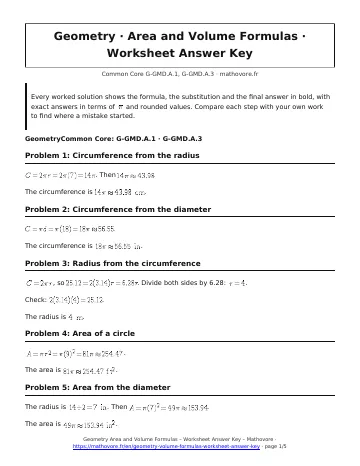
See every chapter on the Geometry math page.