



Problem 1: Name the sides
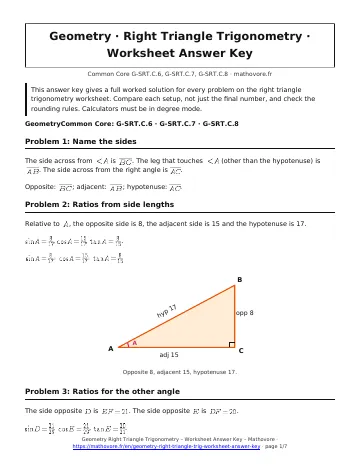
The side across from \(\angle A\) is \(\overline{BC}\). The leg that touches \(\angle A\) (other than the hypotenuse) is \(\overline{AB}\). The side across from the right angle is \(\overline{AC}\).
Opposite: \(\overline{BC}\); adjacent: \(\overline{AB}\); hypotenuse: \(\overline{AC}\).
Problem 2: Ratios from side lengths
Relative to \(A\), the opposite side is 8, the adjacent side is 15 and the hypotenuse is 17.
\(\sin A=\frac{8}{17}\), \(\cos A=\frac{15}{17}\), \(\tan A=\frac{8}{15}\).
\(\sin A=\frac{8}{17},\ \cos A=\frac{15}{17},\ \tan A=\frac{8}{15}\)
Problem 3: Ratios for the other angle
The side opposite \(D\) is \(EF=21\). The side opposite \(E\) is \(DF=20\).
\(\sin D=\frac{21}{29}\), \(\cos E=\frac{21}{29}\), \(\tan E=\frac{20}{21}\).
\(\sin D=\cos E=\frac{21}{29}\). They are equal because \(D\) and \(E\) are complementary.
Problem 4: Ratios in a 7-24-25 triangle
The side opposite \(P\) is \(QR=7\) and the side adjacent to \(P\) is \(PQ=24\).
\(\tan P=\frac{7}{24}\), \(\cos P=\frac{24}{25}\). The side opposite \(R\) is \(PQ=24\), so \(\sin R=\frac{24}{25}\).
\(\tan P=\frac{7}{24},\ \cos P=\frac{24}{25},\ \sin R=\frac{24}{25}\)
Problem 5: Using a calculator
Enter each angle with the calculator in degree mode.
\(\sin 28^{\circ}\approx 0.4695\), \(\cos 63^{\circ}\approx 0.4540\), \(\tan 51^{\circ}\approx 1.2349\).
\(0.4695,\ 0.4540,\ 1.2349\)
Problem 6: Finding an angle from a ratio
Use the inverse function for each ratio.
\(x=\sin^{-1}(0.6)\approx 36.9^{\circ}\); \(x=\cos^{-1}(0.25)\approx 75.5^{\circ}\); \(x=\tan^{-1}(2.4)\approx 67.4^{\circ}\).
\(36.9^{\circ},\ 75.5^{\circ},\ 67.4^{\circ}\)
Problem 7: Similar right triangles
In triangle ABC, \(\sin A=\frac{9}{15}=\frac{3}{5}\). Since \(\angle D\cong\angle A\), \(\sin D=\sin A=\frac{3}{5}\). In triangle DEF, \(\sin D=\frac{EF}{DE}=\frac{21}{DE}\). Set the ratios equal: \(\frac{21}{DE}=\frac{3}{5}\), so \(3\cdot DE=105\) and \(DE=35\).
Check: \(\frac{21}{35}=\frac{3}{5}\).
\(DE=35\)
Problem 8: Complementary angle identities
Subtract each angle from \(90^{\circ}\) and switch between sine and cosine.
\(\sin 20^{\circ}=\cos 70^{\circ}\), \(\cos 75^{\circ}=\sin 15^{\circ}\), \(\sin 38^{\circ}=\cos 52^{\circ}\).
\(\cos 70^{\circ},\ \sin 15^{\circ},\ \cos 52^{\circ}\)
Problem 9: Solving with complementary angles
Sine and cosine are equal only for complementary angles, so the angles add to \(90^{\circ}\).
\((3x+5)+(2x+10)=90\), so \(5x+15=90\), \(5x=75\) and \(x=15\).
Check: \(\sin 50^{\circ}=\cos 40^{\circ}\).
\(x=15\)
Problem 10: 45-45-90 triangle, find the hypotenuse
In a 45-45-90 triangle the hypotenuse is the leg times \(\sqrt{2}\).
\(x=7\sqrt{2}\approx 9.9\).
\(x=7\sqrt{2}\approx 9.9\)
Problem 11: 45-45-90 triangle, find the legs
The legs equal the hypotenuse divided by \(\sqrt{2}\).
\(\text{leg}=\frac{12}{\sqrt{2}}\cdot\frac{\sqrt{2}}{\sqrt{2}}=\frac{12\sqrt{2}}{2}=6\sqrt{2}\approx 8.5\).
\(6\sqrt{2}\approx 8.5\text{ in}\)
Problem 12: 30-60-90 triangle, short leg given
The side opposite \(30^{\circ}\) is the short leg, 5. The hypotenuse is twice the short leg, and the long leg is the short leg times \(\sqrt{3}\).
\(x=2(5)=10\) and \(y=5\sqrt{3}\approx 8.7\).
\(x=10,\ y=5\sqrt{3}\approx 8.7\)
Problem 13: 30-60-90 triangle, hypotenuse given
The short leg is half the hypotenuse, and the long leg is the short leg times \(\sqrt{3}\).
\(\text{short leg}=\frac{18}{2}=9\) and \(\text{long leg}=9\sqrt{3}\approx 15.6\).
\(9\text{ cm},\ 9\sqrt{3}\text{ cm}\)
Problem 14: 30-60-90 triangle, long leg given
The long leg equals the short leg times \(\sqrt{3}\), so the short leg is \(\frac{6\sqrt{3}}{\sqrt{3}}=6\). The hypotenuse is twice the short leg: \(2(6)=12\).
\(\text{short leg }6\text{ ft},\ \text{hypotenuse }12\text{ ft}\)
Problem 15: Angle from two sides
The known sides are opposite and adjacent, so use tangent: \(\tan A=\frac{7}{11}\).
\(A=\tan^{-1}(\frac{7}{11})\approx 32.5^{\circ}\).
\(m\angle A\approx 32.5^{\circ}\)
Problem 16: Solve a right triangle
The acute angles are complementary: \(\angle B=90^{\circ}-34^{\circ}=56^{\circ}\).
Side \(a\) is opposite \(A\): \(\sin 34^{\circ}=\frac{a}{20}\), so \(a=20\sin 34^{\circ}\approx 11.2\).
Side \(b\) is adjacent: \(\cos 34^{\circ}=\frac{b}{20}\), so \(b=20\cos 34^{\circ}\approx 16.6\).
Check: \(11.2^{2}+16.6^{2}\approx 401.0\approx 20^{2}\).
\(\angle B=56^{\circ},\ a\approx 11.2,\ b\approx 16.6\)
Problem 17: Ladder against a wall
The height is opposite the \(70^{\circ}\) angle and the ladder is the hypotenuse, so use sine.
\(\sin 70^{\circ}=\frac{h}{15}\), so \(h=15\sin 70^{\circ}\approx 14.1\).
\(h\approx 14.1\text{ ft}\)
Problem 18: Height of a flagpole
The distance is adjacent to the angle and the part of the pole above her eyes is opposite, so use tangent.
\(\tan 32^{\circ}=\frac{h}{85}\), so \(h=85\tan 32^{\circ}\approx 53.1\) ft above eye level.
Add her eye height: \(53.1+5.5=58.6\).
\(\approx 58.6\text{ ft}\)
Problem 19: Lighthouse and boat
The angle of depression equals the angle of elevation from the boat, so the angle at the boat is \(25^{\circ}\). The 120 ft height is opposite and the distance \(d\) is adjacent.
\(\tan 25^{\circ}=\frac{120}{d}\), so \(d=\frac{120}{\tan 25^{\circ}}\approx 257.3\).
\(d\approx 257.3\text{ ft}\)
Problem 20: Wheelchair ramp
The rise is opposite the angle. The ramp surface is the hypotenuse and the horizontal distance is adjacent.
Length: \(\sin 4.8^{\circ}=\frac{2.5}{L}\), so \(L=\frac{2.5}{\sin 4.8^{\circ}}\approx 29.9\).
Horizontal distance: \(\tan 4.8^{\circ}=\frac{2.5}{x}\), so \(x=\frac{2.5}{\tan 4.8^{\circ}}\approx 29.8\).
\(\text{ramp}\approx 29.9\text{ ft},\ \text{horizontal}\approx 29.8\text{ ft}\)
Problem 21: Kite height
The string is the hypotenuse and the height above his hand is opposite the angle, so use sine.
\(100\sin 48^{\circ}\approx 74.3\) ft above his hand. Add 4 ft: \(74.3+4=78.3\).
\(\approx 78.3\text{ ft}\)
Problem 22: Flagpole on a building
Find each height with tangent, then subtract.
To the roof: \(40\tan 50^{\circ}\approx 47.7\). To the top of the pole: \(40\tan 58^{\circ}\approx 64.0\).
Flagpole: \(64.0-47.7\approx 16.3\), which agrees with \(40(\tan 58^{\circ}-\tan 50^{\circ})\approx 16.3\).
\(\approx 16.3\text{ ft}\)
See every chapter on the Geometry math page.