


This geometry probability worksheet answer key solves all 24 problems of the probability: independence, conditional probability and fair decisions worksheet step by step.
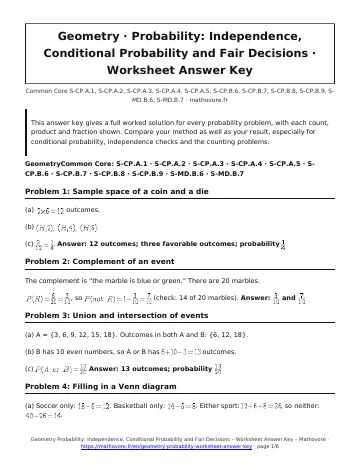
This answer key gives a full worked solution for every probability problem, with each count, product and fraction shown. Compare your method as well as your result, especially for conditional probability, independence checks and the counting problems.
Geometry Probability Worksheet Answer Key: problems 1–5
Problem 1: Sample space of a coin and a die
(a) \(2\times 6=12\) outcomes.
(b) \((H,2),\ (H,4),\ (H,6)\).
(c) \(\frac{3}{12}=\frac{1}{4}\). Answer: 12 outcomes; three favorable outcomes; probability \(\frac{1}{4}\)
Problem 2: Complement of an event
The complement is “the marble is blue or green.” There are 20 marbles.
\(P(R)=\frac{6}{20}=\frac{3}{10}\), so \(P(\text{not }R)=1-\frac{3}{10}=\frac{7}{10}\) (check: 14 of 20 marbles). Answer: \(\frac{3}{10}\) and \(\frac{7}{10}\)
Problem 3: Union and intersection of events
(a) A = {3, 6, 9, 12, 15, 18}. Outcomes in both A and B: {6, 12, 18}.
(b) B has 10 even numbers, so A or B has \(6+10-3=13\) outcomes.
(c) \(P(A\text{ or }B)=\frac{13}{20}\). Answer: 13 outcomes; probability \(\frac{13}{20}\)
Problem 4: Filling in a Venn diagram
(a) Soccer only: \(18-6=12\). Basketball only: \(14-6=8\). Either sport: \(12+6+8=26\), so neither: \(40-26=14\).
(b) \(\frac{14}{40}=\frac{7}{20}\). Answer: 12, 8, 14; probability \(\frac{7}{20}\)
Problem 5: Addition rule with decimals
\(P(A\text{ or }B)=0.45+0.30-0.12=0.63\). Neither: \(1-0.63=0.37\). Answer: 0.63 and 0.37
Geometry Probability Worksheet Answer Key: problems 6–10
Problem 6: Addition rule with cards
13 hearts and 4 kings, with the king of hearts counted twice: \(13+4-1=16\) cards.
\(\frac{16}{52}=\frac{4}{13}\). Answer: \(\frac{4}{13}\)
Problem 7: Testing independence with numbers
(a) \(0.4\times 0.5=0.20\), which equals \(P(A\text{ and }B)\): independent.
(b) \(0.6\times 0.3=0.18\), which is not \(0.15\): not independent. Answer: (a) independent; (b) not independent
Problem 8: Independent free throws
(a) \(0.7\times 0.7=0.49\). (b) \(0.3\times 0.3=0.09\). (c) Make-miss or miss-make: \(2\times 0.7\times 0.3=0.42\).
Check: \(0.49+0.09+0.42=1\). Answer: 0.49, 0.09, 0.42
Problem 9: Conditional probability formula
(a) \(P(A\mid B)=\frac{0.18}{0.45}=0.4\).
(b) Yes. \(P(A\mid B)=0.4=P(A)\), so knowing B does not change the probability of A. Answer: 0.4; independent
Problem 10: Reading a two-way table
(a) \(\frac{38}{150}=\frac{19}{75}\).
(b) Among 90 girls, 38 chose pizza: \(\frac{38}{90}=\frac{19}{45}\).
(c) Among 72 pizza fans, 38 are girls: \(\frac{38}{72}=\frac{19}{36}\).
Answer: \(\frac{19}{75}\), \(\frac{19}{45}\), \(\frac{19}{36}\)
Geometry Probability Worksheet Answer Key: problems 11–15
Problem 11: Independence in a table
Overall, 50 of 200 walk: \(P(\text{walk})=\frac{1}{4}\). Seniors: \(\frac{20}{80}=\frac{1}{4}\). Juniors: \(\frac{30}{120}=\frac{1}{4}\).
All three equal, so the events are independent. Answer: independent
Problem 12: Comparing conditional probabilities
\(P(\text{pizza})=\frac{72}{150}=0.48\). Boys: \(\frac{34}{60}\approx 0.567\). Girls: \(\frac{38}{90}\approx 0.422\).
The values differ, so the events are not independent. Answer: not independent
Problem 13: Two aces without replacement
\(P(\text{ace first})=\frac{4}{52}\) and \(P(\text{ace second}\mid\text{ace first})=\frac{3}{51}\).
\(\frac{4}{52}\cdot\frac{3}{51}=\frac{12}{2652}=\frac{1}{221}\). Answer: \(\frac{1}{221}\)
Problem 14: Marbles without replacement
(a) \(\frac{5}{8}\cdot\frac{3}{7}=\frac{15}{56}\).
(b) Blue then red has the same probability, so \(2\cdot\frac{15}{56}=\frac{15}{28}\). Answer: \(\frac{15}{56}\) and \(\frac{15}{28}\)
Problem 15: Tree diagram for a game
(a) \(P(\text{win})=0.3(0.4)+0.7(0.7)=0.12+0.49=0.61\).
(b) \(P(\text{rain}\mid\text{win})=\frac{0.12}{0.61}=\frac{12}{61}\approx 0.197\). Answer: 0.61 and about 0.197
Geometry Probability Worksheet Answer Key: problems 16–20
Problem 16: Awarding medals (permutations)
(a) Order matters: \(_{8}P_{3}=8\cdot 7\cdot 6=336\).
(b) One favorable order out of 336: \(\frac{1}{336}\). Answer: 336 ways; \(\frac{1}{336}\)
Problem 17: Choosing a committee (combinations)
(a) Order does not matter: \(_{10}C_{3}=\frac{10\cdot 9\cdot 8}{3\cdot 2\cdot 1}=120\).
(b) Maya and Jamal plus one of the other 8 students: 8 committees. \(\frac{8}{120}=\frac{1}{15}\). Answer: 120; \(\frac{1}{15}\)
Problem 18: Probability with combinations
Total teams: \(_{12}C_{4}=495\).
(a) \(\frac{_{7}C_{4}}{495}=\frac{35}{495}=\frac{7}{99}\).
(b) \(\frac{_{7}C_{2}\cdot\,_{5}C_{2}}{495}=\frac{21\cdot 10}{495}=\frac{210}{495}=\frac{14}{33}\). Answer: \(\frac{7}{99}\) and \(\frac{14}{33}\)
Problem 19: Lottery odds
\(_{30}C_{5}=\frac{30\cdot 29\cdot 28\cdot 27\cdot 26}{5!}=\frac{17{,}100{,}720}{120}=142{,}506\).
One winning ticket: \(\frac{1}{142{,}506}\). Answer: 142,506 tickets; \(\frac{1}{142{,}506}\)
Problem 20: Is the die rule fair?
Rule X: each friend has \(\frac{2}{6}=\frac{1}{3}\). Rule Y: Maya \(\frac{1}{6}\), Jamal \(\frac{2}{6}=\frac{1}{3}\), Sofia \(\frac{3}{6}=\frac{1}{2}\).
Only Rule X gives equal chances. Answer: Rule X is fair; Rule Y is not
Geometry Probability Worksheet Answer Key: problems 21–24
Problem 21: A fair dice game
Of 36 equally likely rolls, sums of 8 to 12 occur \(5+4+3+2+1=15\) times , and sums of 2 to 6 occur \(1+2+3+4+5=15\) times . A sum of 7 occurs 6 times and is rolled again.
\(P(\text{Diego})=\frac{15}{36}=P(\text{Aisha})\), so each wins half of the decided games. Answer: fair
Problem 22: Analyzing a medical test
Condition: \(10{,}000\times 0.01=100\) people; 90 test positive. No condition: \(9{,}900\) people; \(0.05\times 9{,}900=495\) false positives.
\(P(\text{condition}\mid +)=\frac{90}{90+495}=\frac{90}{585}=\frac{2}{13}\approx 0.154\). Answer: 90 and 495; about 15.4%
Problem 23: Game strategy: stay or switch
The car is behind Door 1, 2 or 3 with probability \(\frac{1}{3}\) each. The host never opens the car door or the contestant’s door.
Car behind Door 1: staying wins. Car behind Door 2: the host must open Door 3, so switching wins. Car behind Door 3: the host must open Door 2, so switching wins.
\(P(\text{stay wins})=\frac{1}{3}\), \(P(\text{switch wins})=\frac{2}{3}\). If the host opens either goat door at random when he has a choice, \(P(\text{car behind 2}\mid\text{host opens 3})=\frac{1/3}{1/6+1/3}=\frac{2}{3}\). Answer: switch (\(\frac{2}{3}\)) beats stay (\(\frac{1}{3}\))
Problem 24: Language electives
(a) Either language: \(150+90-40=200\), so neither: \(40\). \(\frac{40}{240}=\frac{1}{6}\).
(b) \(P(\text{French}\mid\text{Spanish})=\frac{40}{150}=\frac{4}{15}\).
(c) \(P(\text{French})=\frac{90}{240}=\frac{3}{8}\neq\frac{4}{15}\), so not independent. Answer: \(\frac{1}{6}\); \(\frac{4}{15}\); not independent
How to use this geometry probability worksheet answer key
Read this geometry probability worksheet answer key after trying each problem yourself, and redo any problem you missed.

See every chapter on the Geometry math page.