Key takeaway: This geometry constructions test answer key gives the expected steps or calculations for nine questions, followed by a scoring guide. Give partial credit for sound reasoning with a small slip. Accept any valid order of steps that reaches the same construction.
Each solution gives the expected construction steps or calculations, then a scoring guide. Give partial credit for correct reasoning with a small slip, and accept any valid order of steps that leads to the same construction. Check that arcs are shown, because the arcs are the evidence of the method.
Geometry Constructions Test Answer Key: questions 1–5
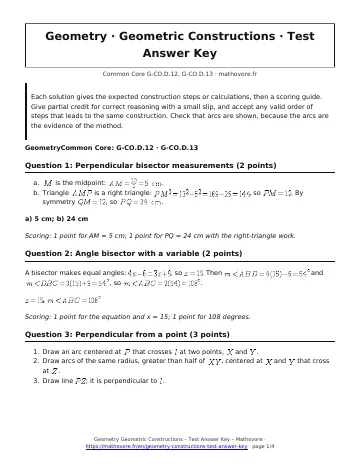
1. Perpendicular bisector measurements (2 points)
- \(M\) is the midpoint: \(AM=\frac{10}{2}=5\text{ cm}\).
- Triangle \(AMP\) is a right triangle: \(PM^{2}=13^{2}-5^{2}=169-25=144\), so \(PM=12\). By symmetry \(QM=12\), so \(PQ=24\text{ cm}\).
a) 5 cm; b) 24 cm
Scoring: 1 point for AM = 5 cm; 1 point for PQ = 24 cm with the right-triangle work.
2. Angle bisector with a variable (2 points)
A bisector makes equal angles: \(4x-6=3x+9\), so \(x=15\). Then \(m\angle ABD=4(15)-6=54^{\circ}\) and \(m\angle DBC=3(15)+9=54^{\circ}\), so \(m\angle ABC=2(54)=108^{\circ}\).
\(x=15\), \(m\angle ABC=108^{\circ}\)
Scoring: 1 point for the equation and x = 15; 1 point for 108 degrees.
3. Perpendicular from a point (3 points)
- Draw an arc centered at \(P\) that crosses \(l\) at two points, \(X\) and \(Y\).
- Draw arcs of the same radius, greater than half of \(XY\), centered at \(X\) and \(Y\) that cross at \(Z\).
- Draw line \(PZ\); it is perpendicular to \(l\).
Scoring: 1 point for the arc at P giving X and Y; 1 point for equal arcs at X and Y (wider than half of XY) meeting at Z; 1 point for drawing PZ.
4. Justify an angle copy (2 points)
Triangles \(APQ\) and \(DP^{\prime}Q^{\prime}\) have \(AP=DP^{\prime}\), \(AQ=DQ^{\prime}\) and \(PQ=P^{\prime}Q^{\prime}\). The triangles are congruent by SSS, and corresponding parts of congruent triangles are congruent, so \(\angle QAP\) is congruent to \(\angle Q^{\prime}DP^{\prime}\).
Scoring: 1 point for naming the three pairs of equal sides; 1 point for SSS and the conclusion.
5. Parallel line construction (2 points)
- The copy is congruent to the original, so it measures \(58^{\circ}\).
- The converse of the corresponding angles theorem: the two congruent angles are corresponding angles.
a) \(58^{\circ}\); b) converse of the corresponding angles theorem
Scoring: 1 point for each part.
Geometry Constructions Test Answer Key: questions 6–9
6. Equilateral triangle (2 points)
- All three sides equal the compass width, 9 in. Perimeter \(3(9)=27\text{ in}\).
- The triangle is equilateral, so its angles are equal and add to \(180^{\circ}\): \(m\angle C=\frac{180}{3}=60^{\circ}\).
a) 27 in; b) \(60^{\circ}\)
Scoring: 1 point for 27 in; 1 point for 60 degrees with a reason.
7. Regular hexagon in a circle (3 points)
- Each side equals the radius: 8 cm.
- \(6(8)=48\text{ cm}\).
- Each triangle with the center is equilateral, so each interior angle is \(60^{\circ}+60^{\circ}=120^{\circ}\).
a) 8 cm; b) 48 cm; c) \(120^{\circ}\)
Scoring: 1 point for each part.
8. Square in a circle (2 points)
- Diagonal \(AC\) is a diameter, so \(AC=12\text{ in}\).
- The diagonals of a square are perpendicular, so \(m\angle AOB=90^{\circ}\). (Four equal central angles: \(\frac{360}{4}=90^{\circ}\).)
a) 12 in; b) \(90^{\circ}\)
Scoring: 1 point for each part.
9. Compass width (2 points)
Each arc reaches only 3 cm from its center, and \(3+3=6\) is less than 8, so the arcs from \(A\) and \(B\) never cross and no points \(P\) and \(Q\) exist. The radius must be greater than half of \(AB\), that is, greater than 4 cm.
Scoring: 1 point for explaining that the arcs do not meet; 1 point for the condition radius greater than 4 cm (half of AB).
Scoring summary
20 points: add the points of every question of this geometry constructions test answer key.
How do you score the constructions test?
In question 1, half of 10 is 5, so \(PM=\sqrt{13^{2}-5^{2}}=12\) and \(PQ=24\) centimeters. Award one point for each. Question 7 has a hexagon side of 8 centimeters, which earns a point, and a perimeter of 48, which earns another, plus one for the construction method.
Where does partial credit apply?
Three points ride on question 3. Give one point for arcs from P that meet the line twice, one for equal arcs from those two points, and one for the line through P and the crossing. Question 9 earns one point for noting that 3 is less than half of 8, so the arcs cannot cross.
Which idea needs a second look?
When item 8 is missed, students probably did not see that the diagonal of the square equals the diameter, 12 inches, so the side is \(6\sqrt{2}\). Therefore, sketch the right isosceles triangle again.
How can you use these scores?
Sort errors into step order, reasons, and measurements. Then give each group one extra construction. A short quiz afterward shows whether the idea stuck.

See every chapter on the Geometry math page.