
Key takeaway: This AP calculus analyzing worksheet answer key presents justified solutions to all 24 problems. Each solution names the test or theorem, shows the sign chart or substitution, and bolds the result. It supports the AB Unit 5 skills. First, try each problem yourself. Then check whether your justification would earn full credit, because the AP exam grades reasons as well as numbers.
Full worked solutions for all 24 problems on analyzing functions. Each solution shows the derivative, the sign analysis or theorem that supports the conclusion, and the final answer in bold. Compare your reasoning, not just your final numbers.
AP Calculus Analyzing Worksheet Answer Key: problems 1–5
1. Critical numbers
\(f\) is a polynomial, so \(f^{\prime}\) exists everywhere. \(f^{\prime}(x)=6x^{2}-6x-36=6(x^{2}-x-6)=6(x-3)(x+2)\).
Setting \(f^{\prime}(x)=0\) gives \(x=3\) and \(x=-2\). Answer: the critical numbers are \(x=-2\) and \(x=3\).
2. Increasing and decreasing
\(g^{\prime}(x)=4x^{3}-16x=4x(x-2)(x+2)\), so the critical numbers are \(-2, 0, 2\).
Test points: \(g^{\prime}(-3)=-60 < 0\); \(g^{\prime}(-1)=12 > 0\); \(g^{\prime}(1)=-12 < 0\); \(g^{\prime}(3)=60 > 0\).
Increasing on \((-2,0)\) and \((2,\infty)\); decreasing on \((-\infty,-2)\) and \((0,2)\). The sign changes give local minima at \(x=\pm 2\) with \(g(\pm 2)=-16\) and a local maximum at \(x=0\) with \(g(0)=0\). Answer: increasing on \((-2,0)\) and \((2,\infty)\), decreasing on \((-\infty,-2)\) and \((0,2)\).
3. First Derivative Test
\(h^{\prime}(x)=3x^{2}-12=3(x-2)(x+2)\), so the critical numbers are \(-2\) and \(2\).
For \(x < -2\), \(h^{\prime} > 0\); for \(-2 < x < 2\), \(h^{\prime} < 0\); for \(x > 2\), \(h^{\prime} > 0\).
At \(x=-2\) the sign changes from \(+\) to \(-\): local maximum, \(h(-2)=-8+24+4=20\). At \(x=2\) it changes from \(-\) to \(+\): local minimum, \(h(2)=8-24+4=-12\). Answer: local maximum \((-2,20)\), local minimum \((2,-12)\).
4. Concavity of a quartic
\(f^{\prime}(x)=4x^{3}-12x^{2}\) and \(f^{\prime\prime}(x)=12x^{2}-24x=12x(x-2)\). The zeros of \(f^{\prime\prime}\) are \(x=0\) and \(x=2\).
\(f^{\prime\prime} > 0\) for \(x < 0\) and \(x > 2\); \(f^{\prime\prime} < 0\) for \(0 < x < 2\). The sign changes at both zeros, with \(f(0)=0\) and \(f(2)=16-32=-16\).
Answer: concave up on \((-\infty,0)\) and \((2,\infty)\), concave down on \((0,2)\), inflection points \((0,0)\) and \((2,-16)\).
5. Second Derivative Test
\(p^{\prime}(x)=6x^{2}-18x+12=6(x-1)(x-2)\), so \(x=1\) and \(x=2\). Also \(p^{\prime\prime}(x)=12x-18\).
\(p^{\prime\prime}(1)=-6 < 0\), so there is a local maximum, \(p(1)=2-9+12=5\). \(p^{\prime\prime}(2)=6 > 0\), so there is a local minimum, \(p(2)=16-36+24=4\).
Answer: local maximum at \((1,5)\), local minimum at \((2,4)\).
AP Calculus Analyzing Worksheet Answer Key: problems 6–10
6. Mean Value Theorem, quadratic
\(f\) is a polynomial, so it is continuous on \([0,5]\) and differentiable on \((0,5)\). The average rate of change is \(\frac{f(5)-f(0)}{5-0}=\frac{5-0}{5}=1\).
Solve \(f^{\prime}(c)=2c-4=1\): \(c=\frac{5}{2}\), which lies in \((0,5)\). Answer: \(c=\frac{5}{2}\).
7. Mean Value Theorem, shifted square root
\(\sqrt{x+1}\) is continuous on \([0,8]\) and differentiable on \((0,8)\). The average rate of change is \(\frac{3-1}{8-0}=\frac{1}{4}\).
\(f^{\prime}(c)=\frac{1}{2\sqrt{c+1}}=\frac{1}{4}\) gives \(\sqrt{c+1}=2\), so \(c+1=4\) and \(c=3\), which is in \((0,8)\). Answer: \(c=3\).
8. When the theorem fails
\(f\) is not differentiable at \(x=2\), which lies in \((0,5)\) (the graph has a corner), so a hypothesis fails.
The average rate of change is \(\frac{f(5)-f(0)}{5}=\frac{3-2}{5}=\frac{1}{5}\). But \(f^{\prime}(x)=-1\) for \(x < 2\) and \(f^{\prime}(x)=1\) for \(x > 2\), so \(f^{\prime}(x)\) never equals \(\frac{1}{5}\). Answer: not differentiable at \(x=2\); no such \(c\) exists.
9. Candidates Test, cubic
\(f^{\prime}(x)=6x^{2}-6x-12=6(x-2)(x+1)\), so the critical numbers \(-1\) and \(2\) are both in \([-2,3]\).
| \(x\) | \(-2\) | \(-1\) | \(2\) | \(3\) |
|---|---|---|---|---|
| \(f(x)\) | \(-3\) | \(8\) | \(-19\) | \(-8\) |
Answer: absolute maximum \(8\) at \(x=-1\); absolute minimum \(-19\) at \(x=2\).
10. Candidates Test, trigonometric
\(f^{\prime}(x)=1-2\sin x=0\) gives \(\sin x=\frac{1}{2}\), so \(x=\frac{\pi}{6}\) or \(x=\frac{5\pi}{6}\).
\(f(0)=2\); \(f(\frac{\pi}{6})=\frac{\pi}{6}+\sqrt{3}\approx 2.256\); \(f(\frac{5\pi}{6})=\frac{5\pi}{6}-\sqrt{3}\approx 0.886\); \(f(\pi)=\pi-2\approx 1.142\).
Answer: absolute maximum \(\frac{\pi}{6}+\sqrt{3}\), absolute minimum \(\frac{5\pi}{6}-\sqrt{3}\).
AP Calculus Analyzing Worksheet Answer Key: problems 11–15
11. Points of inflection
\(f^{\prime}(x)=4x^{3}-24x^{2}+36x\) and \(f^{\prime\prime}(x)=12x^{2}-48x+36=12(x-1)(x-3)\).
\(f^{\prime\prime} > 0\) for \(x < 1\), \(f^{\prime\prime} < 0\) for \(1 < x < 3\), and \(f^{\prime\prime} > 0\) for \(x > 3\), so the concavity changes at both zeros. \(f(1)=1-8+18=11\) and \(f(3)=81-216+162=27\).
Answer: inflection points \((1,11)\) and \((3,27)\).
12. Not an inflection point
\(f^{\prime\prime}(x)=12x^{2}\), so \(f^{\prime\prime}(0)=0\). However, \(12x^{2} > 0\) for every \(x\neq 0\), so \(f^{\prime\prime}\) does not change sign at \(0\). The graph stays concave up on both sides. Answer: no inflection, because the concavity never changes.
13. Reading the graph of f prime
Signs of \(f^{\prime}\): negative for \(x < -2\), positive on \((-2,1)\), negative on \((1,3)\), positive for \(x > 3\).
- \(f\) is increasing where \(f^{\prime} > 0\): \((-2,1)\) and \((3,\infty)\).
- The sign changes of \(f^{\prime}\): \(-\) to \(+\) at \(x=-2\) (local minimum), \(+\) to \(-\) at \(x=1\) (local maximum), \(-\) to \(+\) at \(x=3\) (local minimum). Answer: local minima at \(x=-2\) and \(x=3\), local maximum at \(x=1\).
- Expand \((x+2)(x-1)(x-3)=x^{3}-2x^{2}-5x+6\), so \(f^{\prime\prime}(x)=\frac{1}{2}(3x^{2}-4x-5)\). Setting it to zero: \(x=\frac{4\pm\sqrt{76}}{6}=\frac{2\pm\sqrt{19}}{3}\), and \(f^{\prime}\) changes from increasing to decreasing and back there. Answer: \(x=\frac{2\pm\sqrt{19}}{3}\approx -0.79\) and \(2.12\).
14. Derivative given in factored form
The critical numbers are \(x=-2\) and \(x=1\). The factor \((x-1)^{2}\) is never negative.
For \(x < -2\): \(h^{\prime} < 0\). For \(-2 < x < 1\): \(h^{\prime} > 0\). For \(x > 1\): \(h^{\prime} > 0\).
\(h^{\prime}\) changes from \(-\) to \(+\) at \(x=-2\), a local minimum. At \(x=1\) the sign stays positive, so there is no extremum. Answer: only a local minimum at \(x=-2\).
15. A logarithmic function
\(f^{\prime}(x)=1-\frac{2}{x}=0\) gives \(x=2\). \(f^{\prime} < 0\) on \((0,2)\) and \(f^{\prime} > 0\) on \((2,\infty)\), so \(f\) has its absolute minimum at \(x=2\): \(f(2)=2-2\ln 2\approx 0.614\).
\(f^{\prime\prime}(x)=\frac{2}{x^{2}} > 0\) for all \(x > 0\), so \(f\) is concave up everywhere with no inflection point. Answer: minimum value \(2-2\ln 2\); concave up on \((0,\infty)\).
AP Calculus Analyzing Worksheet Answer Key: problems 16–20
16. Complete function analysis
\(f^{\prime}(x)=4x^{3}-12x^{2}=4x^{2}(x-3)\), so the critical numbers are \(0\) and \(3\). \(f^{\prime} < 0\) for \(x < 3\) (\(x\neq 0\)) and \(f^{\prime} > 0\) for \(x > 3\). Decreasing on \((-\infty,3)\), increasing on \((3,\infty)\). Only \(x=3\) gives an extremum: a local (and absolute) minimum \(f(3)=81-108=-27\); \(x=0\) is not an extremum.
\(f^{\prime\prime}(x)=12x^{2}-24x=12x(x-2)\). Concave up on \((-\infty,0)\) and \((2,\infty)\), concave down on \((0,2)\). Inflection points: \((0,0)\) and \((2,-16)\).
Answer: minimum \((3,-27)\); inflection points \((0,0)\) and \((2,-16)\).
17. Concavity of an implicit curve
Differentiate: \(2x+2y\frac{dy}{dx}=0\), so \(\frac{dy}{dx}=-\frac{x}{y}\).
Differentiate again: \(\frac{d^{2}y}{dx^{2}}=-\frac{y-x\frac{dy}{dx}}{y^{2}}=-\frac{y+\frac{x^{2}}{y}}{y^{2}}=-\frac{y^{2}+x^{2}}{y^{3}}=-\frac{25}{y^{3}}\).
At \((3,4)\): \(-\frac{25}{64} < 0\). Answer: \(\frac{d^{2}y}{dx^{2}}=-\frac{25}{y^{3}}\); concave down at \((3,4)\).
18. Tangent lines to a circle
Differentiate: \(2x+2y\frac{dy}{dx}-6+4\frac{dy}{dx}=0\), so \(\frac{dy}{dx}=\frac{3-x}{y+2}\).
A horizontal tangent needs \(\frac{dy}{dx}=0\) with \(y\neq -2\), so \(x=3\). Substitute: \(9+y^{2}-18+4y=12\), so \(y^{2}+4y-21=0\), \((y+7)(y-3)=0\), \(y=3\) or \(y=-7\).
Answer: \((3,3)\) and \((3,-7)\).
19. Fencing against a barn
Let \(x\) be the length of each side perpendicular to the barn. The side parallel to the barn is \(120-2x\), so \(A(x)=x(120-2x)=120x-2x^{2}\) on \(0 < x < 60\).
\(A^{\prime}(x)=120-4x=0\) gives \(x=30\), and \(A^{\prime\prime}=-4 < 0\), so this is a maximum. (The endpoints give area \(0\).)
Then the parallel side is \(120-60=60\) ft, and \(A(30)=30\cdot 60=1800\). Answer: 30 ft by 60 ft, area 1800 square feet.
20. Open-top box
The base is \(12-2x\) on each side and the height is \(x\), so \(V(x)=x(12-2x)^{2}\) on \([0,6]\).
\(V^{\prime}(x)=(12-2x)^{2}+x\cdot 2(12-2x)(-2)=(12-2x)(12-6x)\). Setting it to zero: \(x=6\) or \(x=2\).
Candidates: \(V(0)=0\), \(V(2)=2\cdot 8^{2}=128\), \(V(6)=0\).
Answer: \(x=2\) in, maximum volume \(128\) cubic inches (an \(8\times 8\times 2\) box).
AP Calculus Analyzing Worksheet Answer Key: problems 21–24
21. Can of minimum surface area
\(\pi r^{2}h=16\pi\) gives \(h=\frac{16}{r^{2}}\). Then \(S=2\pi r^{2}+2\pi rh=2\pi r^{2}+\frac{32\pi}{r}\) for \(r > 0\).
\(S^{\prime}(r)=4\pi r-\frac{32\pi}{r^{2}}=0\) gives \(r^{3}=8\), so \(r=2\). \(S^{\prime\prime}(r)=4\pi+\frac{64\pi}{r^{3}} > 0\), so this is a minimum.
Then \(h=\frac{16}{4}=4\) and \(S(2)=8\pi+16\pi=24\pi\). Answer: \(r=2\) in, \(h=4\) in, \(S=24\pi\approx 75.4\) square inches.
22. Closest point on a curve
The squared distance from \((x,\sqrt{x})\) to \((3,0)\) is \(D(x)=(x-3)^{2}+x\) for \(x\ge 0\). Minimizing \(D\) also minimizes the distance.
\(D^{\prime}(x)=2(x-3)+1=0\) gives \(x=\frac{5}{2}\). \(D^{\prime\prime}=2 > 0\), so this is a minimum.
\(D(\frac{5}{2})=\frac{1}{4}+\frac{5}{2}=\frac{11}{4}\), so the distance is \(\frac{\sqrt{11}}{2}\approx 1.66\), at the point \((\frac{5}{2},\frac{\sqrt{10}}{2})\). Answer: closest point \((\frac{5}{2},\sqrt{\frac{5}{2}})\), distance \(\frac{\sqrt{11}}{2}\).
23. Height of a thrown ball
\(s^{\prime}(t)=-32t+64=0\) gives \(t=2\), and \(s^{\prime\prime}=-32 < 0\), so this is the maximum. \(s(2)=-64+128+5=69\).
The velocity at \(t=3\) is \(s^{\prime}(3)=-96+64=-32\) ft/s, so the ball is falling. Answer: maximum height 69 ft at \(t=2\) s; velocity \(-32\) ft/s at \(t=3\).
24. Maximum profit
\(P^{\prime}(x)=-0.04x+8=0\) gives \(x=200\), and \(P^{\prime\prime}(x)=-0.04 < 0\), so profit is maximized at \(x=200\).
\(P(200)=-0.02(40{,}000)+1600-300=-800+1300=500\). Answer: 200 cupcakes, maximum profit $500.
Which critical-number answers should you verify first?
For problem 1, the critical numbers are \(-2\) and \(3\). In problem 2, \(4x(x-2)(x+2)\) gives \(-2\), \(0\) and \(2\), so \(g\) increases on \((-2,0)\) and \((2,\infty)\). Problem 3 gives a local maximum of 20 at \(x=-2\) and a local minimum of \(-12\) at \(x=2\).
What are the absolute extrema in problems 9 and 10?
The cubic in problem 9 has candidates at \(-2\), \(-1\), \(2\) and \(3\) with values \(-3\), \(8\), \(-19\) and \(-8\). Therefore the maximum is 8 and the minimum is \(-19\). In problem 10, the maximum is \(\frac{\pi}{6}+\sqrt{3}\) at \(x=\frac{\pi}{6}\), and the minimum is \(\pi-2\).
How do the optimization answers end?
Problem 19 gives a pen 30 ft wide and 60 ft long with area 1800 square feet. Then the can in problem 21 has radius 2 in and height 4 in. Meanwhile, the ball in problem 23 reaches a maximum height of 69 ft at \(t=2\) seconds, and problem 24 peaks at a profit of 500 dollars when 200 cupcakes sell.
How can you check a justification sentence?
A good sentence cites the derivative sign and the interval. For example, write that \(f’\) changes from positive to negative at \(x=-2\), so \(f\) has a local maximum there. Do not write only the word maximum.
Which sign-chart habits make a justification complete?
First, list every critical number in increasing order. Next, test one point in each interval and note the sign of \(f’\). Then state the conclusion in a sentence. For example, say that \(f’\) changes from negative to positive at \(x=2\), so \(f\) has a local minimum there. Also, name the interval, because a grader looks for it. As a result, a short sentence earns the same credit as a long paragraph.
How do you confirm an optimization answer?
Next, check that the endpoint values are smaller than your candidate. In problem 19, the area of 1800 square feet beats every other pen with the same fence. However, a candidate alone does not prove a maximum. Therefore, cite the second derivative or the sign change of the first derivative. Finally, close every optimization with a sentence that includes the unit of measure.
Why does the Mean Value Theorem answer need hypotheses?
First, state that the function is continuous on the closed interval. Next, state that it is differentiable on the open interval. Then compute the average rate of change. After that, set the derivative equal to that rate and solve. Also, reject any solution outside the interval. As a result, the grader sees every required step. In contrast, a guess with no hypotheses earns almost nothing.
How do you read the concavity answers?
Next, find where \(f”\) is zero or undefined. Then test each interval for sign. If \(f”\) is positive, the graph holds water. However, an inflection point needs a sign change, not just a zero. Therefore, always show the change. For instance, \(x^4\) has \(f”(0)=0\), yet it has no inflection at the origin. Finally, name the interval in your sentence.
How can you grade your own justifications quickly?
First, compare each bold result with your own. Next, check the reason that follows it. Then ask whether a stranger could verify the claim. For example, a sign chart without a stated conclusion earns nothing. Also, a theorem named without its hypotheses loses a point. Because of that, the fix is usually a sentence, not a calculation. After that, rewrite only the weak sentence. As a result, review time drops sharply. Finally, keep a short list of the phrases that work, so you reuse them.
What should you do after finishing all 24 problems?
First, sort the misses by topic. Next, count how many fall under critical numbers, concavity or optimization. Then reread the matching lesson section. After that, redo one missed problem without notes. Also, time yourself. As a result, you learn whether speed or understanding is the weak point. Finally, plan the next practice session around that answer.
How can the key sharpen your free-response writing?
Choose three solutions and rewrite their reasoning in your own words. Then swap with a partner and look for missing hypotheses, such as continuity. Afterward, time yourself writing one complete justification in under three minutes.

Printable PDF · Worksheet Answer Key
AP Calculus AB Analyzing Functions with Derivatives worksheet answer key
Download the PDF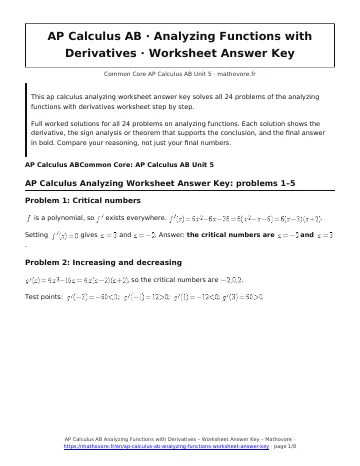
See every chapter on the AP Calculus AB math page.