


This answer key gives a full worked solution for each of the 22 problems, with excluded values stated and every solution of a rational equation checked. Compare your factoring and your final bold answer with these solutions.
Problem 1: Find the excluded values
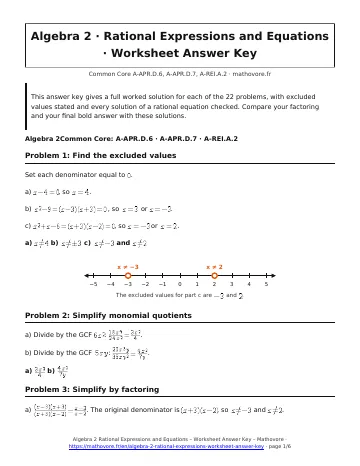
Set each denominator equal to \(0\).
a) \(x-4=0\), so \(x=4\).
b) \(x^{2}-9=(x-3)(x+3)=0\), so \(x=3\) or \(x=-3\).
c) \(x^{2}+x-6=(x+3)(x-2)=0\), so \(x=-3\) or \(x=2\).
a) \(x\neq4\) b) \(x\neq\pm3\) c) \(x\neq-3\) and \(x\neq2\)
Problem 2: Simplify monomial quotients
a) Divide by the GCF \(6x^{2}\): \(\frac{18x^{4}}{24x^{2}}=\frac{3x^{2}}{4}\).
b) Divide by the GCF \(5xy\): \(\frac{20x^{3}y}{35xy^{2}}=\frac{4x^{2}}{7y}\).
a) \(\frac{3x^{2}}{4}\) b) \(\frac{4x^{2}}{7y}\)
Problem 3: Simplify by factoring
a) \(\frac{(x-3)(x+3)}{(x+3)(x-2)}=\frac{x-3}{x-2}\). The original denominator is \((x+3)(x-2)\), so \(x\neq-3\) and \(x\neq2\).
b) \(\frac{(x+2)(x+3)}{(x+1)(x+2)}=\frac{x+3}{x+1}\). The original denominator is \((x+1)(x+2)\), so \(x\neq-1\) and \(x\neq-2\).
a) \(\frac{x-3}{x-2}\), \(x\neq-3,\ 2\) b) \(\frac{x+3}{x+1}\), \(x\neq-2,\ -1\)
Problem 4: Why the graph has a hole
Factor: \(\frac{(x-1)(x+1)}{x+1}=x-1\) for \(x\neq-1\). The factor \(x+1\) cancels, but the original expression is undefined at \(x=-1\), so the line \(y=x-1\) is missing one point.
At \(x=-1\) the line has \(y=-1-1=-2\).
Simplified: \(x-1\). The hole is at \((-1,-2)\).
Problem 5: Opposite factors
a) \(4-x=-(x-4)\), so \(\frac{4-x}{x-4}=-1\) for \(x\neq4\).
b) \(9-x^{2}=(3-x)(3+x)=-(x-3)(x+3)\), so the expression equals \(-(x+3)\) for \(x\neq3\).
a) \(-1\), \(x\neq4\) b) \(-(x+3)=-x-3\), \(x\neq3\)
Problem 6: Multiply rational expressions
a) \(\frac{(x-2)(x+2)}{x+5}\cdot\frac{2(x+5)}{x-2}=2(x+2)\), with \(x\neq-5,\ 2\).
b) \(\frac{x(x+3)}{(x-1)(x+1)}\cdot\frac{x-1}{x}=\frac{x+3}{x+1}\), with \(x\neq0,\ 1,\ -1\).
a) \(2(x+2)\) b) \(\frac{x+3}{x+1}\)
Problem 7: Divide rational expressions
a) Multiply by the reciprocal: \(\frac{(x-3)(x+2)}{x+4}\cdot\frac{(x-4)(x+4)}{x-3}=(x+2)(x-4)\). Excluded: \(x\neq-4,\ 3,\ 4\).
b) \(\frac{6x^{2}}{5y}\cdot\frac{10y^{2}}{3x}=\frac{60x^{2}y^{2}}{15xy}=4xy\), with \(x\neq0,\ y\neq0\).
a) \((x+2)(x-4)\) b) \(4xy\)
Problem 8: Same denominator
a) \(\frac{(3x+1)+(2x-5)}{x+4}=\frac{5x-4}{x+4}\).
b) Distribute the minus sign: \(\frac{5x+2-2x+7}{x-1}=\frac{3x+9}{x-1}=\frac{3(x+3)}{x-1}\).
a) \(\frac{5x-4}{x+4}\) b) \(\frac{3(x+3)}{x-1}\)
Problem 9: Different denominators
a) LCD \(x(x+1)\): \(\frac{2(x+1)+3x}{x(x+1)}=\frac{5x+2}{x(x+1)}\).
b) LCD \(12x^{2}\): \(\frac{5\cdot2x}{12x^{2}}-\frac{1\cdot3}{12x^{2}}=\frac{10x-3}{12x^{2}}\).
a) \(\frac{5x+2}{x(x+1)}\) b) \(\frac{10x-3}{12x^{2}}\)
Problem 10: Binomial denominators
The LCD is \((x-2)(x+3)\). Then \(\frac{4(x+3)-3(x-2)}{(x-2)(x+3)}=\frac{4x+12-3x+6}{(x-2)(x+3)}=\frac{x+18}{(x-2)(x+3)}\).
\(\frac{x+18}{(x-2)(x+3)}\), \(x\neq2,\ -3\)
Problem 11: Factor the denominators first
a) \(x^{2}-9=(x-3)(x+3)\) is the LCD. \(\frac{x-(x+3)}{(x-3)(x+3)}=\frac{-3}{(x-3)(x+3)}\).
b) \(x^{2}-x-6=(x-3)(x+2)\) is the LCD. \(\frac{2+(x-3)}{(x-3)(x+2)}=\frac{x-1}{(x-3)(x+2)}\).
a) \(\frac{-3}{(x-3)(x+3)}\) b) \(\frac{x-1}{(x-3)(x+2)}\)
Problem 12: Rewrite using long division
a) \(x^{2}: x=x\); subtract \(x^{2}+x\) to get \(2x+5\); \(2x: x=2\); subtract \(2x+2\) to get \(3\). So \(x+2+\frac{3}{x+1}\).
b) \(2x^{2}: x=2x\); subtract \(2x^{2}-4x\) to get \(3x-7\); \(3x: x=3\); subtract \(3x-6\) to get \(-1\). So \(2x+3-\frac{1}{x-2}\).
a) \(x+2+\frac{3}{x+1}\) b) \(2x+3-\frac{1}{x-2}\)
Problem 13: Rewrite by inspection
a) \(2x+7=2(x+3)+1\), so \(\frac{2x+7}{x+3}=2+\frac{1}{x+3}\).
b) \(3x-4=3(x-1)-1\), so \(\frac{3x-4}{x-1}=3-\frac{1}{x-1}\).
a) \(2+\frac{1}{x+3}\) b) \(3-\frac{1}{x-1}\)
Problem 14: Solve a proportion-style equation
a) Cross multiply: \(3(x+4)=5x\), so \(3x+12=5x\) and \(x=6\). Check: \(\frac{3}{6}=\frac{1}{2}\) and \(\frac{5}{10}=\frac{1}{2}\).
b) Cross multiply: \(2(x+3)=6(x-1)\), so \(2x+6=6x-6\) and \(x=3\). Check: \(\frac{2}{2}=1\) and \(\frac{6}{6}=1\).
a) \(x=6\) b) \(x=3\)
Problem 15: Rational equation with a quadratic
The LCD is \(2x(x+3)\). Multiply every term: \(2(x+3)+2x=x(x+3)\), so \(4x+6=x^{2}+3x\).
Then \(x^{2}-x-6=0\), so \((x-3)(x+2)=0\) and \(x=3\) or \(x=-2\).
Check \(x=3\): \(\frac{1}{3}+\frac{1}{6}=\frac{1}{2}\). Check \(x=-2\): \(-\frac{1}{2}+1=\frac{1}{2}\).
\(x=3\) or \(x=-2\)
Problem 16: Spot the extraneous solution
Multiply both sides by \(x-3\): \(x^{2}=9\), so \(x=3\) or \(x=-3\).
At \(x=3\) both denominators are \(0\), so \(x=3\) is not allowed. At \(x=-3\): \(\frac{9}{-6}=-\frac{3}{2}\) and \(\frac{9}{-6}=-\frac{3}{2}\), so it works.
\(x=-3\) is the only solution; \(x=3\) is extraneous. The graphs meet only at \((-3,-1.5)\).
Problem 17: Equation with no solution
Multiply by \(x-4\): \(x=4+2(x-4)\), so \(x=2x-4\) and \(x=4\).
But \(x=4\) makes the denominator \(0\), so it is extraneous.
No solution.
Problem 18: Average cost
a) Solve \(\frac{120+8n}{n}=11\). Multiply by \(n\): \(120+8n=11n\), so \(3n=120\) and \(n=40\). Check: \(\frac{120+320}{40}=\frac{440}{40}=11\).
b) \(\frac{120+8n}{n}=\frac{120}{n}+8\). As \(n\) grows, \(\frac{120}{n}\) gets close to \(0\), so \(A(n)\) approaches \(8\).
a) \(40\) hoodies b) \(\$8\) per hoodie
Problem 19: Painting a fence together
Rates: Maya \(\frac{1}{6}\) fence per hour, Jamal \(\frac{1}{3}\). Together: \(\frac{1}{6}+\frac{1}{3}=\frac{1}{t}\).
Multiply by \(6t\): \(t+2t=6\), so \(3t=6\) and \(t=2\). Check: in \(2\) hours Maya paints \(\frac{2}{6}=\frac{1}{3}\) and Jamal paints \(\frac{2}{3}\), a total of \(1\) fence.
\(2\) hours
Problem 20: Fill pipe and drain
The pipe adds \(\frac{1}{4}\) of the tank per hour and the drain removes \(\frac{1}{12}\). So \(\frac{1}{4}-\frac{1}{12}=\frac{1}{t}\).
Multiply by \(12t\): \(3t-t=12\), so \(2t=12\) and \(t=6\).
\(6\) hours
Problem 21: Boat on a river
Time \(=\) distance \(: \) speed. The equation is \(\frac{24}{r+2}+\frac{8}{r-2}=5\).
Multiply by \((r+2)(r-2)\): \(24(r-2)+8(r+2)=5(r^{2}-4)\), so \(32r-32=5r^{2}-20\). Then \(5r^{2}-32r+12=0\), which factors as \((5r-2)(r-6)=0\).
So \(r=\frac{2}{5}\) or \(r=6\). Upstream speed is \(r-2\), which must be positive, so \(r=\frac{2}{5}\) is rejected. Check \(r=6\): \(\frac{24}{8}+\frac{8}{4}=3+2=5\).
\(6\) mph
Problem 22: Decorating the gym
Let \(a\) be Aisha’s time alone. Then \(\frac{1}{6}+\frac{1}{a}=\frac{1}{4}\).
Multiply by \(12a\): \(2a+12=3a\), so \(a=12\). Check: \(\frac{1}{6}+\frac{1}{12}=\frac{2}{12}+\frac{1}{12}=\frac{3}{12}=\frac{1}{4}\).
\(12\) hours
See every chapter on the Algebra 2 math page.