Key takeaway: This algebra 2 probability test answer key gives each solution with grading notes for the nine-item test. Award points as shown, and accept equivalent fractions, decimals and percents. A correct setup with a small arithmetic slip earns most of the credit.
Use this key to score the test out of 20 points. Every solution gives the full reasoning and a scoring guide. Award points per part as described, and require a justification wherever the question asks students to justify.
Algebra 2 Probability Test Answer Key: questions 1–5
1. Sample space of coin flips (2 points)
- \(\{HHH,HHT,HTH,HTT,THH,THT,TTH,TTT\}\): 8 outcomes.
- \(A=\{HHT,HTH,THH\}\), so \(P(A)=\) \(\frac{3}{8}\).
Scoring: 1 point for all 8 outcomes (no repeats or omissions); 1 point for the set \(A\) and the probability.
2. Events from a set of numbers (2 points)
- \(A\) and \(B\): \(\{6,12\}\). \(A\) or \(B\): \(\{2,3,4,6,8,9,10,12\}\).
- \(P(A\text{ or }B)=\frac{8}{12}=\) \(\frac{2}{3}\). \(P(\text{not }A)=\frac{6}{12}=\) \(\frac{1}{2}\).
Scoring: 1 point for both lists; 1 point for both probabilities.
3. Addition rule with a Venn diagram (2 points)
- Choir \(11+6=17\), drama \(9+6=15\): \(P(\text{choir})=\) \(\frac{17}{40}\), \(P(\text{drama})=\) \(\frac{15}{40}=\frac{3}{8}\), \(P(\text{both})=\) \(\frac{6}{40}=\frac{3}{20}\).
- \(\frac{17}{40}+\frac{15}{40}-\frac{6}{40}=\frac{26}{40}=\) \(\frac{13}{20}\). Neither: \(\frac{14}{40}=\) \(\frac{7}{20}\).
Scoring: 1 point for the three probabilities; 1 point for the union (with the subtraction shown) and the probability of neither.
4. Independent or not (2 points)
- \(P(A)P(B)=0.3\cdot 0.6=0.18=P(A\text{ and }B)\), so the events are independent.
- \(P(A|B)=\frac{0.2}{0.6}=\) \(\frac{1}{3}\).
Scoring: 1 point for the product comparison and conclusion; 1 point for the correct conditional probability.
5. Two-way table of lunches (3 points)
- \(\frac{64}{120}=\) \(\frac{8}{15}\).
- The packed lunch row has \(56\) students, \(32\) in 10th: \(\frac{32}{56}=\) \(\frac{4}{7}\).
- \(P(\text{school}\,|\,\text{9th})=\frac{36}{60}=\frac{3}{5}=0.6\), but \(P(\text{school})=\frac{8}{15}\approx 0.533\). The values differ, so the events are not independent.
Scoring: 1 point per part.
Algebra 2 Probability Test Answer Key: questions 6–9
6. Pens without replacement (3 points)
- \(\frac{4}{6}\cdot\frac{3}{5}=\frac{12}{30}=\) \(\frac{2}{5}\).
- Black-white \(\frac{4}{6}\cdot\frac{2}{5}=\frac{8}{30}\) and white-black \(\frac{2}{6}\cdot\frac{4}{5}=\frac{8}{30}\): \(\frac{16}{30}=\) \(\frac{8}{15}\).
- Second white: \(\frac{8}{30}+\frac{2}{30}=\frac{10}{30}=\frac{1}{3}\). Then \(\frac{8/30}{10/30}=\) \(\frac{4}{5}\).
Scoring: 1 point per part; in part c, award the point for \(\frac{4}{5}\) with the correct denominator \(\frac{1}{3}\) shown.
7. Free throws in a row (3 points)
- \(0.8\cdot 0.8=\) 0.64.
- \(0.2\cdot 0.2=\) 0.04.
- \(1-0.04=\) 0.96 (the complement of missing both).
Scoring: 1 point per part.
8. Conditional probability formula (2 points)
- \(P(C|D)=\frac{0.25}{0.60}=\) \(\frac{5}{12}\).
- \(P(D|C)=\frac{0.25}{0.40}=\) 0.625.
Scoring: 1 point per part; the denominator must be the probability of the given event.
9. At least one six (1 point)
\(P(\text{no six on one roll})=\frac{5}{6}\), so \(P(\text{no six in two rolls})=\frac{25}{36}\). Then \(1-\frac{25}{36}=\) \(\frac{11}{36}\).
Scoring: 1 point for \(\frac{11}{36}\) with the complement idea shown.
Scoring summary
20 points: add the points of every question of this algebra 2 probability test answer key.
What are the answers to items 1 to 4?
Three coin flips give 8 outcomes. For the event of exactly two heads, three outcomes qualify, so the probability is \(\frac{3}{8}\). Item 4 finds \(0.3\cdot 0.6=0.18\), which equals the joint, so the events are independent. Give one point for the product and one for the conclusion.
How do you score items 5 to 7?
In the lunch table, credit the correct row or column total as the denominator. The pen tree needs branch products, and the final answer adds the matching branches. For Jamal, \(0.8\cdot 0.8=0.64\). Deduct a point when a student adds 0.8 and 0.8.
What do the final items give?
The conditional item gives \(P(D|C)=\frac{0.25}{0.4}=0.625\) and \(P(C|D)=\frac{0.25}{0.6}\approx 0.417\). For at least one six, \(1-(\frac{5}{6})^{2}=\frac{11}{36}\). A common wrong approach adds \(\frac{1}{6}+\frac{1}{6}\), which double counts the case of two sixes.
How can feedback help students?
Write the name of the rule beside each lost point. Students then see whether they confused independence with exclusivity or divided by the wrong total. Afterward, assign two worksheet problems on that rule, and finish with the quiz.

Printable PDF · Test Answer Key
Algebra 2 Probability: Sample Spaces, Independence and Conditional Probability test answer key
Download the PDF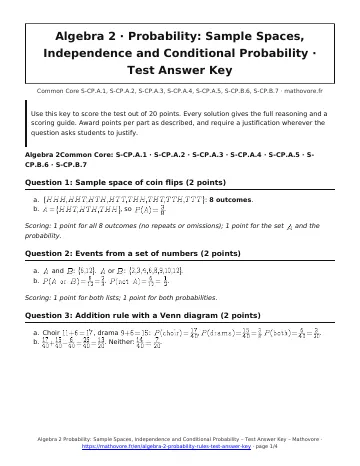
See every chapter on the Algebra 2 math page.