


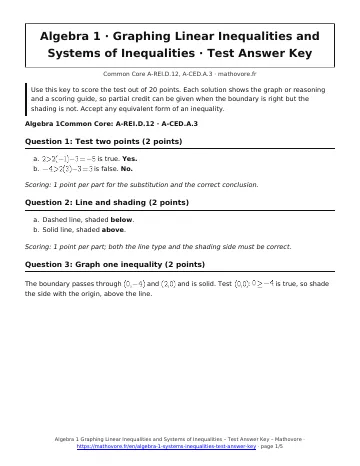
Question 1: Test two points (2 points)
- \(2>2(-1)-3=-5\) is true. Yes.
- \(-4>2(3)-3=3\) is false. No.
Scoring: 1 point per part for the substitution and the correct conclusion.
Question 2: Line and shading (2 points)
- Dashed line, shaded below.
- Solid line, shaded above.
Scoring: 1 point per part; both the line type and the shading side must be correct.
Question 3: Graph one inequality (2 points)
The boundary passes through \((0, -4)\) and \((2, 0)\) and is solid. Test \((0, 0)\): \(0\ge -4\) is true, so shade the side with the origin, above the line.
Scoring: 1 point for the correct solid boundary, 1 point for shading the correct side.
Question 4: Standard form (2 points)
The intercepts are \((4, 0)\) and \((0, 2)\). The boundary is dashed. Test \((0, 0)\): \(0<4\) is true, so shade the side containing the origin.
Scoring: 1 point for the dashed boundary through both intercepts, 1 point for correct shading.
Question 5: Write from a graph (2 points)
The line passes through \((0, 1)\) and \((2, 2)\), so its slope is \(\frac{1}{2}\) and its equation is \(y=\frac{1}{2}x+1\). The line is solid and the shading is below it.
The inequality is \(y\le \frac{1}{2}x+1\).
Scoring: 1 point for the boundary equation, 1 point for the correct symbol.
Question 6: Graph a system (2 points)
\(y=-x+1\) is dashed with shading above. \(y=2x-2\) is solid with shading below. They meet where \(-x+1=2x-2\), so \(x=1\) and \(y=0\). The point \((1, 0)\) is not a solution, because \(0>0\) is false.
Scoring: 1 point for both boundary lines with the correct line types, 1 point for the correct overlapping region.
Question 7: Read a system (2 points)
- The bottom edge is solid with shading above: \(y\ge 1\). The left edge is solid with shading to the right: \(x\ge -1\). The slanted edge \(y=-x+4\) is dashed with shading below: \(y<-x+4\).
- \((1, 2)\): \(2\ge 1\), \(1\ge -1\) and \(2<3\) are true, so yes. \((3, 2)\): \(2<1\) is false, so no.
Scoring: 1 point for all three inequalities correct, 1 point for both decisions.
Question 8: Overlap or not (2 points)
- A solution would need \(2x+1<y<2x-3\), so \(2x+1<2x-3\), which gives \(1<-3\). That is false, so there is no solution: the lines are parallel and the regions do not overlap.
- Both conditions hold only when \(y=3\). The solution set is the horizontal line \(y=3\).
Scoring: 1 point per part for the correct conclusion with a valid reason.
Question 9: Bake sale goal (2 points)
- \(3x+2y\ge 48\)
- \(3(10)+2(9)=30+18=48\), and \(48\ge 48\) is true. Yes, the goal is reached.
Scoring: 1 point for each part.
Question 10: Shirts and caps (2 points)
- \(8x+6y\le 24\), \(x\ge 2\) and \(y\ge 0\).
- 3 shirts and 1 cap: \(8(3)+6(1)=30>24\). Not possible. 2 shirts and 1 cap: \(16+6=22\le 24\) and \(2\ge 2\). Possible.
Scoring: 1 point for the cost inequality and the shirt minimum, 1 point for both decisions.
20 points
See every chapter on the Algebra 1 math page.