Key takeaway: Teachers can grade the nine questions with this algebra 1 factoring test answer key. Each solution shows the working that earns full credit, and every question lists its points, for a total of 20.
Accept factors in any order and accept any correct method. A student who factors \(x^{2}-4x-21\) as \((x+3)(x-7)\) has the same answer as one who writes \((x-7)(x+3)\).
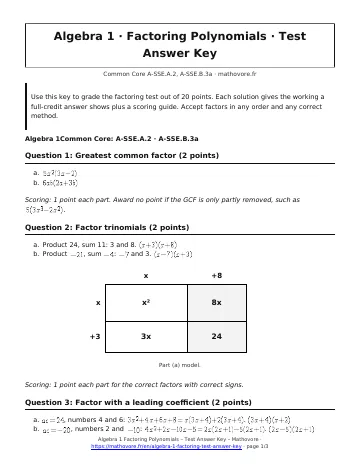
Use this key to grade the factoring test out of 20 points. Each solution gives the working a full-credit answer shows plus a scoring guide. Accept factors in any order and any correct method.
Algebra 1 Factoring Test Answer Key: questions 1–5
1. Greatest common factor (2 points)
- \(5 x^{2} (3 x – 2)\)
- \(6 a b (2 a + 3 b)\)
Scoring: 1 point each part. Award no point if the GCF is only partly removed, such as \(5(3x^{3}-2x^{2})\).
2. Factor trinomials (2 points)
- Product 24, sum 11: 3 and 8. \((x + 3) (x + 8)\)
- Product \(-21\), sum \(-4\): \(-7\) and 3. \((x – 7) (x + 3)\)
Scoring: 1 point each part for the correct factors with correct signs.
3. Factor with a leading coefficient (2 points)
- \(ac=24\), numbers 4 and 6: \(3x^{2}+4x+6x+8=x(3x+4)+2(3x+4)\). \((3 x + 4) (x + 2)\)
- \(ac=-20\), numbers 2 and \(-10\): \(4x^{2}+2x-10x-5=2x(2x+1)-5(2x+1)\). \((2 x – 5) (2 x + 1)\)
Scoring: 1 point each part. Accept the factors in either order.
4. Special patterns (2 points)
- \((7x)^{2}-6^{2}\): \((7 x – 6) (7 x + 6)\)
- \((3x)^{2}+2(3x)(5)+5^{2}\): \((3 x + 5)^{2}\)
Scoring: 1 point each part.
5. Factor by grouping (2 points)
- \(x^{2}(x+5)+2(x+5)\). \((x^{2} + 2) (x + 5)\)
- \(3x^{2}(x-2)-4(x-2)\). \((3 x^{2} – 4) (x – 2)\)
Scoring: 1 point each part. In part (b), the sign of the second group must be changed to factor out \(-4\).
Algebra 1 Factoring Test Answer Key: questions 6–9
6. Factor completely (3 points)
- \(3(x^{2}-16)\): \(3 (x – 4) (x + 4)\)
- \(2x(x^{2}+6x+9)\): \(2 x (x + 3)^{2}\)
- \(ac=-24\), numbers 3 and \(-8\): \(6x^{2}+3x-8x-4=3x(2x+1)-4(2x+1)\). \((3 x – 4) (2 x + 1)\)
Scoring: 1 point each part. Part (a) needs both the GCF and the difference of squares.
7. Zeros and the graph (3 points)
- Product \(-6\), sum \(-1\): \(-3\) and 2. \((x – 3) (x + 2)\)
- \(x-3=0\) or \(x+2=0\), so \(x=3\) or \(x=-2\).
- The x-intercepts are \((-2,0)\) and \((3,0)\).
Scoring: 1 point for each part. In part (c), both coordinates must be given as ordered pairs.
8. Poster dimensions (2 points)
- \(ac=24\), numbers 3 and 8: \(2x^{2}+3x+8x+12=x(2x+3)+4(2x+3)\). \((2 x + 3) (x + 4)\). The length is \(2x+3\) inches.
- Length \(2(5)+3=13\) inches, width \(5+4=9\) inches. Check: \(13\times 9=117\) and \(50+55+12=117\).
Scoring: part (a) 1 point; part (b) 1 point for both values.
9. Is it complete? (2 points)
- Each binomial has a common factor of 2: \(2x-10=2(x-5)\) and \(2x+10=2(x+5)\), so further factoring is possible.
- \(4(x^{2}-25)\) gives \(4 (x – 5) (x + 5)\).
Scoring: 1 point for naming the remaining common factor; 1 point for the complete factorization.
Scoring summary
20 points: add the points of every question of this algebra 1 factoring test answer key.
Which answers does the algebra 1 factoring test answer key expect?
Question 1 gives \(5x^{2}(3x-2)\) and \(6ab(2a+3b)\), with a point per part. Then question 2 gives \((x+3)(x+8)\) and \((x-7)(x+3)\). In question 3, expect \((3x+4)(x+2)\) and \((2x-5)(2x+1)\). Question 4 expects \((7x-6)(7x+6)\) and \((3x+5)^{2}\).
When should graders split the credit?
Question 5 gives \((x+5)(x^{2}+2)\) and \((x-2)(3x^{2}-4)\). If a student groups correctly but forgets the final binomial, give half the credit. Question 6 expects \(3(x-4)(x+4)\), \(2x(x+3)^{2}\) and \((3x-4)(2x+1)\). However, deduct a point if the common factor 3 or 2x is missing.
Meanwhile, question 7 expects \((x-3)(x+2)\), so the zeros are 3 and -2. Likewise, question 8 gives a length of \(2x+3\). Question 9 gives \(4(x-5)(x+5)\), since a 4 can be pulled out first.
What should you reteach after scoring?
If many papers miss question 6, review factoring completely. Meanwhile, if many miss question 3, practice splitting the middle term. As a result, a short targeted lesson can replace a full unit review.
What can the score report tell you?
Sort papers by the first missed question, then make small groups for GCF, trinomials and patterns. Next, give each group three short problems and have them multiply the answers back. Finally, retest with the quiz, which repeats the same skills in a multiple-choice format.

See every chapter on the Algebra 1 math page.