



This ap calculus chain worksheet answer key solves all 24 problems of the chain rule, implicit differentiation and inverse functions worksheet step by step.
Every solution below shows the identification of the outer and inner function or the implicit step, then the arithmetic. Compare the structure of your work, not only the final answer.
AP Calculus Chain Worksheet Answer Key: problems 1–5
Problem 1: Power of a linear function
Outer function \(u^{5}\), inner function \(u=3x+1\). Then \(5(3x+1)^{4}\cdot 3\).
\(15(3x+1)^{4}\)
Problem 2: Square root of a linear function
Write \(y=(4x-7)^{1/2}\). Then \(y^{\prime}=\frac{1}{2}(4x-7)^{-1/2}\cdot 4\).
\(y^{\prime}=\frac{2}{\sqrt{4x-7}}\)
Problem 3: Sine of a multiple
The derivative of the outer function is \(\cos(5x)\) and the inner derivative is \(5\).
\(5\cos(5x)\)
Problem 4: Exponential with a power
Outer \(e^{u}\) stays \(e^{x^{2}}\); inner derivative \(2x\).
\(y^{\prime}=2x\,e^{x^{2}}\)
Problem 5: Log of a quadratic
Outer derivative \(\frac{1}{x^{2}+1}\), inner derivative \(2x\).
\(\frac{2x}{x^{2}+1}\)
AP Calculus Chain Worksheet Answer Key: problems 6–10
Problem 6: Cube of cosine
Think \(y=(\cos x)^{3}\). Then \(y^{\prime}=3(\cos x)^{2}\cdot(-\sin x)\).
\(-3\cos^{2}x\,\sin x\)
Problem 7: Product with a chain
Product rule: \(f^{\prime}(x)=1\cdot(x^{2}+3)^{4}+x\cdot 4(x^{2}+3)^{3}\cdot 2x\).
Factor out \((x^{2}+3)^{3}\): \((x^{2}+3)^{3}[(x^{2}+3)+8x^{2}]\).
\(f^{\prime}(x)=(x^{2}+3)^{3}(9x^{2}+3)\)
Problem 8: Composite from given values
\(h(1)=f(g(1))=f(2)=7\).
\(h^{\prime}(1)=f^{\prime}(g(1))\cdot g^{\prime}(1)=f^{\prime}(2)\cdot 5=(-4)(5)\).
\(h(1)=7,\ h^{\prime}(1)=-20\)
Problem 9: Slope on a circle
- \(2x+2y\frac{dy}{dx}=0\), so \(\frac{dy}{dx}=-\frac{x}{y}\).
- At \((3,4)\) the slope is \(-\frac{3}{4}\). Then \(y-4=-\frac{3}{4}(x-3)\), so \(y=-\frac{3}{4}x+\frac{25}{4}\).
Problem 10: Implicit slope with a mixed term
Check: \(1+2+4=7\). Differentiate: \(2x+y+x\frac{dy}{dx}+2y\frac{dy}{dx}=0\).
Solve: \(\frac{dy}{dx}=-\frac{2x+y}{x+2y}\). At \((1,2)\): \(-\frac{4}{5}\).
\(-\frac{4}{5}\)
AP Calculus Chain Worksheet Answer Key: problems 11–15
Problem 11: Tangent line to a cubic curve
Check: \(1+8=9\). Differentiate: \(3x^{2}+3y^{2}\frac{dy}{dx}=0\), so \(\frac{dy}{dx}=-\frac{x^{2}}{y^{2}}\). At \((1,2)\) the slope is \(-\frac{1}{4}\).
\(y-2=-\frac{1}{4}(x-1)\), or \(y=-\frac{1}{4}x+\frac{9}{4}\).
Problem 12: Product of x and y terms
Check: \(2+8=10\). Differentiate with the product rule: \(2xy+x^{2}\frac{dy}{dx}+3y^{2}\frac{dy}{dx}=0\).
\(\frac{dy}{dx}=-\frac{2xy}{x^{2}+3y^{2}}\). At \((1,2)\): \(-\frac{4}{1+12}\).
\(-\frac{4}{13}\)
Problem 13: Slope of an inverse function
Find \(a\) with \(f(a)=4\): \(f(1)=1+2+1=4\), so \(a=1\).
\(f^{\prime}(x)=3x^{2}+2\), so \(f^{\prime}(1)=5\).
\(g^{\prime}(4)=\frac{1}{f^{\prime}(1)}\) gives \(g^{\prime}(4)=\frac{1}{5}\).
Problem 14: Inverse of an exponential sum
Solve \(f(a)=1\): \(f(0)=1+0=1\), so \(a=0\).
\(f^{\prime}(x)=e^{x}+1\), so \(f^{\prime}(0)=2\).
\((f^{-1})^{\prime}(1)=\frac{1}{2}\)
Problem 15: Arctangent of a multiple
\(\frac{1}{1+(3x)^{2}}\cdot 3\).
\(\frac{3}{1+9x^{2}}\)
AP Calculus Chain Worksheet Answer Key: problems 16–20
Problem 16: Arcsine of a power
\(y^{\prime}=\frac{1}{\sqrt{1-(x^{2})^{2}}}\cdot 2x\).
\(y^{\prime}=\frac{2x}{\sqrt{1-x^{4}}}\)
Problem 17: Second derivative of a polynomial
\(f^{\prime}(x)=4x^{3}-6x+2\), so \(f^{\prime\prime}(x)=12x^{2}-6\).
\(f^{\prime\prime}(2)=12(4)-6=42\).
\(12x^{2}-6=0\) gives \(x^{2}=\frac{1}{2}\), so \(x=\pm\frac{1}{\sqrt{2}}\approx\pm 0.707\). The second derivative changes sign at both values.
Problem 18: Second derivative with a product
\(y^{\prime}=e^{2x}+2xe^{2x}=e^{2x}(1+2x)\).
\(y^{\prime\prime}=2e^{2x}(1+2x)+e^{2x}\cdot 2=e^{2x}(4+4x)\).
\(y^{\prime\prime}=4(1+x)e^{2x}\)
Problem 19: Second derivative on a circle
\(\frac{d^{2}y}{dx^{2}}=-\frac{y-x\frac{dy}{dx}}{y^{2}}\). Substitute \(\frac{dy}{dx}=-\frac{x}{y}\): \(-\frac{y+\frac{x^{2}}{y}}{y^{2}}=-\frac{y^{2}+x^{2}}{y^{3}}=-\frac{25}{y^{3}}\).
At \((3,4)\): \(-\frac{25}{64}\). The negative sign means the circle is concave down at that point.
\(-\frac{25}{64}\)
Problem 20: Town population growth
\(P^{\prime}(t)=1200(0.03)e^{0.03t}=36e^{0.03t}\).
\(P^{\prime}(10)=36e^{0.3}\approx 36(1.34986)\approx 48.6\).
In 2030 the population is growing at about 48.6 residents per year.
AP Calculus Chain Worksheet Answer Key: problems 21–24
Problem 21: Growing balloon
\(\frac{dV}{dt}=4\pi r^{2}\frac{dr}{dt}\) by the chain rule. At \(t=4\): \(r=2+0.5(4)=4\) and \(\frac{dr}{dt}=0.5\).
\(\frac{dV}{dt}=4\pi(16)(0.5)=32\pi\).
\(32\pi\approx 100.5\text{ in}^{3}/\text{s}\)
Problem 22: Composites from a table
\(h^{\prime}(1)=f^{\prime}(g(1))\cdot g^{\prime}(1)=f^{\prime}(2)\cdot g^{\prime}(1)=4\cdot(-1)=-4\).
\(k^{\prime}(3)=g^{\prime}(f(3))\cdot f^{\prime}(3)=g^{\prime}(2)\cdot f^{\prime}(3)=5\cdot(-3)=-15\).
\(h^{\prime}(1)=-4,\ k^{\prime}(3)=-15\)
Problem 23: Choosing the procedure
Product rule with a chain inside: \(f^{\prime}(x)=\frac{1}{x}\sqrt{x^{2}+1}+\ln x\cdot\frac{x}{\sqrt{x^{2}+1}}\).
At \(x=1\), \(\ln 1=0\), so the second term vanishes: \(f^{\prime}(1)=\frac{1}{1}\sqrt{2}\).
\(f^{\prime}(1)=\sqrt{2}\approx 1.414\)
Problem 24: Horizontal tangents on an ellipse
\(2x+8y\frac{dy}{dx}=0\), so \(\frac{dy}{dx}=-\frac{x}{4y}\).
A horizontal tangent needs \(\frac{dy}{dx}=0\), so \(x=0\) (with \(y\neq 0\)). Then \(4y^{2}=20\) and \(y=\pm\sqrt{5}\).
The points are \((0,\sqrt{5})\) and \((0,-\sqrt{5})\).
How to use this ap calculus chain worksheet answer key
Read this ap calculus chain worksheet answer key after trying each problem yourself, and redo any problem you missed.

Printable PDF · Worksheet Answer Key
AP Calculus AB Chain Rule, Implicit Differentiation and Inverse Functions worksheet answer key
Download the PDF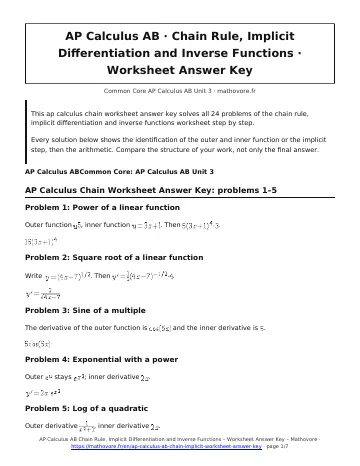
See every chapter on the AP Calculus AB math page.