



This precalculus matrices lesson explains matrices and matrix operations in one printable page, with definitions, a method and a worked example.
A matrix is a rectangular array of numbers in rows and columns that organizes data. Matrices of equal dimensions add entry by entry, any matrix can be scaled, and \(AB\) multiplies rows by columns. A 2 × 2 matrix has an inverse exactly when its determinant \(ad-bc\) is not zero.
Precalculus Matrices Lesson: key facts
- An \(m\times n\) matrix has \(m\) rows and \(n\) columns; entry \(a_{ij}\) sits in row \(i\), column \(j\).
- Add or subtract matrices only when dimensions match; scalar multiplication scales every entry.
- \(AB\) exists when columns of \(A\) equal rows of \(B\), and in general \(AB\neq BA\).
- \(A+O=A\) and \(AI=IA=A\) for the zero matrix \(O\) and identity matrix \(I\).
- For a 2 × 2 matrix, \(\det A=ad-bc\), and \(A^{-1}\) exists exactly when \(\det A\neq 0\).
What is a matrix and how does it organize data?
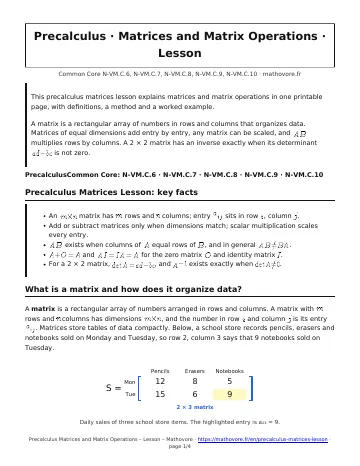
A matrix is a rectangular array of numbers arranged in rows and columns. A matrix with \(m\) rows and \(n\) columns has dimensions \(m\times n\), and the number in row \(i\) and column \(j\) is its entry \(a_{ij}\). Matrices store tables of data compactly. Below, a school store records pencils, erasers and notebooks sold on Monday and Tuesday, so row 2, column 3 says that 9 notebooks sold on Tuesday.
How do you add and scale matrices?
Matrices with the same dimensions add or subtract entry by entry. A scalar multiple \(kA\) multiplies every entry of \(A\) by the number \(k\). For the matrix \(A\) below, \(3A\) has entries 6, \(-3\), 0 and 15.
The zero matrix \(O\) has every entry 0, so \(A+O=A\). The identity matrix \(I\) has 1s on the main diagonal and 0s elsewhere, so \(AI=IA=A\).
How do you multiply matrices?
The product \(AB\) exists only when the number of columns of \(A\) equals the number of rows of \(B\). An \(m\times n\) matrix times an \(n\times p\) matrix is an \(m\times p\) matrix. Entry \(c_{ij}\) comes from row \(i\) of \(A\) and column \(j\) of \(B\): multiply matching entries, then add.
Matrix multiplication is not commutative: \(AB\) and \(BA\) usually differ, and one may exist when the other does not. It is distributive, so \(A(B+C)=AB+AC\).
How do you find the determinant and inverse of a 2 × 2 matrix?
For a matrix with top row \(a,b\) and bottom row \(c,d\), the determinant is \(\det A=ad-bc\). The inverse \(A^{-1}\) satisfies \(AA^{-1}=A^{-1}A=I\). It exists exactly when \(\det A\neq 0\).
- Compute \(ad-bc\). If it is 0, there is no inverse.
- Swap \(a\) and \(d\), and change the signs of \(b\) and \(c\).
- Multiply every entry by \(\frac{1}{\det A}\).
- Check that \(AA^{-1}=I\).
Example: for \(D\) with top row 4, 3 and bottom row 2, 2, \(\det D=4\cdot 2-3\cdot 2=2\), so the inverse exists.
Matrices and Matrix Operations: frequently asked questions
What is a matrix used for?
A matrix organizes data, such as sales by day and item, so it can be added, scaled or combined with another table. Multiplying a sales matrix by a price matrix, for example, gives total revenue for each day in one step.
When can you multiply two matrices?
You can multiply \(AB\) only when the number of columns in \(A\) equals the number of rows in \(B\). A \(2\times 3\) matrix times a \(3\times 4\) matrix is a \(2\times 4\) matrix, but a \(2\times 3\) times a \(2\times 3\) is not defined.
Why is matrix multiplication not commutative?
Row-by-column products depend on which matrix supplies the rows. Swapping the order changes which entries pair up, so \(AB\) and \(BA\) often differ. Counterexamples with two \(2\times 2\) matrices show this.
How do you know if a 2 × 2 matrix has an inverse?
Compute the determinant \(ad-bc\). If it is not zero, the inverse exists and equals \(\frac{1}{ad-bc}\) times the matrix with \(a\) and \(d\) swapped and \(b\), \(c\) negated. If it is zero, there is no inverse.
What do the zero and identity matrices do?
The zero matrix \(O\) acts like 0: \(A+O=A\) and \(AO=O\). The identity matrix \(I\) acts like 1: \(AI=IA=A\). Both must have dimensions that match \(A\).
How to use this precalculus matrices lesson
Use this precalculus matrices lesson before the worksheet, then check what you learned with the quiz.

See every chapter on the Precalculus math page.