Key takeaway: This algebra 2 polynomial division worksheet gives 22 printable problems on long division, synthetic division, the Remainder and Factor Theorems and polynomial identities. Problems 1 to 6 use long division, problems 7 to 12 use synthetic division and remainders, and problems 13 to 22 mix factoring, identities and word problems. Standards A-APR.B.2 through A-APR.C.4 apply. Plan about 55 minutes.
These 22 problems practice dividing polynomials with long division and synthetic division, using the Remainder Theorem and the Factor Theorem, and proving polynomial identities (A-APR.B.2, A-APR.D.6, A-APR.C.4).
The problems start with simple quotients, move to cubics and quartics, and end with word problems about boxes, profit, and gardens. Show every step of each division.
Algebra 2 Polynomial Division Worksheet: problems 1–5
1. Divide by a monomial
Divide.
- \((12x^{3}-8x^{2}+20x): 4x\)
- \((9x^{4}+6x^{3}-15x^{2}): 3x^{2}\)
2. Missing side of a rectangle
The rectangle has area \(x^{2}+7x+12\) and one side of length \(x+3\). Find the length of the other side.
3. Long division, zero remainder
Divide using long division.
- \((x^{2}-5x-14): (x+2)\)
- \((x^{2}+11x+28): (x+4)\)
4. Long division with a remainder
Divide. Write each answer in the form quotient \(+\) remainder over divisor.
- \((x^{2}+3x-2): (x-1)\)
- \((x^{2}-6x+4): (x-3)\)
5. Cubic by long division
Divide \(x^{3}+4x^{2}-3x-18\) by \(x-2\) using long division.
Algebra 2 Polynomial Division Worksheet: problems 6–10
6. Division with missing terms
Rewrite each dividend with zero coefficients for the missing powers, then divide.
- \((x^{3}-8): (x-2)\)
- \((x^{3}+27): (x+3)\)
7. Fill in a synthetic division table
The table sets up synthetic division of \(x^{3}-6x^{2}+11x-6\) by \(x-1\). Complete the table and write the quotient and the remainder.
8. Synthetic division with a remainder
Use synthetic division to divide \(2x^{3}-5x^{2}+x+7\) by \(x-3\).
9. Divide by x plus a number
Use synthetic division. Remember that \(x+2\) means \(c=-2\).
- \((x^{3}+5x^{2}-2x-24): (x+2)\)
- \((x^{4}-3x^{2}+x+5): (x+1)\)
10. Remainder Theorem
Let \(p(x)=x^{3}-4x^{2}+2x+5\). Use the Remainder Theorem to find the remainder when \(p(x)\) is divided by each divisor. Do not divide.
- \(x-3\)
- \(x+1\)
- \(x-2\)
Algebra 2 Polynomial Division Worksheet: problems 11–15
11. Use the Factor Theorem
Let \(f(x)=x^{3}-3x^{2}-10x+24\). Decide whether each expression is a factor of \(f(x)\). Justify each answer.
- \(x-2\)
- \(x-3\)
- \(x+3\)
12. Find the missing coefficient
Find the value of \(k\) so that \(x-2\) is a factor of \(x^{3}+kx^{2}-4x-12\).
13. Divide by a binomial with leading coefficient 2
Divide using long division.
- \((6x^{2}+x-12): (2x+3)\)
- \((4x^{2}-4x+5): (2x-1)\)
14. Write the division statement
Divide \(p(x)=3x^{3}+2x^{2}-x+4\) by \(x+1\). Then write \(p(x)\) in the form \(d(x)q(x)+r\).
15. Factor a cubic from its graph
The graph of \(f(x)=x^{3}-2x^{2}-5x+6\) shows that \(x=1\) is a zero. Use synthetic division to factor \(f(x)\) completely and list all zeros.
Algebra 2 Polynomial Division Worksheet: problems 16–20
16. Find the remaining zeros
Given that \(x=-1\) and \(x=2\) are zeros of \(g(x)=x^{4}-2x^{3}-7x^{2}+8x+12\), find the other two zeros.
17. Verify a polynomial identity
Show that \((x^{2}+y^{2})^{2}=(x^{2}-y^{2})^{2}+(2xy)^{2}\) for all \(x\) and \(y\) by expanding both sides.
18. Pythagorean triples from the identity
The triangle has legs \(2xy\) and \(x^{2}-y^{2}\) and hypotenuse \(x^{2}+y^{2}\). Let \(x=3\) and \(y=2\).
- Find the three side lengths.
- Show that they satisfy the Pythagorean Theorem.
- Find the three side lengths when \(x=5\) and \(y=2\).
19. Height of a storage box
The volume of a storage box is \(V(x)=x^{3}+9x^{2}+26x+24\) cubic feet. The length is \(x+4\) feet and the width is \(x+2\) feet.
- Find an expression for the height.
- Find the dimensions and the volume when \(x=3\).
20. Break-even points
Mei models the profit from printing T-shirts for the school store with \(P(x)=x^{3}-10x^{2}+31x-30\), in hundreds of dollars, where \(x\) is the number of shirts in hundreds. The store breaks even when \(P(x)=0\), and \(x=2\) is one break-even point. Find the other break-even points.
Algebra 2 Polynomial Division Worksheet: problems 21–22
21. Find two unknown coefficients
When \(p(x)=x^{3}+ax^{2}+bx-6\) is divided by \(x-1\), the remainder is \(0\). When it is divided by \(x+1\), the remainder is \(-10\). Find \(a\) and \(b\).
22. Garden dimensions
The area of Aisha’s rectangular garden is \(A(x)=2x^{3}+7x^{2}-5x-4\) square feet, and its width is \(2x+1\) feet.
- Find an expression for the length.
- Factor the length completely.
- Find the length, width, and area when \(x=3\).

How do the long division problems progress?
Problem 1 divides by a monomial, so each term splits on its own. Next, a rectangle with area \(x^{2}+7x+12\) and one side \(x+3\) asks for the missing side. Problem 6 hides zero coefficients in \(x^{3}-8\). Write them in before you start. Problem 13 raises the stakes with divisors such as \(2x+3\), where the leading coefficient is not 1.
Where do students slip with synthetic division?
The classic slip is the sign of \(c\). In problem 9, \(x+2\) means \(c=-2\), not 2. Another slip is skipping a missing power in a quartic. Likewise, problem 7 gives an incomplete table for \(x^{3}-6x^{2}+11x-6\), so fill each row and read the quotient from the bottom. A final zero means the divisor is a factor.
What do the theorem and application problems add?
Problem 12 finds \(k\) so that \(x-2\) is a factor. Problem 16 gives two zeros of a quartic, so divide twice. Meanwhile, problem 18 sets \(x=3\) and \(y=2\) in the identity, which produces a 5-12-13 triangle. Finally, the garden and storage box problems turn volume and area into missing dimensions.
How do you finish strong?
Multiply back at least three quotients to confirm they reproduce the dividend. Afterward, mark problems where your sign of \(c\) was wrong. Then use the answer key and move on to the unit test.

Printable PDF · Worksheet
Algebra 2 Polynomial Division and the Remainder Theorem worksheet
Download the PDF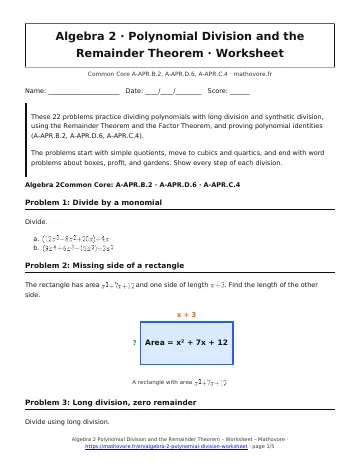
See every chapter on the Algebra 2 math page.