
This geometry foundations lesson explains points, lines, planes, segments and angles in one printable page, with definitions, a method and a worked example.
Geometry builds on three undefined terms: point, line and plane. A segment has two endpoints, a ray has one, and an angle is two rays with a common vertex. The Segment Addition and Angle Addition Postulates let you add parts to find a whole, and angle pairs give equations to solve.
Geometry Foundations Lesson: key facts
- Point, line and plane are undefined terms; all other figures are defined from them.
- Segment Addition Postulate: if B is between A and C, then AB + BC = AC.
- Angle Addition Postulate: if D is inside angle ABC, the two smaller angles add to angle ABC.
- Complementary angles add to 90 degrees; supplementary angles and linear pairs add to 180 degrees.
- Vertical angles are congruent.
What are the undefined terms of geometry?
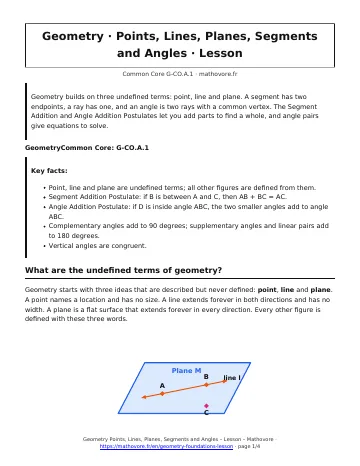
Geometry starts with three ideas that are described but never defined: point, line and plane. A point names a location and has no size. A line extends forever in both directions and has no width. A plane is a flat surface that extends forever in every direction. Every other figure is defined with these three words.
How are segments, rays, angles, circles and perpendicular lines defined?
Line segment: two endpoints and all points of the line between them. Ray: a point on a line (the endpoint) and all points extending in one direction.
Angle: two rays with the same endpoint, called the vertex. Circle: the set of all points in a plane that are the same distance from a given point, the center.
Parallel lines: lines in the same plane that never intersect. Perpendicular lines: lines that intersect to form a right angle.
What are the Segment Addition and Angle Addition Postulates?
If point B is between A and C, then \(AB+BC=AC\). If ray BD lies inside \(\angle ABC\), then \(m\angle ABD+m\angle DBC=m\angle ABC\). A midpoint splits a segment into two congruent segments. A bisector splits a segment or an angle into two congruent parts.
Which angle pairs can you name and measure?
| Pair | Definition | Measures |
|---|---|---|
| Complementary | two angles whose measures add to \(90^{\circ}\) | \(m\angle 1+m\angle 2=90^{\circ}\) |
| Supplementary | two angles whose measures add to \(180^{\circ}\) | \(m\angle 1+m\angle 2=180^{\circ}\) |
| Linear pair | adjacent angles whose outer sides are opposite rays | supplementary |
| Vertical angles | opposite angles formed by two intersecting lines | congruent |
How do you find a missing angle with algebra?
- Name the relationship (linear pair, vertical, complementary or an addition postulate).
- Write the equation that relationship gives.
- Solve for the variable.
- Substitute to find each measure and check.
Worked example. Angles 1 and 2 form a linear pair with \(m\angle 1=(2x+30)^{\circ}\) and \(m\angle 2=(3x+10)^{\circ}\). Then \(5x+40=180\), so \(x=28\). Angle 1 measures \(86^{\circ}\), angle 2 measures \(94^{\circ}\), and \(86+94=180\).
Points, Lines, Planes, Segments and Angles: frequently asked questions
What is the difference between a line, a segment and a ray?
A line extends forever in both directions, a ray has one endpoint and extends forever in one direction, and a segment has two endpoints and a fixed length. Only a segment can be measured.
How do you use the Segment Addition Postulate?
When B is between A and C, add the two smaller parts to get the whole: \(AB+BC=AC\). If the whole and one part are known, subtract to find the other part.
What is the difference between complementary and supplementary angles?
Complementary angles add to \(90^{\circ}\) and supplementary angles add to \(180^{\circ}\). Neither pair has to be adjacent. A linear pair is a supplementary pair that is also adjacent.
Are vertical angles always congruent?
Yes. When two lines intersect, each pair of opposite angles has the same measure. Both angles are supplementary to the same neighbor, which is the idea behind the Vertical Angles Theorem.
What is the difference between a midpoint and a bisector?
A midpoint is a single point at the center of a segment. A bisector is a point, line, ray or segment that cuts a segment or an angle into two congruent parts.
How to use this geometry foundations lesson
Use this geometry foundations lesson before the worksheet, then check what you learned with the quiz.

See every chapter on the Geometry math page.