This algebra 1 solving worksheet answer key solves all 27 problems of the solving quadratic equations worksheet step by step.
Each solution shows the method, the key computation and the final answer in bold. For word problems, check every solution against the situation and reject any that cannot happen, such as a negative length.
Algebra 1 Solving Worksheet Answer Key: problems 1–5
Problem 1: Standard form
- Subtract \(5x\) and add 2: \(3x^{2}-5x+2=0\), so \(a=3\), \(b=-5\), \(c=2\).
- Distribute: \(x^{2}+4x=21\). Subtract 21: \(x^{2}+4x-21=0\), so \(a=1\), \(b=4\), \(c=-21\).
Problem 2: Perfect-square roots
- \(x=\pm\sqrt{81}\). \(x=9\) or \(x=-9\).
- Add 11: \(x^{2}=36\). \(x=6\) or \(x=-6\). Check: \(36-11=25\).
Problem 3: Square roots, not perfect
- \(x=\pm\sqrt{20}=\pm 2\sqrt{5}\approx\pm 4.47\). \(x=\pm 2\sqrt{5}\).
- Divide by 3: \(x^{2}=25\). \(x=\pm 5\).
Problem 4: Square both sides back
Take square roots: \(x-3=\pm 4\). Then \(x=3+4=7\) or \(x=3-4=-1\). \(x=7\) or \(x=-1\).
Check: \((7-3)^{2}=16\) and \((-1-3)^{2}=16\). Both points are 4 units from 3.
Problem 5: Square roots with a shift
\(x+2=\pm\sqrt{10}\), so \(x=-2\pm\sqrt{10}\).
With \(\sqrt{10}\approx 3.162\): \(x\approx 1.16\) or \(x\approx -5.16\).
Algebra 1 Solving Worksheet Answer Key: problems 6–10
Problem 6: Zero-product property
Set each factor to 0: \(x-4=0\) or \(x+7=0\). \(x=4\) or \(x=-7\).
Problem 7: Factor a trinomial
Find two numbers with product 20 and sum 9: 4 and 5. So \((x+4)(x+5)=0\).
\(x=-4\) or \(x=-5\). Check: \(16-36+20=0\).
Problem 8: Negative constant
Two numbers with product \(-28\) and sum \(-3\): \(-7\) and 4. So \((x-7)(x+4)=0\).
\(x=7\) or \(x=-4\). Check: \(49-21-28=0\).
Problem 9: Common factor
- Factor out \(x\): \(x(x-6)=0\). \(x=0\) or \(x=6\).
- \(x(x+8)=0\). \(x=0\) or \(x=-8\).
Do not divide by \(x\): that would lose the solution \(x=0\).
Problem 10: Rearrange first
Move every term to the left: \(x^{2}-2x-15=0\). Factor: \((x-5)(x+3)=0\).
\(x=5\) or \(x=-3\). Check \(x=-3\): \(9=-6+15\).
Algebra 1 Solving Worksheet Answer Key: problems 11–15
Problem 11: Leading coefficient 2
Split the middle term: \(2x^{2}+6x+x+3=2x(x+3)+1(x+3)=(2x+1)(x+3)\).
\(2x+1=0\) gives \(x=-\frac{1}{2}\), and \(x+3=0\) gives \(x=-3\). \(x=-\frac{1}{2}\) or \(x=-3\).
Problem 12: Solve from a graph
The solutions are the x-intercepts: \(x=-2\) and \(x=4\).
Factoring: \((x-4)(x+2)=0\), so \(x=4\) or \(x=-2\). The graph and the algebra agree. The lowest point is \((1, -9)\), halfway between the zeros.
Problem 13: Complete the square
Subtract 5: \(x^{2}+6x=-5\). Add \(3^{2}=9\): \(x^{2}+6x+9=4\), so \((x+3)^{2}=4\).
\(x+3=\pm 2\). \(x=-1\) or \(x=-5\).
Problem 14: Irrational solutions
\(x^{2}-8x=-3\). Add \((-4)^{2}=16\): \((x-4)^{2}=13\).
\(x=4\pm\sqrt{13}\), so \(x\approx 7.61\) or \(x\approx 0.39\).
Problem 15: Odd middle coefficient
\(x^{2}+5x=2\). Half of 5 is \(\frac{5}{2}\), and its square is \(\frac{25}{4}\). So \(x^{2}+5x+\frac{25}{4}=2+\frac{25}{4}=\frac{33}{4}\).
\((x+\frac{5}{2})^{2}=\frac{33}{4}\), so \(x=\frac{-5\pm\sqrt{33}}{2}\). \(x\approx 0.37\) or \(x\approx -5.37\).
Algebra 1 Solving Worksheet Answer Key: problems 16–20
Problem 16: Divide first
Divide by 2: \(x^{2}-6x+5=0\), so \(x^{2}-6x=-5\). Add 9: \((x-3)^{2}=4\).
\(x-3=\pm 2\). \(x=5\) or \(x=1\). Check: \(50-60+10=0\).
Problem 17: Use the formula
\(a=2\), \(b=-5\), \(c=-3\). \(b^{2}-4ac=25+24=49\).
\(x=\frac{5\pm 7}{4}\). \(x=3\) or \(x=-\frac{1}{2}\).
Problem 18: Formula with a radical
\(b^{2}-4ac=16+12=28\), and \(\sqrt{28}=2\sqrt{7}\).
\(x=\frac{4\pm 2\sqrt{7}}{2}=2\pm\sqrt{7}\). \(x\approx 4.65\) or \(x\approx -0.65\).
Problem 19: Formula, a not 1
\(a=3\), \(b=-4\), \(c=-2\). \(b^{2}-4ac=16+24=40\).
\(x=\frac{4\pm\sqrt{40}}{6}=\frac{2\pm\sqrt{10}}{3}\). \(x\approx 1.72\) or \(x\approx -0.39\).
Problem 20: Discriminant and graph
The parabola never touches the x-axis, so there are no real solutions.
Discriminant: \(b^{2}-4ac=(-2)^{2}-4(1)(3)=4-12=-8 < 0\). A negative discriminant means no real solutions.
Algebra 1 Solving Worksheet Answer Key: problems 21–25
Problem 21: Find k
One solution means \(b^{2}-4ac=0\): \(36-4k=0\), so \(k=9\).
Then \(x^{2}+6x+9=(x+3)^{2}=0\) gives \(x=-3\).
Problem 22: Rectangle area
\(w(w+3)=70\), so \(w^{2}+3w-70=0\). Factor: \((w+10)(w-7)=0\).
\(w=-10\) is rejected because a width cannot be negative. So \(w=7\) and the length is \(7+3=10\).
7 ft by 10 ft. Check: \(7\times 10=70\).
Problem 23: Stone from a cliff
- Set \(h=0\): \(-16(t^{2}-2t-3)=0\), so \(-16(t-3)(t+1)=0\). \(t=-1\) is rejected because time cannot be negative. \(t=3\) seconds.
- Set \(h=48\): \(-16t^{2}+32t=0\), so \(-16t(t-2)=0\). \(t=0\) and \(t=2\) seconds: the launch and the return to ledge height.
Problem 24: Consecutive integers
Let the integers be \(n\) and \(n+1\). \(n(n+1)=156\), so \(n^{2}+n-156=0\). Factor: \((n+13)(n-12)=0\).
\(n=12\) gives 12 and 13. \(n=-13\) gives \(-13\) and \(-12\), whose product is also 156, so \(-13\) and \(-12\) is the other pair, but it is not positive.
Problem 25: Garden border
The outer rectangle is \((12+2x)\) by \((8+2x)\). \((12+2x)(8+2x)=192\), so \(4x^{2}+40x+96=192\) and \(4x^{2}+40x-96=0\). Divide by 4: \(x^{2}+10x-24=0\), so \((x+12)(x-2)=0\).
\(x=-12\) is rejected. \(x=2\) feet. Check: \(16\times 12=192\).
Algebra 1 Solving Worksheet Answer Key: problems 26–27
Problem 26: School play tickets
- \(200x-10x^{2}=1000\), so \(x^{2}-20x+100=0\), or \((x-10)^{2}=0\). \(x=10\): a price of \(\$10\), with 100 tickets sold. This is the only price, because it is the maximum.
- \(200x-10x^{2}=1200\) gives \(x^{2}-20x+120=0\). \(D=400-480=-80 < 0\). No: \(\$1{,}200\) is never reached.
Problem 27: Find the error
The zero-product property only applies when the product is 0. Here the product is 14, so the factors do not have to equal 14.
Correct work: \(x^{2}-5x-14=0\), so \((x-7)(x+2)=0\). \(x=7\) or \(x=-2\). Check \(x=7\): \(49-35=14\).
How to use this algebra 1 solving worksheet answer key
Read this algebra 1 solving worksheet answer key after trying each problem yourself, and redo any problem you missed.

Printable PDF · Worksheet Answer Key
Algebra 1 Solving Quadratic Equations worksheet answer key
Download the PDF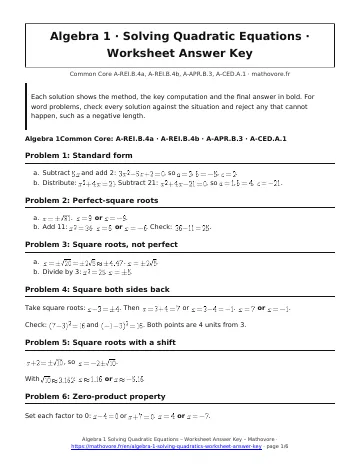
See every chapter on the Algebra 1 math page.