Key takeaway: This algebra 1 sequences test has nine questions worth 20 points on arithmetic and geometric sequences. It takes about 40 minutes and supports code F-LE.A.2. Students classify sequences, write explicit and recursive formulas, read a table and a graph, and solve a short growth model. A scoring guide with a separate key is available.
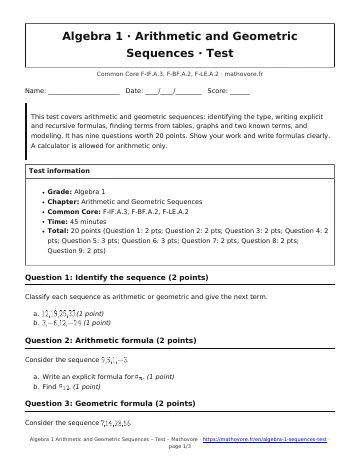
This test covers arithmetic and geometric sequences: identifying the type, writing explicit and recursive formulas, finding terms from tables, graphs and two known terms, and modeling. It has nine questions worth 20 points. Show your work and write formulas clearly. A calculator is allowed for arithmetic only.
- Grade: Algebra 1
- Chapter: Arithmetic and Geometric Sequences
- Common Core: F-IF.A.3, F-BF.A.2, F-LE.A.2
- Time: 45 minutes
- Total: 20 points (Question 1: 2 pts; Question 2: 2 pts; Question 3: 2 pts; Question 4: 2 pts; Question 5: 3 pts; Question 6: 3 pts; Question 7: 2 pts; Question 8: 2 pts; Question 9: 2 pts)
Algebra 1 Sequences Test: questions 1–5
1. Identify the sequence (2 points)
Classify each sequence as arithmetic or geometric and give the next term.
- \(12,19,26,33\) (1 point)
- \(3,-6,12,-24\) (1 point)
2. Arithmetic formula (2 points)
Consider the sequence \(9,5,1,-3\).
- Write an explicit formula for \(a_{n}\). (1 point)
- Find \(a_{12}\). (1 point)
3. Geometric formula (2 points)
Consider the sequence \(7,14,28,56\).
- Write an explicit formula for \(a_{n}\). (1 point)
- Find \(a_{9}\). (1 point)
4. Recursive formulas (2 points)
- Write a recursive formula for the sequence \(100,85,70,55\). (1 point)
- A sequence has \(a_{1}=2\) and \(a_{n}=5\cdot a_{n-1}\). Find \(a_{4}\). (1 point)
5. Sequence from a table (3 points)
The table shows the first four terms of an arithmetic sequence.
- Find the common difference. (1 point)
- Write an explicit formula for \(a_{n}\). (1 point)
- Which term of the sequence equals 140? (1 point)
Algebra 1 Sequences Test: questions 6–9
6. Sequence from a graph (3 points)
The graph shows the first four terms of a geometric sequence.
- Find the common ratio. (1 point)
- Write an explicit formula for \(a_{n}\). (1 point)
- Find \(a_{7}\). (1 point)
7. Arithmetic from two terms (2 points)
An arithmetic sequence has \(a_{4}=19\) and \(a_{9}=44\).
- Find the common difference. (1 point)
- Write an explicit formula for \(a_{n}\). (1 point)
8. Geometric from two terms (2 points)
A geometric sequence has a positive common ratio, \(a_{2}=12\) and \(a_{4}=48\).
- Find the common ratio. (1 point)
- Find \(a_{6}\). (1 point)
9. Growing plant (2 points)
Noah’s plant is 4 inches tall in week 1 and grows 1.5 inches each week. Let \(a_{n}\) be its height in week \(n\).
- Write an explicit formula and find the height in week 9. (1 point)
- In which week is the plant first taller than 30 inches? (1 point)

What is on the algebra 1 sequences test?
Question 1 mixes \(12,19,26,33\) with \(3,-6,12,\dots\), so students must name each type. Questions 2 to 4 ask for formulas from \(9,5,1,-3\), \(7,14,28,56\) and \(100,85,70,55\). Next, questions 5 and 6 move to a table and a graph worth 3 points each.
How should you pace an arithmetic and geometric sequences test?
Spend about two minutes on question 1. Then give the 3-point items more time, because they have several parts. Questions 7 and 8 use two known terms. In question 7, \(a_{4}=19\) and \(a_{9}=44\) are five steps apart. In question 8, \(a_{2}=12\) and \(a_{4}=48\) give \(r^{2}=4\), and the test says r is positive.
What mistakes cost points?
- Writing \(a_{n}=a_{1}+nd\) without \(n-1\).
- Using a negative ratio when the problem says positive.
- Leaving out units in the plant-growth question 9.
How can you prepare before the test?
First, build one explicit and one recursive rule for each sequence type. Then solve two puzzles from two known terms. Finally, time yourself on questions 1 to 4 and review every sign slip.

See every chapter on the Algebra 1 math page.