
This algebra 1 exponents radicals lesson explains exponent rules, radicals and rational exponents in one printable page, with definitions, a method and a worked example.
A rational exponent writes a root as a power: \(x^{1/n}\) is the \(n\)th root of \(x\), and \(x^{m/n}\) means take the \(n\)th root, then raise to the \(m\)th power. All integer exponent rules still hold for these new exponents, so \(8^{2/3}=4\) and \(\sqrt{72}=6\sqrt{2}\).
Algebra 1 Exponents Radicals Lesson: key facts
- Product rule: \(x^{m}\cdot x^{n}=x^{m+n}\); quotient rule: subtract the exponents.
- Power of a power: multiply the exponents, \((x^{m})^{n}=x^{mn}\).
- \(x^{0}=1\) and \(x^{-n}=\frac{1}{x^{n}}\) for \(x\neq 0\).
- \(x^{m/n}=(\sqrt[n]{x})^{m}\): root in the denominator, power in the numerator.
- Simplify a square root by pulling out the largest perfect square factor.
What are the rules for integer exponents?
An exponent tells how many times a base is used as a factor. In \(x^{5}\), the base is \(x\) and the exponent is 5. Every rule below comes from counting factors. Assume \(x\neq 0\) and \(y\neq 0\).
| Rule | Pattern | Example |
|---|---|---|
| Product | \(x^{m}\cdot x^{n}=x^{m+n}\) | \(x^{3}\cdot x^{4}=x^{7}\) |
| Quotient | \(\frac{x^{m}}{x^{n}}=x^{m-n}\) | \(\frac{x^{9}}{x^{5}}=x^{4}\) |
| Power of a power | \((x^{m})^{n}=x^{mn}\) | \((x^{2})^{5}=x^{10}\) |
| Power of a product | \((xy)^{n}=x^{n}y^{n}\) | \((3x)^{2}=9x^{2}\) |
| Zero exponent | \(x^{0}=1\) | \(7^{0}=1\) |
| Negative exponent | \(x^{-n}=\frac{1}{x^{n}}\) | \(2^{-3}=\frac{1}{8}\) |
Why is \(x^{0}=1\)? Look at the powers of 2 and keep dividing by 2. The pattern continues past 1 without a break.
What does a rational exponent mean?
\(x^{1/n}=\sqrt[n]{x}\), the number whose \(n\)th power is \(x\).
\(x^{m/n}=(\sqrt[n]{x})^{m}=\sqrt[n]{x^{m}}\). The denominator is the root, the numerator is the power.
This definition keeps the power rules working: \((x^{1/2})^{2}=x^{1}\), so \(x^{1/2}\) must be a number that squares to \(x\).
Example. \(8^{2/3}=(\sqrt[3]{8})^{2}=2^{2}=4\). Take the root first; the numbers stay small.
How do you simplify a square root?
- Find the largest perfect square that divides the number under the root.
- Split the root: \(\sqrt{ab}=\sqrt{a}\cdot\sqrt{b}\).
- Replace the root of the perfect square with its value and keep what is left under the root.
Worked example. \(\sqrt{72}=\sqrt{36\cdot 2}=\sqrt{36}\cdot\sqrt{2}=6\sqrt{2}\). Check: \(6\sqrt{2}\approx 8.49\) and \(\sqrt{72}\approx 8.49\).
With variables that are positive, an even power comes out whole: \(\sqrt{x^{6}}=x^{3}\). The graph of \(y=x^{1/2}\) shows how slowly square roots grow.
Exponent Rules, Radicals and Rational Exponents: frequently asked questions
What is a number to the zero power?
Any nonzero number to the zero power equals 1. The pattern \(2^{3}=8\), \(2^{2}=4\), \(2^{1}=2\) divides by 2 each step, so the next value is \(2^{0}=1\). The expression \(0^{0}\) is left undefined in Algebra 1.
What does a negative exponent mean?
A negative exponent means a reciprocal, not a negative number. For example, \(5^{-2}=\frac{1}{5^{2}}=\frac{1}{25}\). Move the base across the fraction bar and the exponent becomes positive.
How do you write a radical as a rational exponent?
Put the index of the root in the denominator and the power inside the root in the numerator. So \(\sqrt[3]{x^{5}}=x^{5/3}\) and \(\sqrt{y}=y^{1/2}\).
When do you add exponents and when do you multiply them?
Add exponents when multiplying powers with the same base: \(x^{2}\cdot x^{3}=x^{5}\). Multiply exponents when raising a power to a power: \((x^{2})^{3}=x^{6}\).
How do you know a square root is fully simplified?
No perfect square larger than 1 divides the number under the root, and no fraction or root is left in a denominator. \(5\sqrt{2}\) is simplified, but \(\sqrt{50}\) is not because 25 divides 50.
How to use this algebra 1 exponents radicals lesson
Use this algebra 1 exponents radicals lesson before the worksheet, then check what you learned with the quiz.

Printable PDF · Lesson
Algebra 1 Exponent Rules, Radicals and Rational Exponents lesson
Download the PDF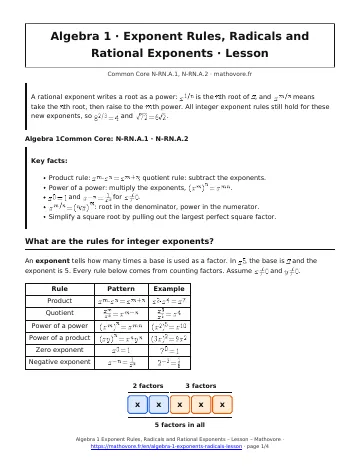
- Exponent Rules, Radicals and Rational Exponents worksheet (25 problems)
- Exponent Rules, Radicals and Rational Exponents quiz (10 questions)
- Exponent Rules, Radicals and Rational Exponents test (45 minutes)
- Previous lesson: Graphing Linear Inequalities and Systems of Inequalities
- Next lesson: Exponential Growth and Decay
See every chapter on the Algebra 1 math page.