


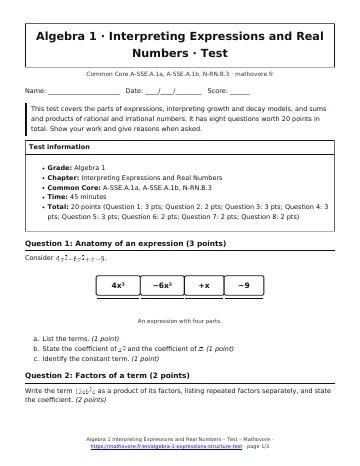
This algebra 1 expressions structure test checks interpreting expressions and real numbers in 45 minutes, with 8 questions for a total of 20 points.
This test covers the parts of expressions, interpreting growth and decay models, and sums and products of rational and irrational numbers. It has eight questions worth 20 points in total. Show your work and give reasons when asked.
- Grade: Algebra 1
- Chapter: Interpreting Expressions and Real Numbers
- Common Core: A-SSE.A.1a, A-SSE.A.1b, N-RN.B.3
- Time: 45 minutes
- Total: 20 points (Question 1: 3 pts; Question 2: 2 pts; Question 3: 3 pts; Question 4: 3 pts; Question 5: 3 pts; Question 6: 2 pts; Question 7: 2 pts; Question 8: 2 pts)
Algebra 1 Expressions Structure Test: questions 1–5
Question 1: Anatomy of an expression (3 points)
Consider \(4x^{3}-6x^{2}+x-9\).
- List the terms. (1 point)
- State the coefficient of \(x^{2}\) and the coefficient of \(x\). (1 point)
- Identify the constant term. (1 point)
Question 2: Factors of a term (2 points)
Write the term \(12ab^{2}c\) as a product of its factors, listing repeated factors separately, and state the coefficient. (2 points)
Question 3: Interpreting an account (3 points)
The balance of an account after \(n\) years is \(A=2500(1.06)^{n}\) dollars.
- State the starting amount and the yearly growth rate. (1 point)
- Find the balance after \(3\) years, to the nearest cent. (1 point)
- Explain what the number \(1.06\) tells about the balance from one year to the next. (1 point)
Question 4: Interpreting depreciation (3 points)
The value of a delivery van is \(V=18000(0.85)^{t}\) dollars after \(t\) years. The graph shows the value for \(t=0\) to \(5\).
- State what \(18000\) represents. (1 point)
- Explain what \(0.85\) tells about the yearly change, as a percent. (1 point)
- Find the value after \(2\) years. (1 point)
Question 5: Classify and justify (3 points)
Decide whether each number is rational or irrational and give a reason.
- \(\sqrt{2}+\frac{7}{8}\) (1 point)
- \(6\pi\) (1 point)
- \(\sqrt{3}\cdot\sqrt{12}\) (1 point)
Algebra 1 Expressions Structure Test: questions 6–8
Question 6: Sum of irrationals (2 points)
Is the sum of two irrational numbers always irrational? Answer yes or no and support the answer with an example. (2 points)
Question 7: A square's perimeter (2 points)
A square has an area of \(72\text{ in}^{2}\).
- Write the side length in simplest radical form. (1 point)
- Find the perimeter, state whether it is rational or irrational, and approximate it to the nearest hundredth. (1 point)
Question 8: Total cost expression (2 points)
A store’s total cost is \(T=1.07p+4.95\), where \(p\) is the item price in dollars. List the terms, explain what \(1.07\) and \(4.95\) mean, and find \(T\) when \(p=30\). (2 points)

How to use this algebra 1 expressions structure test
Take this algebra 1 expressions structure test without notes, then grade it with the test answer key out of 20 points.

See every chapter on the Algebra 1 math page.