


Question 1: Median and IQR (2 points)
Order the data: 27, 29, 31, 33, 35, 38, 40. The median is the middle value, 33.
Lower half: 27, 29, 31, so \(Q_1 = 29\). Upper half: 35, 38, 40, so \(Q_3 = 38\).
\(\text{IQR} = 38 – 29 = 9\). The IQR is 9.
Scoring: 1 point for the median; 1 point for the quartiles and the IQR.
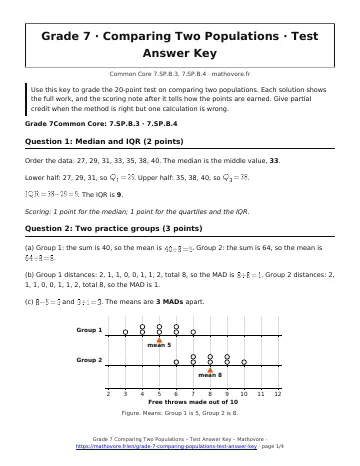
Question 2: Two practice groups (3 points)
(a) Group 1: the sum is 40, so the mean is \(40 : 8 = 5\). Group 2: the sum is 64, so the mean is \(64 : 8 = 8\).
(b) Group 1 distances: 2, 1, 1, 0, 0, 1, 1, 2, total 8, so the MAD is \(8 : 8 = 1\). Group 2 distances: 2, 1, 1, 0, 0, 1, 1, 2, total 8, so the MAD is 1.
(c) \(8 – 5 = 3\) and \(3 : 1 = 3\). The means are 3 MADs apart.
Scoring: 1 point for (a) both means; 1 point for (b) both MADs; 1 point for (c) the multiple.
Question 3: Text messages (2 points)
(a) The difference is \(66 – 48 = 18\), and \(18 : 9 = 2\). The means are 2 MADs apart.
(b) \(18 : 6 = 3\). With a MAD of 6 the means are 3 MADs apart.
Scoring: 1 point for each part (correct difference and division).
Question 4: Biking clubs (3 points)
(a) Club X median 28, Club Y median 40. The difference is \(40 – 28 = 12\) miles.
(b) Club X: \(36 – 20 = 16\). Club Y: \(48 – 24 = 24\). The IQRs are 16 and 24 miles.
(c) The box of Club X spans 20 to 36 and the box of Club Y spans 24 to 48. They share the values from 24 to 36, so the boxes overlap.
Scoring: 1 point for (a), 1 point for (b), 1 point for (c) with the overlap explained.
Question 5: Typing speeds (3 points)
(a) Class 1: the sum is 400, so the mean is 40. Class 2: the sum is 440, so the mean is 44.
(b) \(44 – 40 = 4\) and \(4 : 2 = 2\). The means are 2 MADs apart.
(c) The values of Class 1 range from 36 to 44 and the values of Class 2 range from 41 to 50. They overlap from 41 to 44, so the overlap is small, but the typical value of Class 2 is higher.
Scoring: 1 point for both means; 1 point for the multiple; 1 point for a correct description of the overlap.
Question 6: Pages read (3 points)
(a) Sixth grade: the sum is 240, so the mean is \(240 : 8 = 30\). Distances: 7, 6, 3, 0, 1, 4, 4, 7, total 32, so the MAD is \(32 : 8 = 4\).
Seventh grade: the sum is 304, so the mean is \(304 : 8 = 38\). Distances: 6, 5, 4, 1, 0, 4, 4, 8, total 32, so the MAD is 4.
(b) \(38 – 30 = 8\) and \(8 : 4 = 2\). Seventh graders typically read about 8 pages, or 2 MADs, more per week than sixth graders.
Scoring: 1 point for both means; 1 point for both MADs; 1 point for the multiple in a comparing sentence.
Question 7: Find the error (2 points)
The difference of the means is \(80 – 70 = 10\). Jamal stopped there. He must divide by the MAD: \(10 : 5 = 2\).
Group B is 2 MADs higher, not 10 MADs.
Scoring: 1 point for explaining that the difference must be divided by the MAD; 1 point for the correct multiple, 2.
Question 8: Working backward (2 points)
(a) The difference is \(150 – 120 = 30\). Then \(30 : 2.5 = 12\). The MAD is 12.
(b) \(1.5 \times 12 = 18\) and \(150 + 18 = 168\). The mean is 168.
Scoring: 1 point for each part.
20 points
See every chapter on the Grade 7 math page.