



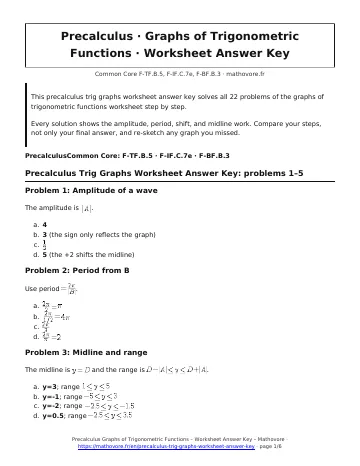
This precalculus trig graphs worksheet answer key solves all 22 problems of the graphs of trigonometric functions worksheet step by step.
Every solution shows the amplitude, period, shift, and midline work. Compare your steps, not only your final answer, and re-sketch any graph you missed.
Precalculus Trig Graphs Worksheet Answer Key: problems 1–5
Problem 1: Amplitude of a wave
The amplitude is \(|A|\).
- 4
- 3 (the sign only reflects the graph)
- \(\frac{1}{2}\)
- 5 (the +2 shifts the midline)
Problem 2: Period from B
Use period \(=\frac{2\pi}{|B|}\).
- \(\frac{2\pi}{2}=\)\(\pi\)
- \(\frac{2\pi}{1/2}=\)\(4\pi\)
- \(\frac{2\pi}{3}\)
- \(\frac{2\pi}{\pi}=\)\(2\)
Problem 3: Midline and range
The midline is \(y=D\) and the range is \(D-|A|\le y\le D+|A|\).
- y=3; range \(1\le y\le 5\)
- y=-1; range \(-5\le y\le 3\)
- y=-2; range \(-2.5\le y\le -1.5\)
- y=0.5; range \(-2.5\le y\le 3.5\)
Problem 4: Five key points
Use \(\cos x=1,0,-1,0,1\) and \(\sin x=0,1,0,-1,0\).
- 3, 1, -1, 1, 3
- 0, -1, 0, 1, 0
Problem 5: Read a cosine graph
Maximum \(2\), minimum \(-4\). Amplitude \(=\frac{2-(-4)}{2}=3\); midline \(y=\frac{2+(-4)}{2}=-1\). The maximum at \(x=0\) and the minimum at \(x=\frac{\pi}{2}\) are half a period apart, so the period is \(\pi\) and \(B=\frac{2\pi}{\pi}=2\).
Amplitude 3, period \(\pi\), midline \(y=-1\), \(y=3\cos 2x-1\)
Precalculus Trig Graphs Worksheet Answer Key: problems 6–10
Problem 6: Graph a reflected sine
The amplitude is 2 and the sign reflects the sine. Key points: \((0,0)\), \((\frac{\pi}{2},-2)\), \((\pi,0)\), \((\frac{3\pi}{2},2)\), \((2\pi,0)\).
Problem 7: Describe transformations
- Reflect across the x-axis, shrink vertically by a factor of \(\frac{1}{2}\), and shift up 3.
- Shift left \(\frac{\pi}{2}\). (The result is the graph of \(y=\cos x\).)
- Stretch horizontally by a factor of 4, so the period becomes \(4\pi\).
Problem 8: Phase shift
Factor out \(B\) first.
- Right \(\frac{\pi}{3}\)
- Left \(\frac{\pi}{4}\)
- \(\sin(2x-\pi)=\sin(2(x-\frac{\pi}{2}))\): right \(\frac{\pi}{2}\)
- \(\cos(3x+\frac{\pi}{2})=\cos(3(x+\frac{\pi}{6}))\): left \(\frac{\pi}{6}\)
Problem 9: Read a tangent graph
Neighboring asymptotes are at \(x=-\frac{\pi}{4}\) and \(x=\frac{\pi}{4}\), so the period is \(\frac{\pi}{2}\), and \(B=\frac{\pi}{\pi/2}=2\). The asymptotes are \(x=\frac{\pi}{4}+\frac{k\pi}{2}\). At \(x=\frac{\pi}{8}\), \(\tan\frac{\pi}{4}=1\), and the graph shows \(y=1\), so \(A=1\).
\(y=\tan 2x\)
Problem 10: Tangent period and asymptotes
Period \(=\frac{\pi}{|B|}\); asymptotes where \(Bx=\pm\frac{\pi}{2}\).
- Period \(\frac{\pi}{3}\); \(3x=\pm\frac{\pi}{2}\) gives \(x=\pm\frac{\pi}{6}\)
- Period \(2\pi\); \(\frac{x}{2}=\pm\frac{\pi}{2}\) gives \(x=\pm\pi\)
Precalculus Trig Graphs Worksheet Answer Key: problems 11–15
Problem 11: Write a sine from a graph
The graph rises through the midline at \(x=\frac{\pi}{4}\) where \(y=2\), reaches a maximum 5 at \(x=\frac{\pi}{2}\), and a minimum \(-1\) at \(x=\pi\). Midline \(D=\frac{5+(-1)}{2}=2\), \(A=3\). A quarter period is \(\frac{\pi}{2}-\frac{\pi}{4}=\frac{\pi}{4}\), so the period is \(\pi\) and \(B=2\). A sine starts its cycle on the midline going up, at \(C=\frac{\pi}{4}\).
\(y=3\sin(2(x-\frac{\pi}{4}))+2\) (also \(y=-3\cos 2x+2\))
Problem 12: Evaluate a sinusoid
- \(3\sin\frac{\pi}{6}+1=3\cdot\frac{1}{2}+1=\)2.5
- \(3\sin\frac{\pi}{2}+1=\)4
- \(3\sin\pi+1=\)1
- \(3\sin\frac{3\pi}{2}+1=3(-1)+1=\)-2
Problem 13: Write an equation
- \(B=\frac{2\pi}{\pi}=2\). Starting on the midline going up: \(y=5\sin 2x-2\)
- \(B=\frac{2\pi}{8\pi}=\frac{1}{4}\). Starting at a maximum: \(y=3\cos(\frac{x}{4})+1\)
- \(B=\frac{2\pi}{6}=\frac{\pi}{3}\): \(y=2\sin(\frac{\pi x}{3})\)
Problem 14: Identify B from a graph
Maximum 2, minimum \(-2\), so \(|A|=2\). The graph goes down first, so \(A=-2\). It crosses the axis at \(0\), \(2\pi\), \(4\pi\), so the period is \(4\pi\) and \(B=\frac{2\pi}{4\pi}=\frac{1}{2}\).
\(y=-2\sin(\frac{x}{2})\); amplitude 2, period \(4\pi\)
Problem 15: Shifted tangent
Asymptotes: \(x-\frac{\pi}{4}=\pm\frac{\pi}{2}\) gives \(x=-\frac{\pi}{4}\) and \(x=\frac{3\pi}{4}\). Center: \(x=\frac{\pi}{4}\), \(y=2\tan 0+1=1\). At \(x=0\): \(2\tan(-\frac{\pi}{4})+1=-1\). At \(x=\frac{\pi}{2}\): \(2\tan\frac{\pi}{4}+1=3\).
Asymptotes \(x=-\frac{\pi}{4}\), \(x=\frac{3\pi}{4}\); center \((\frac{\pi}{4},1)\); points \((0,-1)\) and \((\frac{\pi}{2},3)\)
Precalculus Trig Graphs Worksheet Answer Key: problems 16–20
Problem 16: Domain of a tangent
The function is undefined when \(2x=\frac{\pi}{2}+k\pi\), that is, when \(x=\frac{\pi}{4}+\frac{k\pi}{2}\).
All real numbers except \(x=\frac{\pi}{4}+\frac{k\pi}{2}\), \(k\) an integer
Problem 17: Ferris wheel height
- Amplitude 40 ft; period \(\frac{2\pi}{\pi/2}=4\), so 4 minutes; midline \(h=50\)
- \(h(1)=-40\cos\frac{\pi}{2}+50=\)50 ft; \(h(2)=-40\cos\pi+50=40+50=\)90 ft
- \(h(0.5)=-40\cos\frac{\pi}{4}+50\approx -28.28+50=\)21.7 ft
Problem 18: Tide model
- \(A=\frac{11-3}{2}=4\), \(D=\frac{11+3}{2}=7\). Half a period is \(9-3=6\), so the period is 12 and \(B=\frac{2\pi}{12}=\frac{\pi}{6}\).
- \(h(t)=4\cos(\frac{\pi}{6}(t-3))+7\)
- \(h(1)=4\cos(-\frac{\pi}{3})+7=4\cdot\frac{1}{2}+7=\)9 ft; \(h(6)=4\cos\frac{\pi}{2}+7=\)7 ft
Problem 19: Monthly temperature
\(A=\frac{74-30}{2}=22\), \(D=\frac{74+30}{2}=52\), period 12 months so \(B=\frac{\pi}{6}\). The maximum is at \(m=7\).
\(T(m)=22\cos(\frac{\pi}{6}(m-7))+52\)
\(T(4)=22\cos(-\frac{\pi}{2})+52=\)\(52^{\circ}\text{F}\); \(T(9)=22\cos\frac{\pi}{3}+52=11+52=\)\(63^{\circ}\text{F}\)
Problem 20: Bobbing buoy
\(A=1.5\), \(B=\frac{2\pi}{5}\), starting on the midline going up, so a sine: \(y(t)=1.5\sin(\frac{2\pi t}{5})\).
\(y(1.25)=1.5\sin\frac{\pi}{2}=\)1.5 ft; \(y(2.5)=1.5\sin\pi=\)0 ft; \(y(0.625)=1.5\sin\frac{\pi}{4}\approx 1.06\approx\)1.1 ft.
Precalculus Trig Graphs Worksheet Answer Key: problems 21–22
Problem 21: Hours of daylight
- Amplitude 4 hours, midline \(D=12\), period 365 days. The longest day is day 172: \(D=16\).
- \(D(80)=4\cos(\frac{2\pi}{365}(-92))+12\approx 4(-0.013)+12\approx\)11.9 hours; \(D(1)=4\cos(\frac{2\pi}{365}(-171))+12\approx 4(-0.981)+12\approx\)8.1 hours
Problem 22: Lighthouse beam
- \(d=300\cdot\frac{1}{\sqrt{3}}\approx\)173.2 ft; \(300\cdot 1=\)300 ft; \(300\sqrt{3}\approx\)519.6 ft
- \(d=300\tan 1.5\approx 300(14.10)\approx\)4,230.4 ft. The line \(\theta=\frac{\pi}{2}\) is a vertical asymptote: the beam becomes parallel to the shore and \(d\) grows without bound.
How to use this precalculus trig graphs worksheet answer key
Read this precalculus trig graphs worksheet answer key after trying each problem yourself, and redo any problem you missed.

See every chapter on the Precalculus math page.