

Key takeaway: This precalculus inverse trig worksheet answer key shows each of the 24 solutions with the angle in radians unless degrees are requested. Every answer lies in the range of the inverse or on the interval named in the problem. If your angle differs, check whether it sits in the correct restricted piece. Bold marks the final answers.
Each solution names the restricted range, the reference angle, and the quadrant reasoning. If your answer differs, check whether it lies in the correct interval and whether your calculator was in the right mode.
Precalculus Inverse Trig Worksheet Answer Key: problems 1–5
1. Evaluate arcsin
The answer must lie in \( [-\frac{\pi}{2},\frac{\pi}{2}] \).
- \(\frac{\pi}{6}\)
- \(-\frac{\pi}{6}\)
- \(\frac{\pi}{3}\)
- \(-\frac{\pi}{2}\)
2. Evaluate arccos
The answer must lie in \( [0,\pi] \).
- \(\frac{\pi}{4}\)
- \(\frac{2\pi}{3}\) (cosine is negative in Quadrant II)
- \(\frac{\pi}{2}\)
- \(\pi\)
3. Evaluate arctan
The answer must lie in \( (-\frac{\pi}{2},\frac{\pi}{2}) \).
- \(\frac{\pi}{4}\)
- \(-\frac{\pi}{4}\)
- \(\frac{\pi}{3}\)
- \(-\frac{\pi}{6}\)
4. Graph of arctan
Every real number can be an input, and the curve stays between the dashed lines at \(y=\pm\frac{\pi}{2}\).
Domain: all real numbers. Range: \( (-\frac{\pi}{2},\frac{\pi}{2}) \). Asymptotes: \(y=\frac{\pi}{2}\) and \(y=-\frac{\pi}{2}\). \(\tan^{-1}(0)=0\).
5. Restricted cosine
The thick piece is \( [0,\pi] \).
- \(\frac{\pi}{3}\) (already in \( [0,\pi] \))
- \(\cos(-\frac{\pi}{3})=\frac{1}{2}\), and \(\cos^{-1}\frac{1}{2}=\)\(\frac{\pi}{3}\)
- \(\cos\frac{4\pi}{3}=-\frac{1}{2}\), and \(\cos^{-1}(-\frac{1}{2})=\)\(\frac{2\pi}{3}\)
Precalculus Inverse Trig Worksheet Answer Key: problems 6–10
6. Compositions that cancel
- 0.3
- -0.8
- 25 (every real number is allowed for \(\tan^{-1}\))
- undefined, because \(1.2\) is not in \( [-1,1] \)
7. Arcsine of a sine
- \(\frac{\pi}{4}\) (already in the range)
- \(\sin\frac{3\pi}{4}=\frac{\sqrt{2}}{2}\), so \(\frac{\pi}{4}\)
- \(\sin\frac{7\pi}{6}=-\frac{1}{2}\), so \(-\frac{\pi}{6}\)
- \(\sin(-\frac{2\pi}{3})=-\frac{\sqrt{3}}{2}\), so \(-\frac{\pi}{3}\)
8. Triangle compositions
- The missing leg is \(\sqrt{5^{2}-3^{2}}=4\), so \(\sin\theta=\)\(\frac{4}{5}\)
- With opposite 5 and hypotenuse 13 the adjacent side is 12, so \(\frac{12}{13}\)
- Adjacent 4, hypotenuse 5, opposite 3: \(\frac{3}{4}\)
- The angle is in Quadrant IV where cosine is positive: opposite \(-3\), adjacent 4, so \(-\frac{3}{4}\)
9. Calculator practice
- 0.36
- 1.37
- 1.33
- 2.28
10. Solve a sine equation
The reference angle is \(\sin^{-1}\frac{\sqrt{3}}{2}=\frac{\pi}{3}\). Sine is positive in Quadrants I and II, so the second solution is \(\pi-\frac{\pi}{3}=\frac{2\pi}{3}\).
\(x=\frac{\pi}{3}\) or \(x=\frac{2\pi}{3}\)
Precalculus Inverse Trig Worksheet Answer Key: problems 11–15
11. Solve a cosine equation
The reference angle is \(\frac{\pi}{4}\). Cosine is negative in Quadrants II and III: \(\pi-\frac{\pi}{4}=\frac{3\pi}{4}\) and \(\pi+\frac{\pi}{4}=\frac{5\pi}{4}\).
\(x=\frac{3\pi}{4}\) or \(x=\frac{5\pi}{4}\)
12. Solve a tangent equation
\(\tan^{-1}(-1)=-\frac{\pi}{4}\). Tangent repeats every \(\pi\), so add \(\pi\) and \(2\pi\) to reach the interval: \(-\frac{\pi}{4}+\pi=\frac{3\pi}{4}\) and \(-\frac{\pi}{4}+2\pi=\frac{7\pi}{4}\).
\(x=\frac{3\pi}{4}\) or \(x=\frac{7\pi}{4}\)
13. Equation with a unit circle
Subtract and divide: \(\cos x=-\frac{1}{2}\). The line \(x=-\frac{1}{2}\) meets the circle in Quadrants II and III. \(\cos^{-1}(-\frac{1}{2})=\frac{2\pi}{3}\) and the other angle is \(2\pi-\frac{2\pi}{3}=\frac{4\pi}{3}\).
\(x=\frac{2\pi}{3}\) or \(x=\frac{4\pi}{3}\)
14. Sine equation by calculator
\(\sin x=0.4\). \(x=\sin^{-1}(0.4)\approx 0.41\). The second solution is \(\pi-0.4115\approx 2.73\).
\(x\approx 0.41\) or \(x\approx 2.73\)
15. Cosine equation by calculator
\(x=\cos^{-1}(0.3)\approx 1.27\). Cosine is also positive in Quadrant IV: \(2\pi-1.2661\approx 5.02\).
\(x\approx 1.27\) or \(x\approx 5.02\)
Precalculus Inverse Trig Worksheet Answer Key: problems 16–20
16. General solutions
- \(x=\frac{\pi}{6}+2\pi k\) or \(x=\frac{5\pi}{6}+2\pi k\)
- \(x=\frac{\pi}{2}+\pi k\) (both \(\frac{\pi}{2}\) and \(\frac{3\pi}{2}\) are included)
- \(x=\frac{\pi}{3}+\pi k\)
17. Quadratic in sine
Factor: \((2\sin x+1)(\sin x-1)=0\). If \(\sin x=1\) then \(x=\frac{\pi}{2}\). If \(\sin x=-\frac{1}{2}\) then \(x=\frac{7\pi}{6}\) or \(x=\frac{11\pi}{6}\).
\(x=\frac{\pi}{2}\), \(\frac{7\pi}{6}\), \(\frac{11\pi}{6}\)
18. Multiple-angle equation
Let \(u=2x\), so \(0\le u< 4\pi\). \(\sin u=\frac{\sqrt{2}}{2}\) gives \(u=\frac{\pi}{4},\frac{3\pi}{4},\frac{9\pi}{4},\frac{11\pi}{4}\). Divide by 2.
\(x=\frac{\pi}{8},\frac{3\pi}{8},\frac{9\pi}{8},\frac{11\pi}{8}\)
19. Wheelchair ramp
\(\sin\theta=\frac{1}{12}\), so \(\theta=\sin^{-1}(\frac{1}{12})\approx 0.0834\text{ rad}\).
\(\theta\approx 4.78^{\circ}\)
20. Ladder angle
- \(\cos\theta=\frac{4}{16}=0.25\), so \(\theta=\cos^{-1}(0.25)\approx\)\(75.5^{\circ}\)
- \(16\cos 70^{\circ}\approx 5.47\), so about 5.5 ft
Precalculus Inverse Trig Worksheet Answer Key: problems 21–24
21. Daylight hours
\(4\sin(\frac{2\pi}{365}(t-80))=2\), so \(\sin u=\frac{1}{2}\) with \(u=\frac{2\pi}{365}(t-80)\). Then \(u=\frac{\pi}{6}\) or \(\frac{5\pi}{6}\). \(t-80=\frac{365}{12}\approx 30.4\) gives \(t\approx 110.4\); \(t-80=\frac{5\cdot 365}{12}\approx 152.1\) gives \(t\approx 232.1\).
About day 110 (April 20) to day 232 (August 20) has more than 14 hours of daylight.
22. Spring height
Height 23: \(\cos\frac{2\pi t}{3}=\frac{1}{2}\), so \(\frac{2\pi t}{3}=\frac{\pi}{3}\) or \(\frac{5\pi}{3}\), giving \(t=0.5\) and \(t=2.5\).
Height 16: \(\cos\frac{2\pi t}{3}=-\frac{2}{3}\). \(\cos^{-1}(-\frac{2}{3})\approx 2.3005\), so \(t=\frac{3(2.3005)}{2\pi}\approx 1.10\); the other angle is \(2\pi-2.3005\), giving \(t\approx 1.90\).
23 in at \(t=0.5\) and \(t=2.5\) s; 16 in at \(t\approx 1.10\) and \(t\approx 1.90\) s
23. Household voltage
\(\sin(120\pi t)=\frac{100}{170}\approx 0.5882\). \(\sin^{-1}(0.5882)\approx 0.6288\). So \(t=\frac{0.6288}{120\pi}\approx 0.001668\) s and \(t=\frac{\pi-0.6288}{120\pi}\approx 0.006665\) s.
\(t\approx 1.67\) ms and \(t\approx 6.67\) ms; one cycle is \(\frac{2\pi}{120\pi}=\frac{1}{60}\) s, about 16.67 ms
24. Sun angle
- \(\tan\theta=\frac{40}{55}\), so \(\theta=\tan^{-1}(\frac{40}{55})\approx\)\(36.0^{\circ}\)
- \(\text{shadow}=\frac{40}{\tan 60^{\circ}}=\frac{40}{\sqrt{3}}\approx\)23.1 ft
What are the exact-value answers?
Problem 1 gives \(\frac{\pi}{6}\) and \(-\frac{\pi}{6}\). Problem 3 gives \(\frac{\pi}{4}\), \(-\frac{\pi}{4}\) and \(\frac{\pi}{3}\). The arctan graph in problem 4 has domain all reals, range \((-\frac{\pi}{2},\frac{\pi}{2})\) and asymptotes \(y=\pm\frac{\pi}{2}\). Because \(\frac{3\pi}{4}\) is outside the sine range, problem 7 returns \(\frac{\pi}{4}\) for that second composition.
Which equation answers do students miss?
Problem 10 gives \(\frac{\pi}{3}\) and \(\frac{2\pi}{3}\), and problem 11 gives \(\frac{3\pi}{4}\) and \(\frac{5\pi}{4}\). Problem 12 returns \(\frac{3\pi}{4}\) and \(\frac{7\pi}{4}\). In problem 13, \(\cos x=-\frac{1}{2}\) gives \(\frac{2\pi}{3}\) and \(\frac{4\pi}{3}\). The calculator problems give 0.41 and 2.73 for problem 14, and 1.27 and 5.01 for problem 15. Factoring in problem 17 gives \(\frac{\pi}{2}\), \(\frac{7\pi}{6}\) and \(\frac{11\pi}{6}\).
How do the application answers look?
The ramp angle is about \(4.8^{\circ}\). The ladder makes an angle of about \(75.5^{\circ}\) with the ground. The sun sits near \(36.0^{\circ}\) above the horizon. Because each model uses an inverse function, the answer is a single angle, not a list.
How can you learn from missed angles?
Sketch the unit circle beside each wrong answer and mark the quadrant. Then count how many solutions the interval allows. Finally, redo the problem with that picture in front of you, so the symmetry step becomes visible.

Printable PDF · Worksheet Answer Key
Precalculus Inverse Trigonometric Functions and Trigonometric Equations worksheet answer key
Download the PDF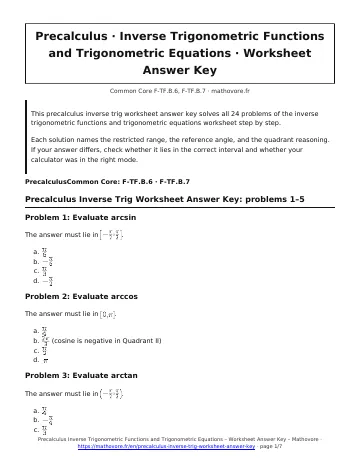
See every chapter on the Precalculus math page.