Key takeaway: This precalculus counting probability test answer key lists a complete solution for each of the 8 questions. Grade the setup before the arithmetic, and accept fractions, decimals or correctly rounded percents. A student who sets up a combination correctly but slips on a product keeps most of the points. Avoid taking points twice for one carried error.
Worked solutions with a point-by-point scoring guide for the 20-point counting and probability test. Award partial credit for a correct setup, such as the right combinations or the right tree paths, even if the final arithmetic is off.
Precalculus Counting Probability Test Answer Key: questions 1–5
1. Counting routes (2 points)
- \(3\times 4=\)12
- Out and back are each 12 choices: \(12\times 12=\)144
Scoring: 1 point for each part.
2. Permutations and combinations (2 points)
- \(9\cdot 8\cdot 7=\)504
- \(\frac{504}{6}=\)84
Scoring: 1 point for each correct value.
3. Arranging letters (2 points)
10 letters: O twice, K twice, E three times . \(\frac{10!}{2!\,2!\,3!}=\frac{3628800}{24}=\)151,200
Scoring: 1 point for the correct repeated-letter denominator; 1 point for the final value.
4. Forming a team (3 points)
- \(_{12}C_{4}=\)495
- \(_{5}C_{2}\cdot{_{7}C_{2}=10\cdot 21=\)210
- \(\frac{210}{495}=\)14/33
Scoring: 1 point for each part.
5. Three spades (2 points)
\(\frac{_{13}C_{3}}{_{52}C_{3}}=\frac{286}{22100}=\)11/850
Scoring: 1 point for the two combinations 286 and 22,100; 1 point for the simplified fraction.
Precalculus Counting Probability Test Answer Key: questions 6–8
6. Two draws (3 points)
The first-draw probabilities are \(\frac{6}{10}=\frac{3}{5}\) and \(\frac{4}{10}=\frac{2}{5}\).
- \(\frac{3}{5}\cdot\frac{5}{9}=\)1/3
- \(\frac{3}{5}\cdot\frac{4}{9}+\frac{2}{5}\cdot\frac{2}{3}=\frac{12}{45}+\frac{12}{45}=\frac{24}{45}=\)8/15
Scoring: 1 point for part (a); in part (b), 1 point for identifying the two paths WB and BW and 1 point for the correct sum.
7. Expected value (3 points)
Probabilities add to 1: \(1-0.2-0.3-0.4=0.1\).
- \(P(X=4)=\)0.1
- \(E(X)=1(0.2)+2(0.3)+3(0.4)+4(0.1)=0.2+0.6+1.2+0.4=\)2.4
Scoring: 1 point for part (a); in part (b), 1 point for the correct products and 1 point for the sum.
8. Carnival game (3 points)
Expected payout: \(30\cdot\frac{1}{20}+5\cdot\frac{4}{20}=1.5+1=2.5\).
Net: \(2.50-4=\)-$1.50. On average Liam loses $1.50 per play, so the game favors the house.
Scoring: 1 point for the probabilities 1/20 and 4/20; 1 point for the expected payout $2.50; 1 point for the net result with interpretation.
Scoring summary
20 points: add the points of every question of this precalculus counting probability test answer key.
Which solutions open the key?
The routes give \(3\cdot 4=12\). Then \(_{9}P_{3}=504\) and \(_{9}C_{3}=84\), and their ratio is 6, which is \(3!\). Next, BOOKKEEPER has 10 letters with 2 O’s, 2 K’s and 3 E’s, so the count is \(\frac{10!}{2!\,2!\,3!}=151{,}200\). The team of 4 from 12 people gives \(_{12}C_{4}=495\).
How do you grade the probability items?
Three spades equal \(\frac{_{13}C_{3}}{_{52}C_{3}}=\frac{286}{22{,}100}=\frac{11}{850}\). Give full credit for the equivalent product \(\frac{13}{52}\cdot\frac{12}{51}\cdot\frac{11}{50}\). In the marble tree, the first-draw branches are \(\frac{6}{10}\) and \(\frac{4}{10}\), and the second-draw branches use denominator 9. Therefore each path probability is a product with a 9 in the second factor.
What is the answer to the carnival game?
Fifteen of 20 cards pay nothing, so \(E=\frac{1\cdot 30+4\cdot 5}{20}=2.5\) dollars. After subtracting the $4 price, the expected net result is \(-\$1.50\) per draw. Award one point for the expected prize, one for the subtraction and one for stating that the player loses money on average.
What feedback helps most?
Write the key question beside each lost point: order, repeats or replacement. Students then see which decision failed. Assign two worksheet problems on that decision, and let them retake the quiz afterward.

Printable PDF · Test Answer Key
Precalculus Counting, Permutations, Combinations and Probability test answer key
Download the PDF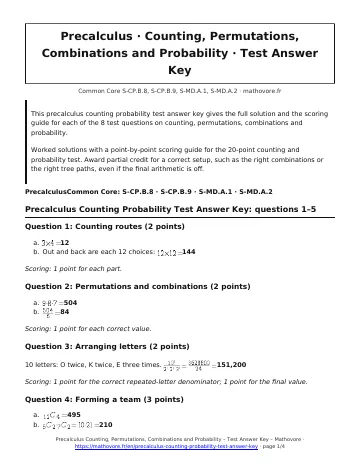
See every chapter on the Precalculus math page.