



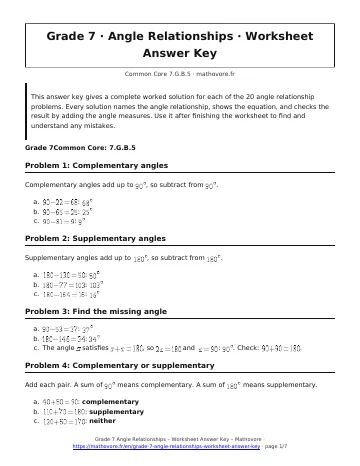
This answer key gives a complete worked solution for each of the 20 angle relationship problems. Every solution names the angle relationship, shows the equation, and checks the result by adding the angle measures. Use it after finishing the worksheet to find and understand any mistakes.
Problem 1: Complementary angles
Complementary angles add up to \(90^{\circ}\), so subtract from \(90^{\circ}\).
- \(90-22=68\): \(68^{\circ}\)
- \(90-65=25\): \(25^{\circ}\)
- \(90-81=9\): \(9^{\circ}\)
Problem 2: Supplementary angles
Supplementary angles add up to \(180^{\circ}\), so subtract from \(180^{\circ}\).
- \(180-130=50\): \(50^{\circ}\)
- \(180-77=103\): \(103^{\circ}\)
- \(180-164=16\): \(16^{\circ}\)
Problem 3: Find the missing angle
- \(90-53=37\): \(37^{\circ}\)
- \(180-146=34\): \(34^{\circ}\)
- The angle \(x\) satisfies \(x+x=180\), so \(2x=180\) and \(x=90\): \(90^{\circ}\). Check: \(90+90=180\).
Problem 4: Complementary or supplementary
Add each pair. A sum of \(90^{\circ}\) means complementary. A sum of \(180^{\circ}\) means supplementary.
- \(40+50=90\): complementary
- \(110+70=180\): supplementary
- \(120+50=170\): neither
- \(25+155=180\): supplementary
Problem 5: Vertical angles
Angle \(b\) is vertical to the \(72^{\circ}\) angle, so \(b=72\). Angle \(a\) is supplementary to \(72^{\circ}\): \(a=180-72=108\). Angle \(c\) is vertical to \(a\), so \(c=108\).
\(a=108^{\circ}\), \(b=72^{\circ}\), \(c=108^{\circ}\)
Problem 6: Crossing lines
Angle \(a\) is next to the \(125^{\circ}\) angle on a straight line, so \(a=180-125=55\).
Angle \(b\) is vertical to the \(125^{\circ}\) angle, so \(b=125\).
Angle \(c\) is vertical to \(a\), so \(c=55\). Check: \(125+55+125+55=360\).
\(a=55^{\circ}\), \(b=125^{\circ}\), \(c=55^{\circ}\)
Problem 7: Angles on a line
The angles are supplementary, so \(115+x=180\).
\(x=180-115=65\). Check: \(115+65=180\).
\(x=65^{\circ}\)
Problem 8: Angles along a line
Angles on a straight line add up to \(180^{\circ}\): \(52+81+x=180\).
\(133+x=180\), so \(x=180-133=47\).
Check: \(52+81+47=180\).
\(x=47^{\circ}\)
Problem 9: Angles in a right angle
The angles are complementary, so \(29+x=90\).
\(x=90-29=61\). Check: \(29+61=90\).
\(x=61^{\circ}\)
Problem 10: Splitting a right angle
The three angles make a right angle, so they add up to \(90^{\circ}\): \(18+x+49=90\).
\(67+x=90\), so \(x=90-67=23\).
Check: \(18+23+49=90\).
\(x=23^{\circ}\)
Problem 11: Complementary equation
Equation: \(x+(2x+9)=90\).
\(3x+9=90\), so \(3x=81\) and \(x=27\).
The second angle is \(2(27)+9=63\). Check: \(27+63=90\).
\(x=27\); the angles are \(27^{\circ}\) and \(63^{\circ}\).
Problem 12: Supplementary equation
Equation: \(x+(x+36)=180\).
\(2x+36=180\), so \(2x=144\) and \(x=72\).
The second angle is \(72+36=108\). Check: \(72+108=180\).
\(x=72\); the angles are \(72^{\circ}\) and \(108^{\circ}\).
Problem 13: Vertical angles equation
Vertical angles are equal: \(4x+7=95\).
\(4x=88\), so \(x=22\). Check: \(4(22)+7=95\).
Angle \(y\) is supplementary to \(95^{\circ}\): \(y=180-95=85\).
\(x=22\), \(y=85^{\circ}\)
Problem 14: Vertical angles with x
(a) Vertical angles are equal: \(3x+8=5x-14\). Subtract \(3x\): \(8=2x-14\). Add \(14\): \(22=2x\), so \(x=11\).
(b) \(3(11)+8=41\) and \(5(11)-14=41\).
(c) An angle next to a marked angle is supplementary to it: \(180-41=139\).
(a) \(x=11\). (b) \(41^{\circ}\) each. (c) \(139^{\circ}\).
Problem 15: Supplementary word problem
Let \(x\) be the smaller angle. The larger is \(3x+20\).
\(x+(3x+20)=180\), so \(4x+20=180\) and \(4x=160\), giving \(x=40\).
The larger angle is \(3(40)+20=140\). Check: \(40+140=180\).
The angles are \(40^{\circ}\) and \(140^{\circ}\).
Problem 16: Complementary word problem
Let \(x\) be the smaller angle. The other angle is \(2x-12\).
\(x+(2x-12)=90\), so \(3x-12=90\) and \(3x=102\), giving \(x=34\).
The other angle is \(2(34)-12=56\). Check: \(34+56=90\).
The angles are \(34^{\circ}\) and \(56^{\circ}\).
Problem 17: Adjacent angles on a line
Adjacent angles on a line are supplementary: \((2x+10)+(3x-5)=180\).
\(5x+5=180\), so \(5x=175\) and \(x=35\).
\(2(35)+10=80\) and \(3(35)-5=100\). Check: \(80+100=180\).
\(x=35\); the angles are \(80^{\circ}\) and \(100^{\circ}\).
Problem 18: Street corner
Neighboring angles formed by two crossing lines are supplementary: \((3x+5)+(2x+25)=180\).
\(5x+30=180\), so \(5x=150\) and \(x=30\).
\(3(30)+5=95\) and \(2(30)+25=85\). Check: \(95+85=180\).
The other two angles are vertical to these, so they measure \(95^{\circ}\) and \(85^{\circ}\).
\(x=30\); the angles are \(95^{\circ}\), \(85^{\circ}\), \(95^{\circ}\), \(85^{\circ}\).
Problem 19: Three angles on a line
The three angles make a straight angle: \(x+(x+10)+(2x+10)=180\).
\(4x+20=180\), so \(4x=160\) and \(x=40\).
The angles are \(40\), \(40+10=50\), and \(2(40)+10=90\). Check: \(40+50+90=180\).
\(40^{\circ}\), \(50^{\circ}\), and \(90^{\circ}\)
Problem 20: Four angles on a line
The angles make a straight angle: \(x+(x+4)+(2x-8)+(2x+16)=180\).
Combine like terms: \(6x+12=180\), so \(6x=168\) and \(x=28\).
The angles are \(28\), \(28+4=32\), \(2(28)-8=48\), and \(2(28)+16=72\). Check: \(28+32+48+72=180\).
\(x=28\); the angles are \(28^{\circ}\), \(32^{\circ}\), \(48^{\circ}\), and \(72^{\circ}\).
See every chapter on the Grade 7 math page.