
Key takeaway: Use this grade 5 add worksheet answer key to see worked solutions for all 23 problems on unlike denominators. Every solution shows the common denominator, the renamed fractions and the simplified result, with the final answer in bold. Parents and teachers can check CCSS 5.NF.A.1 in minutes. Students can also use the key to find the exact step where a wrong answer began, instead of only seeing that it was wrong.
Each problem below has a full worked solution with the final answer in bold. Check the common denominator first, then the renamed fractions, and finally the simplified result. If your answer differs, compare your estimate with the exact value to find the step that went wrong.
Grade 5 Add Worksheet Answer Key: problems 1–5
1. Add with fraction bars
Fourths are the common unit: \(\frac{1}{2} = \frac{2}{4}\). Then \(\frac{2}{4} + \frac{1}{4} = \frac{3}{4}\).
Answer: \(\frac{3}{4}\)
2. Rename fractions
- Multiply top and bottom by 4: \(\frac{1}{3} = \frac{4}{12}\). n = 4
- Multiply top and bottom by 3: \(\frac{3}{4} = \frac{9}{12}\). n = 9
- Multiply top and bottom by 2: \(\frac{5}{6} = \frac{10}{12}\). n = 10
- Multiply top and bottom by 4: \(\frac{2}{5} = \frac{8}{20}\). n = 8
3. Find the least common denominator
- Multiples of 6 are checked until both 6 and 4 divide evenly: 12
- Multiples of 10 are checked until both 5 and 10 divide evenly: 10
- Multiples of 12 are checked until both 8 and 12 divide evenly: 24
- Multiples of 9 are checked until both 9 and 6 divide evenly: 18
4. Add fractions with sums less than 1
- \(\frac{1}{2} + \frac{1}{3} = \frac{3}{6} + \frac{2}{6} = \frac{5}{6}\). \(\frac{5}{6}\)
- \(\frac{1}{4} + \frac{2}{5} = \frac{5}{20} + \frac{8}{20} = \frac{13}{20}\). \(\frac{13}{20}\)
- \(\frac{3}{8} + \frac{1}{4} = \frac{3}{8} + \frac{2}{8} = \frac{5}{8}\). \(\frac{5}{8}\)
- \(\frac{2}{9} + \frac{1}{6} = \frac{4}{18} + \frac{3}{18} = \frac{7}{18}\). \(\frac{7}{18}\)
5. Add fractions with sums greater than 1
- \(\frac{2}{3} + \frac{3}{4} = \frac{8}{12} + \frac{9}{12} = \frac{17}{12} = 1\frac{5}{12}\). \(1\frac{5}{12}\)
- \(\frac{5}{6} + \frac{5}{8} = \frac{20}{24} + \frac{15}{24} = \frac{35}{24} = 1\frac{11}{24}\). \(1\frac{11}{24}\)
- \(\frac{3}{5} + \frac{7}{10} = \frac{6}{10} + \frac{7}{10} = \frac{13}{10} = 1\frac{3}{10}\). \(1\frac{3}{10}\)
- \(\frac{7}{12} + \frac{5}{8} = \frac{14}{24} + \frac{15}{24} = \frac{29}{24} = 1\frac{5}{24}\). \(1\frac{5}{24}\)
Grade 5 Add Worksheet Answer Key: problems 6–10
6. Subtract fractions with unlike denominators
- \(\frac{3}{4} – \frac{1}{3} = \frac{9}{12} – \frac{4}{12} = \frac{5}{12}\). \(\frac{5}{12}\)
- \(\frac{5}{6} – \frac{1}{4} = \frac{10}{12} – \frac{3}{12} = \frac{7}{12}\). \(\frac{7}{12}\)
- \(\frac{7}{8} – \frac{1}{2} = \frac{7}{8} – \frac{4}{8} = \frac{3}{8}\). \(\frac{3}{8}\)
- \(\frac{4}{5} – \frac{3}{10} = \frac{8}{10} – \frac{3}{10} = \frac{5}{10} = \frac{1}{2}\). \(\frac{1}{2}\)
7. Subtract on a number line
One half is three sixths, so \(\frac{5}{6} – \frac{3}{6} = \frac{2}{6} = \frac{1}{3}\). The jump covers two sixths.
Answer: \(\frac{1}{3}\)
8. Find the missing fraction
- Subtract the known addend: \(\frac{7}{12} – \frac{1}{4} = \frac{7}{12} – \frac{3}{12} = \frac{4}{12} = \frac{1}{3}\). \(\frac{1}{3}\)
- Subtract the difference from the starting amount: \(\frac{5}{6} – \frac{1}{2} = \frac{5}{6} – \frac{3}{6} = \frac{2}{6} = \frac{1}{3}\). \(\frac{1}{3}\)
- Subtract the difference from the starting amount: \(\frac{3}{4} – \frac{3}{8} = \frac{6}{8} – \frac{3}{8} = \frac{3}{8}\). \(\frac{3}{8}\)
- Subtract the known addend: \(\frac{9}{10} – \frac{2}{5} = \frac{9}{10} – \frac{4}{10} = \frac{5}{10} = \frac{1}{2}\). \(\frac{1}{2}\)
9. Add mixed numbers
- \(2\frac{1}{2} + 1\frac{1}{3} = \frac{5}{2} + \frac{4}{3} = \frac{15}{6} + \frac{8}{6} = \frac{23}{6} = 3\frac{5}{6}\). \(3\frac{5}{6}\)
- \(3\frac{1}{4} + 2\frac{2}{5} = \frac{13}{4} + \frac{12}{5} = \frac{65}{20} + \frac{48}{20} = \frac{113}{20} = 5\frac{13}{20}\). \(5\frac{13}{20}\)
- \(1\frac{3}{4} + 2\frac{1}{2} = \frac{7}{4} + \frac{5}{2} = \frac{7}{4} + \frac{10}{4} = \frac{17}{4} = 4\frac{1}{4}\). \(4\frac{1}{4}\)
- \(4\frac{5}{6} + 1\frac{3}{8} = \frac{29}{6} + \frac{11}{8} = \frac{116}{24} + \frac{33}{24} = \frac{149}{24} = 6\frac{5}{24}\). \(6\frac{5}{24}\)
10. Subtract mixed numbers
- \(5\frac{3}{4} – 2\frac{1}{3} = \frac{23}{4} – \frac{7}{3} = \frac{69}{12} – \frac{28}{12} = \frac{41}{12} = 3\frac{5}{12}\). \(3\frac{5}{12}\)
- \(6\frac{1}{2} – 2\frac{3}{4} = \frac{13}{2} – \frac{11}{4} = \frac{26}{4} – \frac{11}{4} = \frac{15}{4} = 3\frac{3}{4}\). \(3\frac{3}{4}\)
- \(4\frac{1}{6} – 1\frac{5}{8} = \frac{25}{6} – \frac{13}{8} = \frac{100}{24} – \frac{39}{24} = \frac{61}{24} = 2\frac{13}{24}\). \(2\frac{13}{24}\)
- \(7 – 3\frac{2}{5} = 7 – \frac{17}{5} = \frac{35}{5} – \frac{17}{5} = \frac{18}{5} = 3\frac{3}{5}\). \(3\frac{3}{5}\)
Grade 5 Add Worksheet Answer Key: problems 11–15
11. Estimate with benchmarks
- Round to benchmarks: \(1 + 0 = 1\). The exact value \(\frac{39}{40}\) is close. About \(1\)
- Round to benchmarks: \(\frac{1}{2} + \frac{1}{2} = 1\). The exact value \(\frac{127}{132}\) is close. About \(1\)
- Round to benchmarks: \(\frac{1}{2} + 0 = \frac{1}{2}\). The exact value \(\frac{31}{56}\) is close. About \(\frac{1}{2}\)
- Round to benchmarks: \(1 – \frac{1}{2} = \frac{1}{2}\). The exact value \(\frac{17}{36}\) is close. About \(\frac{1}{2}\)
12. Is the answer reasonable?
A sum must be larger than each addend, but \(\frac{3}{5}\) is less than \(\frac{2}{3}\). Liam added the numerators and the denominators. Correct work: \(\frac{4}{6} + \frac{3}{6}\) uses sixths, so \(\frac{2}{3} + \frac{1}{2} = \frac{4}{6} + \frac{3}{6} = \frac{7}{6} = 1\frac{1}{6}\).
Answer: \(1\frac{1}{6}\)
13. Add with twelfths bars
\(\frac{1}{3} = \frac{4}{12}\) and \(\frac{1}{4} = \frac{3}{12}\), so \(\frac{4}{12} + \frac{3}{12} = \frac{7}{12}\).
Answer: \(\frac{7}{12}\)
14. Compare sums and differences
- \(\frac{1}{2} + \frac{1}{3} = \frac{3}{6} + \frac{2}{6} = \frac{5}{6}\). Compare in 30ths: \(\frac{25}{30} > \frac{24}{30}\). \(\frac{5}{6} > \frac{4}{5}\)
- \(\frac{3}{4} – \frac{1}{6} = \frac{9}{12} – \frac{2}{12} = \frac{7}{12}\). Compare in 12ths: \(\frac{7}{12} > \frac{6}{12}\). \(\frac{7}{12} > \frac{1}{2}\)
- \(\frac{2}{3} + \frac{1}{4} = \frac{8}{12} + \frac{3}{12} = \frac{11}{12}\). Compare in 12ths: \(\frac{11}{12} = \frac{11}{12}\). \(\frac{11}{12} = \frac{11}{12}\)
- \(\frac{5}{6} – \frac{1}{3} = \frac{5}{6} – \frac{2}{6} = \frac{3}{6} = \frac{1}{2}\). Compare in 6ths: \(\frac{3}{6} < \frac{4}{6}\). \(\frac{1}{2} < \frac{2}{3}\)
15. Add three fractions
- \(\frac{1}{2} + \frac{1}{3} + \frac{1}{6} = \frac{3}{6} + \frac{2}{6} + \frac{1}{6} = \frac{6}{6} = 1\). \(1\)
- \(\frac{1}{4} + \frac{1}{6} + \frac{1}{3} = \frac{3}{12} + \frac{2}{12} + \frac{4}{12} = \frac{9}{12} = \frac{3}{4}\). \(\frac{3}{4}\)
- \(\frac{2}{5} + \frac{1}{2} + \frac{1}{10} = \frac{4}{10} + \frac{5}{10} + \frac{1}{10} = \frac{10}{10} = 1\). \(1\)
Grade 5 Add Worksheet Answer Key: problems 16–20
16. Flour and oats
\(\frac{2}{3} + \frac{1}{4} = \frac{8}{12} + \frac{3}{12} = \frac{11}{12}\). The cup is almost full, one twelfth short of 1 cup.
Answer: \(\frac{11}{12}\) cup
17. Running miles
\(\frac{3}{4} + \frac{5}{6} = \frac{9}{12} + \frac{10}{12} = \frac{19}{12} = 1\frac{7}{12}\).
Answer: \(1\frac{7}{12}\) miles
18. Pizza night
- \(\frac{3}{8} + \frac{1}{4} = \frac{3}{8} + \frac{2}{8} = \frac{5}{8}\). \(\frac{5}{8}\)
- \(1 – \frac{5}{8} = \frac{8}{8} – \frac{5}{8} = \frac{3}{8}\). \(\frac{3}{8}\)
19. Ribbon for a gift
\(5\frac{1}{2} – 2\frac{3}{4} = \frac{11}{2} – \frac{11}{4} = \frac{22}{4} – \frac{11}{4} = \frac{11}{4} = 2\frac{3}{4}\).
Answer: \(2\frac{3}{4}\) yards
20. Walk to the park
- 2 1/3 rounds to 2 1/2 and 1 7/8 rounds to 2, so the total is about \(2\frac{1}{2} + 2 = 4\frac{1}{2}\). About 4 1/2 miles
- \(2\frac{1}{3} + 1\frac{7}{8} = \frac{7}{3} + \frac{15}{8} = \frac{56}{24} + \frac{45}{24} = \frac{101}{24} = 4\frac{5}{24}\). \(4\frac{5}{24}\) miles. This is close to the estimate.
Grade 5 Add Worksheet Answer Key: problems 21–23
21. Flour and sugar
\(4\frac{1}{4} – 2\frac{2}{3} = \frac{17}{4} – \frac{8}{3} = \frac{51}{12} – \frac{32}{12} = \frac{19}{12} = 1\frac{7}{12}\).
Answer: \(1\frac{7}{12}\) cups
22. Trail mix
Nuts and raisins: \(3\frac{1}{2} + 2\frac{3}{4} = \frac{7}{2} + \frac{11}{4} = \frac{14}{4} + \frac{11}{4} = \frac{25}{4} = 6\frac{1}{4}\). Chips: \(10 – 6\frac{1}{4} = 10 – \frac{25}{4} = \frac{40}{4} – \frac{25}{4} = \frac{15}{4} = 3\frac{3}{4}\).
Answer: \(3\frac{3}{4}\) pounds
23. Homework time
- \(1\frac{1}{4} + \frac{3}{4} + 1\frac{1}{2} = \frac{5}{4} + \frac{3}{4} + \frac{3}{2} = \frac{5}{4} + \frac{3}{4} + \frac{6}{4} = \frac{14}{4} = \frac{7}{2} = 3\frac{1}{2}\). \(3\frac{1}{2}\) hours
- \(4 – 3\frac{1}{2} = 4 – \frac{7}{2} = \frac{8}{2} – \frac{7}{2} = \frac{1}{2}\). \(\frac{1}{2}\) hour
How do you read a worked fraction answer?
First, look at the denominator before you look at the sum. In problem 4, the pair \(\frac{1}{4} + \frac{2}{5}\) needs twentieths, so the key writes \(\frac{5}{20} + \frac{8}{20} = \frac{13}{20}\). If your denominator differs, that is fine, because any common multiple works. Then simplify and compare the two results.
Which answers do students miss most often?
Problem 10 causes the most trouble because \(6\frac{1}{2} – 2\frac{3}{4}\) needs regrouping. As a result, students often subtract the smaller fraction from the larger one, which gives \(\frac{1}{4}\) instead of \(3\frac{3}{4}\). Instead, the key shows \(6\frac{2}{4}\) rewritten as \(5\frac{6}{4}\), then \(5\frac{6}{4} – 2\frac{3}{4} = 3\frac{3}{4}\). Another common slip is problem 5, because a sum such as \(\frac{5}{6} + \frac{5}{8}\) lands above 1 and must become a mixed number.
Why compare your grade 5 add worksheet answer key with an estimate?
An estimate tells you whether the exact value is believable. For example, in problem 20, the walk of \(2\frac{1}{3}\) and \(1\frac{7}{8}\) miles rounds to \(2\frac{1}{2}\) plus 2, so about \(4\frac{1}{2}\) miles. Then the exact total, a little over 4 miles, confirms the estimate. As a result, students trust the process, not just the key.
How can you use the key to improve?
Circle each problem you missed, then redo it on a fresh sheet before you look again. Next, explain the step aloud to someone else. Finally, return to the lesson for any topic that appears twice in your circled list.

Printable PDF · Worksheet Answer Key
Grade 5 Adding and Subtracting Fractions with Unlike Denominators worksheet answer key
Download the PDF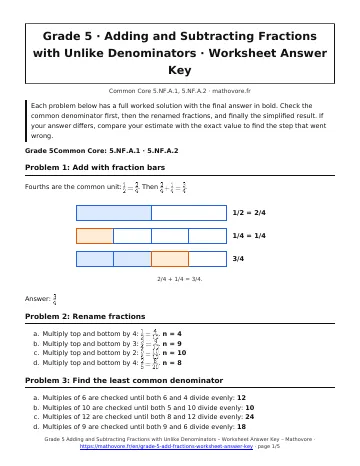
See every chapter on the Grade 5 math page.