



Problem 1: Miles to feet
Multiply by the factor that cancels miles: \(5\text{ mi}\times \frac{5280\text{ ft}}{1\text{ mi}}=26{,}400\text{ ft}\).
26,400 ft
Problem 2: Hours to seconds
\(3.5\text{ h}\times \frac{60\text{ min}}{1\text{ h}}\times \frac{60\text{ s}}{1\text{ min}}=3.5\times 3600\text{ s}=12{,}600\text{ s}\).
12,600 s
Problem 3: Inches to yards
\(72\text{ in}\times \frac{1\text{ yd}}{36\text{ in}}=2\text{ yd}\).
2 yd
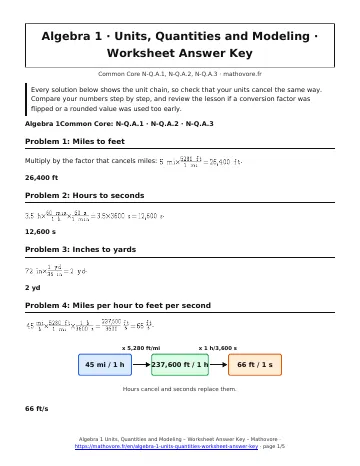
Problem 4: Miles per hour to feet per second
\(45\,\frac{\text{mi}}{\text{h}}\times \frac{5280\text{ ft}}{1\text{ mi}}\times \frac{1\text{ h}}{3600\text{ s}}=\frac{237{,}600}{3600}\,\frac{\text{ft}}{\text{s}}=66\,\frac{\text{ft}}{\text{s}}\).
66 ft/s
Problem 5: Gallons to cups
\(2.5\text{ gal}\times \frac{4\text{ qt}}{1\text{ gal}}\times \frac{4\text{ cups}}{1\text{ qt}}=2.5\times 16=40\text{ cups}\).
40 cups
Problem 6: Units of a product
\(\frac{\$14}{1\text{ h}}\times \frac{18\text{ h}}{1\text{ week}}\times 6\text{ weeks}\): hours cancel and weeks cancel, leaving dollars.
\(14\times 18\times 6=1512\).
\(\$1{,}512\)
Problem 7: Cost per mile
\(\frac{\$3.50}{1\text{ gal}}\times \frac{1\text{ gal}}{28\text{ mi}}=\frac{\$3.50}{28\text{ mi}}=\$0.125\text{ per mi}\).
\(\$0.125\) per mile (12.5 cents)
Problem 8: Weight of water
\(62.4\,\frac{\text{lb}}{\text{ft}^{3}}\times 8\text{ ft}^{3}=499.2\text{ lb}\); cubic feet cancel.
499.2 lb
Problem 9: Acres of a field
Area: \(330\times 330=108{,}900\text{ ft}^{2}\).
\(108{,}900\text{ ft}^{2}\times \frac{1\text{ acre}}{43{,}560\text{ ft}^{2}}=2.5\text{ acres}\).
2.5 acres
Problem 10: Square feet to square yards
\(1\text{ yd}=3\text{ ft}\), so \(1\text{ yd}^{2}=9\text{ ft}^{2}\).
\(540\text{ ft}^{2}\times \frac{1\text{ yd}^{2}}{9\text{ ft}^{2}}=60\text{ yd}^{2}\).
60 yd2
Problem 11: Reading a measurement
The ruler is accurate to the nearest tenth, so the true length is within half a tenth, \(0.05\text{ in}\), of \(3.4\).
\(3.4-0.05\le L< 3.4+0.05\).
\(3.35\le L< 3.45\)
Problem 12: Choosing a vertical scale
Data range: \(340-310=30\).
Graph A: axis height \(400-0=400\), and \(\frac{30}{400}=0.075=7.5\%\).
Graph B: axis height \(350-300=50\), and \(\frac{30}{50}=0.6=60\%\).
Graph A: 7.5%. Graph B: 60%. Graph B shows the changes much more clearly.
Problem 13: Choosing an origin
(a) \(2026-2010=16\), so \(x=16\).
(b) \(P\) is in thousands: \(48.3\times 1000=48{,}300\). The population is 48,300 people.
(c) \(2010+22=2032\). 2032
Problem 14: Defining a quantity
Let \(h\) be the rental time in hours and \(C\) the total cost in dollars. The equation is \(C=8+12h\).
For \(h=3\): \(C=8+36=44\). For \(C=80\): \(12h=72\), so \(h=6\).
\(\$44\) for 3 hours; 6 hours for \(\$80\)
Problem 15: Rounding a product
Each measurement has two significant digits, so the area should not show more than two: \(35.04\approx 35\).
About \(35\text{ in}^{2}\)
Problem 16: Units of a slope
(a) Use \((0,0)\) and \((2,110)\): \(\frac{110-0}{2-0}=55\).
(b) Slope units are \(\frac{\text{miles}}{\text{hours}}\): the truck travels \(55\) miles per hour.
(c) \(d=55\times 3.5=192.5\).
(a) 55 (b) 55 mi/h (c) 192.5 mi
Problem 17: Gallons in a tank
Volume: \(4\times 3\times 2=24\text{ ft}^{3}\).
\(24\text{ ft}^{3}\times \frac{7.48\text{ gal}}{1\text{ ft}^{3}}=179.52\text{ gal}\).
About 179.5 gallons
Problem 18: Percent error of a length
The greatest error is half of the smallest division: \(0.05\text{ ft}\).
\(\frac{0.05}{12.5}=0.004=0.4\%\).
\(0.05\text{ ft}\), or \(0.4\%\)
Problem 19: Speed of sound
\(1125\,\frac{\text{ft}}{\text{s}}\times \frac{1\text{ mi}}{5280\text{ ft}}\times \frac{3600\text{ s}}{1\text{ h}}=\frac{4{,}050{,}000}{5280}\,\frac{\text{mi}}{\text{h}}\approx 767.05\,\frac{\text{mi}}{\text{h}}\).
About 767 mi/h
Problem 20: Walking time
\(8\text{ mi}\times \frac{1\text{ h}}{3.2\text{ mi}}=2.5\text{ h}\).
\(0.5\text{ h}=30\text{ min}\).
2.5 h, or 2 h 30 min
Problem 21: Filling the gas tank
(a) \(12\text{ gal}\times \frac{\$3.80}{1\text{ gal}}=\$45.60\).
(b) \(12\text{ gal}\times \frac{32\text{ mi}}{1\text{ gal}}=384\text{ mi}\).
(c) \(100\text{ mi}\times \frac{1\text{ gal}}{32\text{ mi}}\times \frac{\$3.80}{1\text{ gal}}=\$11.875\approx\$11.88\).
(a) \(\$45.60\) (b) 384 mi (c) \(\$11.88\)
Problem 22: Filling a pool
Time: \(6000\text{ gal}\times \frac{1\text{ min}}{12\text{ gal}}=500\text{ min}\). \(500=8\times 60+20\), so 8 h 20 min.
Cost: \(6\times \$4.50=\$27.00\).
8 h 20 min; \(\$27.00\)
Problem 23: Printing a packet
Time: \(2700\text{ pages}\times \frac{1\text{ min}}{18\text{ pages}}=150\text{ min}=2.5\text{ h}\).
Sheets: \(2700: 2=1350\). Reams: \(1350: 500=2.7\), so Noah must buy \(3\) whole reams.
Cost: \(3\times \$6.25=\$18.75\).
2.5 hours; \(\$18.75\)
See every chapter on the Algebra 1 math page.