Key takeaway: Use this algebra 1 factoring worksheet answer key after you attempt all 24 problems. Each entry shows the factors, the key middle step and a quick multiplication check, so you can see how every product was built.
Compare your method as well as your answer. Many factoring errors hide in one sign inside the middle term, and the check by multiplying exposes it at once. Factors may appear in any order. If your product differs from the printed one, multiply both out before you decide which is wrong.
Each solution shows how the factors were found and, where useful, a check by multiplying. Compare your method as well as your answer, because many factoring errors are sign mistakes in the middle step.
Algebra 1 Factoring Worksheet Answer Key: problems 1–5
1. GCF of a binomial
The GCF of 6 and 9 is 3, and both terms contain \(x\), so the GCF is \(3x\).
\(6x^{2}: 3x=2x\) and \(9x: 3x=3\).
\(3 x (2 x + 3)\)
2. GCF with powers
The GCF of 12 and 20 is 4. The lowest power of \(a\) is \(a^{2}\). So the GCF is \(4a^{2}\).
\(4 a^{2} (3 a – 5)\)
3. GCF of a trinomial
The GCF of 8, 12 and 16 is 4, and the lowest power of \(x\) is \(x\), so the GCF is \(4x\).
\(4 x (2 x^{2} + 3 x – 4)\)
4. Factor x² + bx + c
Find two numbers with product 15 and sum 8: the pairs are 1 and 15 (sum 16) and 3 and 5 (sum 8). Use 3 and 5.
\((x + 3) (x + 5)\)
5. Both numbers negative
The product 20 is positive and the sum \(-9\) is negative, so both numbers are negative. The pair \(-4\) and \(-5\) has product 20 and sum \(-9\).
\((x – 4) (x – 5)\)
Algebra 1 Factoring Worksheet Answer Key: problems 6–10
6. Opposite signs
The product \(-35\) is negative, so the numbers have opposite signs. The pair 7 and \(-5\) has product \(-35\) and sum 2.
\((x + 7) (x – 5)\)
7. Larger negative number
Find two numbers with product \(-28\) and sum \(-3\). The pair \(-7\) and 4 works: \((-7)(4)=-28\) and \(-7+4=-3\).
\((x – 7) (x + 4)\)
8. Difference of squares
\(x^{2}-49=x^{2}-7^{2}\), which fits \(a^{2}-b^{2}=(a+b)(a-b)\).
\((x – 7) (x + 7)\)
9. Difference of squares with a coefficient
\(25x^{2}=(5x)^{2}\) and \(16=4^{2}\), so \(a=5x\) and \(b=4\).
\((5 x – 4) (5 x + 4)\)
10. Perfect square trinomial
The first term is \(x^{2}\) and the last is \(6^{2}\). The middle term is \(2\cdot x\cdot 6=12x\), so the pattern \(a^{2}+2ab+b^{2}\) applies.
\((x + 6)^{2}\)
Algebra 1 Factoring Worksheet Answer Key: problems 11–15
11. Perfect square with a coefficient
\(4x^{2}=(2x)^{2}\) and \(25=5^{2}\). The middle term is \(-2(2x)(5)=-20x\), so the pattern \(a^{2}-2ab+b^{2}\) applies.
\((2 x – 5)^{2}\)
12. Factor ax² + bx + c
\(ac=2\cdot 3=6\). Two numbers with product 6 and sum 7 are 1 and 6.
Split the middle term: \(2x^{2}+x+6x+3\). Group: \(x(2x+1)+3(2x+1)\).
\((2 x + 1) (x + 3)\)
13. ax² + bx + c, negative middle
\(ac=24\). Two numbers with product 24 and sum \(-10\) are \(-4\) and \(-6\).
\(3x^{2}-4x-6x+8=x(3x-4)-2(3x-4)\).
\((3 x – 4) (x – 2)\)
14. ax² + bx + c, negative constant
\(ac=-90\). Two numbers with product \(-90\) and sum 1 are 10 and \(-9\).
\(6x^{2}+10x-9x-15=2x(3x+5)-3(3x+5)\).
\((2 x – 3) (3 x + 5)\)
15. Factor by grouping
Group the first two and last two terms: \((x^{3}+4x^{2})+(3x+12)\). Factor each group: \(x^{2}(x+4)+3(x+4)\).
\((x^{2} + 3) (x + 4)\)
Algebra 1 Factoring Worksheet Answer Key: problems 16–20
16. GCF then difference of squares
Pull out the GCF 2: \(2(x^{2}-16)\). Then \(x^{2}-16=(x-4)(x+4)\).
\(2 (x – 4) (x + 4)\)
17. GCF then perfect square
The GCF is \(3x\): \(3x(x^{2}+6x+9)\). The trinomial is a perfect square: \(x^{2}+6x+9=(x+3)^{2}\).
\(3 x (x + 3)^{2}\)
18. Zeros of a quadratic
Find two numbers with product \(-14\) and sum \(-5\): \(-7\) and 2.
\((x – 7) (x + 2)\) \(=0\). By the zero product property, \(x-7=0\) or \(x+2=0\).
\(x=7\) or \(x=-2\)
19. Zeros with a leading coefficient
\(ac=-12\). Two numbers with product \(-12\) and sum 1 are 4 and \(-3\).
\(2x^{2}+4x-3x-6=2x(x+2)-3(x+2)=(2x-3)(x+2)\).
Set each factor to zero: \(2x-3=0\) gives \(x=\frac{3}{2}\), and \(x+2=0\) gives \(x=-2\).
\(x=\frac{3}{2}\) or \(x=-2\)
20. Dimensions of a rectangle
Numbers with product 14 and sum 9 are 2 and 7, so the area factors as \((x + 2) (x + 7)\). The width is \(x+2\) and the length is \(x+7\).
If \(x+2=5\), then \(x=3\), so the length is \(3+7=10\) feet and the area is \(5\times 10=50\) square feet. Check: \(9+27+14=50\).
length 10 ft, area 50 square feet
Algebra 1 Factoring Worksheet Answer Key: problems 21–24
21. When does the ball land?
Pull out the GCF \(-16\): \(-16(t^{2}-4t-5)\). Then \(t^{2}-4t-5=(t-5)(t+1)\).
\(-16(t-5)(t+1)=0\) gives \(t=5\) or \(t=-1\). Time cannot be negative, so the ball lands after 5 seconds.
Check: \(-16(25)+64(5)+80=-400+320+80=0\).
22. Consecutive integers
Let the integers be \(n\) and \(n+1\). Then \(n(n+1)=156\), which gives \(n^{2}+n-156=0\).
Numbers with product \(-156\) and sum 1: 13 and \(-12\). So \((n+13)(n-12)=0\), and \(n=-13\) or \(n=12\).
The integers are positive, so \(n=12\). Check: \(12\times 13=156\).
12 and 13
23. Is it factored completely?
The product is correct: \((2x)^{2}-6^{2}=4x^{2}-36\). But each binomial still has a common factor of 2: \(2x-6=2(x-3)\) and \(2x+6=2(x+3)\).
A better first step is the GCF: \(4(x^{2}-9)\).
\(4 (x – 3) (x + 3)\)
24. Banner dimensions
\(ac=36\). Two numbers with product 36 and sum 13 are 4 and 9.
\(6x^{2}+4x+9x+6=2x(3x+2)+3(3x+2)\).
\((2 x + 3) (3 x + 2)\)
How do you use the algebra 1 factoring worksheet answer key?
First, cover the printed factors and try again. Next, compare each step. For example, problem 1 gives \(3x(2x+3)\), and problem 2 gives \(4a^{2}(3a-5)\). Problem 3 gives \(4x(2x^{2}+3x-4)\), since 4x divides every term.
Which factorizations are easy to miss?
Next, problem 5 gives \((x-4)(x-5)\), while problem 7 gives \((x-7)(x+4)\). Because the sign of the larger number matters, test the sum. In problem 14, the pair -9 and 10 splits the middle term, so \(6x^{2}+x-15=(2x-3)(3x+5)\). Likewise, problem 16 gives \(2(x-4)(x+4)\), and problem 17 gives \(3x(x+3)^{2}\).
Problem 15 groups to \((x+4)(x^{2}+3)\). However, many students stop after one pair, so check that both pairs share the same binomial.
What do the zeros and applications show?
Problem 18 gives zeros 7 and -2, and problem 19 gives \(\frac{3}{2}\) and -2. The ball in problem 21 lands at \(t=5\) seconds, because \(-16(t-5)(t+1)=0\). Meanwhile, the integers in problem 22 are 12 and 13.
The banner in problem 24 has sides \(2x+3\) and \(3x+2\). Thus a factorization turns an area into two lengths.
How can you learn from a wrong factorization?
First, multiply your answer. Next, find the term that disagrees with the original. Then identify the sign that caused it. Also, list the factor pairs again, because a missing pair is a common cause. After that, redo the problem from the start. Finally, record the slip in a short log.
Which step comes after you review this key?
Group your misses into GCF, trinomial and special-pattern errors. Then rework one problem per group without looking. Finally, factor the same expressions with new coefficients to confirm that the idea, not the memory, carries you through the test.

Printable PDF · Worksheet Answer Key
Algebra 1 Factoring Polynomials worksheet answer key
Download the PDF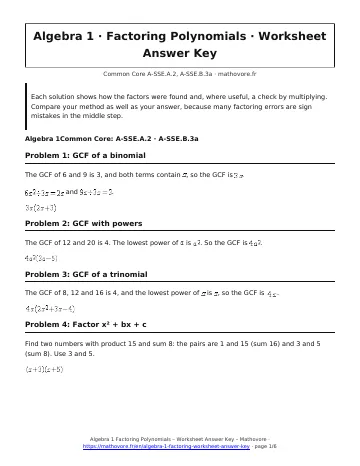
See every chapter on the Algebra 1 math page.