Key takeaway: Use this algebra 1 exponents worksheet answer key after you finish all 25 problems. Each entry gives the rule used, the middle steps and the final form, so you see why a negative exponent flips or why a root splits.
Compare the rule before you compare the answer. If your final form differs, check whether the two expressions are equal before you mark a miss, since several forms can be correct. Then fix the first line that went wrong, and rerun the rest of the work from there.
Every problem has a full worked solution with the final answer in bold. Compare each step with your own work, especially the order of root and power in rational exponents, and the signs in negative exponents.
Algebra 1 Exponents Worksheet Answer Key: problems 1–5
1. Evaluate powers
- \(3^{4}=3\cdot3\cdot3\cdot3=\)\(81\)
- \((-2)^{3}=(-2)(-2)(-2)=\)\(-8\)
- The exponent applies only to 5, so \(-5^{2}=-(5\cdot 5)=\)\(-25\).
2. Pattern of powers of 10
Divide by 10 at each step: \(10^{0}=10: 10=\)\(1\), \(10^{-1}=1: 10=\)\(\frac{1}{10}\), \(10^{-2}=\)\(\frac{1}{100}\).
3. Product rule
- Add the exponents: \(x^{6+3}=\)\(x^{9}\).
- \(a^{1+4}=\)\(a^{5}\).
- \(y^{2+5+1}=\)\(y^{8}\).
4. Quotient rule
- Subtract: \(x^{12-5}=\)\(x^{7}\).
- \(m^{7-1}=\)\(m^{6}\).
- \(b^{6-6}=b^{0}=\)\(1\).
5. Power of a power
- Multiply: \(y^{4\cdot3}=\)\(y^{12}\).
- \(n^{10}\), so \(n^{10}\).
- \(z^{2\cdot6}=\)\(z^{12}\).
Algebra 1 Exponents Worksheet Answer Key: problems 6–10
6. Power of a product
- \(2^{4}a^{12}=\)\(16a^{12}\).
- \((-3)^{3}x^{6}=\)\(-27x^{6}\).
- \(5^{2}p^{2}q^{4}=\)\(25p^{2}q^{4}\).
7. Coefficients and variables
- Multiply coefficients, add exponents: \(12x^{7}\), so \(12x^{7}\).
- \((-2)(5)=-10\), \(a^{3+1}=a^{4}\), \(b^{1+4}=b^{5}\). Answer: \(-10a^{4}b^{5}\).
- \((7)(-1)=-7\) and \(y^{2+6}=y^{8}\). Answer: \(-7y^{8}\).
8. Dividing monomials
- \(20: 5=4\) and \(m^{8-3}=m^{5}\): \(4m^{5}\).
- \(36: 12=3\), \(x^{5-1}=x^{4}\), \(y^{4-2}=y^{2}\): \(3x^{4}y^{2}\).
- \(-18: 6=-3\) and \(a^{9-9}=1\): \(-3\).
9. Negative exponents
- Only \(x\) has the negative exponent: \(\dfrac{4}{x^{3}}\).
- Move \(m^{-2}\) to the numerator: \(5m^{2}\).
- \(2^{-5}=\dfrac{1}{2^{5}}=\)\(\dfrac{1}{32}\).
10. Mixed exponent rules
- \(x^{5-8}=x^{-3}=\)\(\dfrac{1}{x^{3}}\).
- \(4x^{6}\cdot x^{-4}=\)\(4x^{2}\).
- \(a^{-2-3}b^{5-2}=a^{-5}b^{3}=\)\(\dfrac{b^{3}}{a^{5}}\).
Algebra 1 Exponents Worksheet Answer Key: problems 11–15
11. Unit-fraction exponents
- \(\sqrt{25}=\)\(5\) because \(5^{2}=25\).
- \(\sqrt[3]{64}=\)\(4\) because \(4^{3}=64\).
- \(\sqrt[4]{81}=\)\(3\) because \(3^{4}=81\).
12. Radicals to exponents
- \(7^{1/2}\)
- The index 3 is the denominator, the power 5 the numerator: \(x^{5/3}\).
- \(a^{3/4}\)
13. Exponents to radicals
- \(\sqrt{x}\)
- \(\sqrt[3]{y^{2}}\), which equals \((\sqrt[3]{y})^{2}\).
- \(\sqrt[4]{5^{3}}\), which equals \(\sqrt[4]{125}\).
14. Rational powers
- \(8^{2/3}=(\sqrt[3]{8})^{2}=2^{2}=\)\(4\).
- \(4^{3/2}=(\sqrt{4})^{3}=2^{3}=\)\(8\).
- \(81^{3/4}=(\sqrt[4]{81})^{3}=3^{3}=\)\(27\).
15. Negative rational powers
- \(27^{2/3}=9\), so \(27^{-2/3}=\)\(\dfrac{1}{9}\).
- \(16^{1/2}=4\), so \(16^{-1/2}=\)\(\dfrac{1}{4}\).
- \(32^{3/5}=2^{3}=8\), so \(32^{-3/5}=\)\(\dfrac{1}{8}\).
Algebra 1 Exponents Worksheet Answer Key: problems 16–20
16. Reading a graph
- The point (9, 3) is on the graph, so \(9^{1/2}=\)\(3\).
- 10 is just past 9, so the curve is a little above 3: about 3.2 (the calculator value is 3.16).
- \(x^{1/2}=4\) means \(x=4^{2}=\)\(16\).
17. Simplify numeric square roots
- \(\sqrt{50}=\sqrt{25\cdot2}=\)\(5\sqrt{2}\).
- The largest perfect square factor of 48 is 16: \(\sqrt{16\cdot3}=\)\(4\sqrt{3}\).
- \(\sqrt{100\cdot2}=\)\(10\sqrt{2}\).
18. Rational exponent rules
- Add: \(x^{1/2+3/2}=x^{2}\), so \(x^{2}\).
- Subtract: \(x^{5/3-2/3}=x^{1}\), so \(x\).
- Multiply: \(x^{3/4\cdot2}=x^{3/2}\), so \(x^{3/2}\).
- \(x^{2/3\cdot6}=x^{4}\), so \(x^{4}\).
19. Square roots with variables
- \(x^{6/2}=\)\(x^{3}\).
- \(\sqrt{9\cdot2\cdot x^{4}}=3x^{2}\sqrt{2}\), so \(3x^{2}\sqrt{2}\).
- \(75a^{5}=25\cdot3\cdot a^{4}\cdot a\), so the root is \(5a^{2}\sqrt{3a}\).
20. Square garden
\(s=\sqrt{98}=\sqrt{49\cdot2}=\)\(7\sqrt{2}\text{ ft}\)\(\approx\)\(9.9\text{ ft}\).
Perimeter: \(4\cdot7\sqrt{2}=28\sqrt{2}\approx\)\(39.6\text{ ft}\) of fencing.
Algebra 1 Exponents Worksheet Answer Key: problems 21–25
21. Orbit model
- \(4^{3/2}=(\sqrt{4})^{3}=2^{3}=\)\(8\text{ years}\). \(9^{3/2}=(\sqrt{9})^{3}=3^{3}=\)\(27\text{ years}\). Both match the graph.
- \(d^{3/2}=64\). Raise both sides to the power \(\frac{2}{3}\): \(d=64^{2/3}=(\sqrt[3]{64})^{2}=4^{2}=\)\(16\text{ AU}\). Check: \(16^{3/2}=4^{3}=64\).
22. Cube crate
\(s^{3}=512\), so \(s=512^{1/3}=\sqrt[3]{512}=\)\(8\text{ in}\) because \(8^{3}=512\).
A cube has 6 square faces: \(6\cdot8^{2}=6\cdot64=\)\(384\text{ square inches}\).
23. Patio diagonal
\(d^{2}=6^{2}+6^{2}=72\), so \(d=\sqrt{72}=\sqrt{36\cdot2}=\)\(6\sqrt{2}\text{ ft}\)\(\approx\)\(8.5\text{ ft}\).
24. Find the errors
- Jamal did not cube the coefficient. \((2x^{3})^{3}=2^{3}x^{9}=\)\(8x^{9}\).
- Aisha multiplied the base by the exponent. The denominator 2 means a square root: \(16^{3/2}=(\sqrt{16})^{3}=4^{3}=\)\(64\).
25. Cube with a variable edge
Edge: \((27x^{6})^{1/3}=27^{1/3}\cdot x^{6/3}=\)\(3x^{2}\). Check: \((3x^{2})^{3}=27x^{6}\).
Surface area: \(6\cdot(3x^{2})^{2}=6\cdot9x^{4}=\)\(54x^{4}\)\(\text{ square units}\).
How do you use the algebra 1 exponents worksheet answer key?
Hide the printed solution and rework the problem. Then uncover one line at a time. For example, problem 1 gives \(3^{4}=81\), \((-2)^{3}=-8\) and \(-5^{2}=-25\). Notice that the exponent applies only to the 5 in the last case.
Which answers surprise students?
Problem 14 gives \(8^{2/3}=4\), \(4^{3/2}=8\) and \(81^{3/4}=27\). In each case, the root comes first, so the numbers stay small. Problem 15 gives \(27^{-2/3}=\frac{1}{9}\), \(16^{-1/2}=\frac{1}{4}\) and \(32^{-3/5}=\frac{1}{8}\). Therefore, a negative sign only flips the result.
Problem 17 gives \(\sqrt{50}=5\sqrt{2}\), \(\sqrt{48}=4\sqrt{3}\) and \(\sqrt{200}=10\sqrt{2}\). However, some students stop at \(\sqrt{4}\cdot\sqrt{12}\), which is not simplified yet.
What do the application answers look like?
The garden in problem 20 has side \(7\sqrt{2}\) feet, about 9.90 feet. The crate in problem 22 has edge 8 inches, because \(512^{1/3}=8\). Likewise, the rope in problem 23 is \(6\sqrt{2}\) feet, roughly 8.49 feet.
In problem 24, the correct work is \((2x^{3})^{3}=8x^{9}\), since 2 is cubed as well. Finally, problem 25 gives an edge of \(3x^{2}\), because \(27x^{6}\) has cube root \(3x^{2}\).
How should you handle a wrong answer?
First, name the rule you broke. Next, write one fresh example with small numbers. Then solve it twice, once with the rule and once by expanding. If both agree, the rule is secure. Also, keep a card of the three most common slips for the next set.
What comes after checking this key?
Sort your misses into exponent rules, negative or rational powers, and radicals. Then revisit the matching lesson section and redo one item from each group. When the corrected work feels natural, try the test and watch for the same three slips.

Printable PDF · Worksheet Answer Key
Algebra 1 Exponent Rules, Radicals and Rational Exponents worksheet answer key
Download the PDF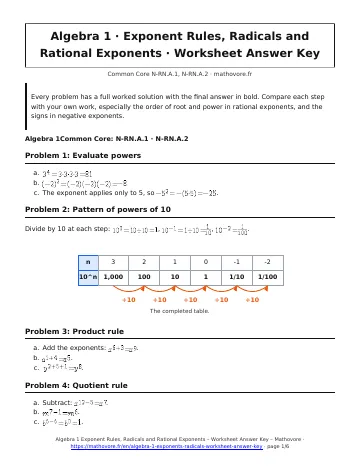
See every chapter on the Algebra 1 math page.