



This ap calculus analyzing worksheet answer key solves all 24 problems of the analyzing functions with derivatives worksheet step by step.
Full worked solutions for all 24 problems on analyzing functions. Each solution shows the derivative, the sign analysis or theorem that supports the conclusion, and the final answer in bold. Compare your reasoning, not just your final numbers.
AP Calculus Analyzing Worksheet Answer Key: problems 1–5
Problem 1: Critical numbers
\(f\) is a polynomial, so \(f^{\prime}\) exists everywhere. \(f^{\prime}(x)=6x^{2}-6x-36=6(x^{2}-x-6)=6(x-3)(x+2)\).
Setting \(f^{\prime}(x)=0\) gives \(x=3\) and \(x=-2\). Answer: the critical numbers are \(x=-2\) and \(x=3\).
Problem 2: Increasing and decreasing
\(g^{\prime}(x)=4x^{3}-16x=4x(x-2)(x+2)\), so the critical numbers are \(-2, 0, 2\).
Test points: \(g^{\prime}(-3)=-60 < 0\); \(g^{\prime}(-1)=12 > 0\); \(g^{\prime}(1)=-12 < 0\); \(g^{\prime}(3)=60 > 0\).
Increasing on \((-2,0)\) and \((2,\infty)\); decreasing on \((-\infty,-2)\) and \((0,2)\). The sign changes give local minima at \(x=\pm 2\) with \(g(\pm 2)=-16\) and a local maximum at \(x=0\) with \(g(0)=0\). Answer: increasing on \((-2,0)\) and \((2,\infty)\), decreasing on \((-\infty,-2)\) and \((0,2)\).
Problem 3: First Derivative Test
\(h^{\prime}(x)=3x^{2}-12=3(x-2)(x+2)\), so the critical numbers are \(-2\) and \(2\).
For \(x < -2\), \(h^{\prime} > 0\); for \(-2 < x < 2\), \(h^{\prime} < 0\); for \(x > 2\), \(h^{\prime} > 0\).
At \(x=-2\) the sign changes from \(+\) to \(-\): local maximum, \(h(-2)=-8+24+4=20\). At \(x=2\) it changes from \(-\) to \(+\): local minimum, \(h(2)=8-24+4=-12\). Answer: local maximum \((-2,20)\), local minimum \((2,-12)\).
Problem 4: Concavity of a quartic
\(f^{\prime}(x)=4x^{3}-12x^{2}\) and \(f^{\prime\prime}(x)=12x^{2}-24x=12x(x-2)\). The zeros of \(f^{\prime\prime}\) are \(x=0\) and \(x=2\).
\(f^{\prime\prime} > 0\) for \(x < 0\) and \(x > 2\); \(f^{\prime\prime} < 0\) for \(0 < x < 2\). The sign changes at both zeros, with \(f(0)=0\) and \(f(2)=16-32=-16\).
Answer: concave up on \((-\infty,0)\) and \((2,\infty)\), concave down on \((0,2)\), inflection points \((0,0)\) and \((2,-16)\).
Problem 5: Second Derivative Test
\(p^{\prime}(x)=6x^{2}-18x+12=6(x-1)(x-2)\), so \(x=1\) and \(x=2\). Also \(p^{\prime\prime}(x)=12x-18\).
\(p^{\prime\prime}(1)=-6 < 0\), so there is a local maximum, \(p(1)=2-9+12=5\). \(p^{\prime\prime}(2)=6 > 0\), so there is a local minimum, \(p(2)=16-36+24=4\).
Answer: local maximum at \((1,5)\), local minimum at \((2,4)\).
AP Calculus Analyzing Worksheet Answer Key: problems 6–10
Problem 6: Mean Value Theorem, quadratic
\(f\) is a polynomial, so it is continuous on \([0,5]\) and differentiable on \((0,5)\). The average rate of change is \(\frac{f(5)-f(0)}{5-0}=\frac{5-0}{5}=1\).
Solve \(f^{\prime}(c)=2c-4=1\): \(c=\frac{5}{2}\), which lies in \((0,5)\). Answer: \(c=\frac{5}{2}\).
Problem 7: Mean Value Theorem, shifted square root
\(\sqrt{x+1}\) is continuous on \([0,8]\) and differentiable on \((0,8)\). The average rate of change is \(\frac{3-1}{8-0}=\frac{1}{4}\).
\(f^{\prime}(c)=\frac{1}{2\sqrt{c+1}}=\frac{1}{4}\) gives \(\sqrt{c+1}=2\), so \(c+1=4\) and \(c=3\), which is in \((0,8)\). Answer: \(c=3\).
Problem 8: When the theorem fails
\(f\) is not differentiable at \(x=2\), which lies in \((0,5)\) (the graph has a corner), so a hypothesis fails.
The average rate of change is \(\frac{f(5)-f(0)}{5}=\frac{3-2}{5}=\frac{1}{5}\). But \(f^{\prime}(x)=-1\) for \(x < 2\) and \(f^{\prime}(x)=1\) for \(x > 2\), so \(f^{\prime}(x)\) never equals \(\frac{1}{5}\). Answer: not differentiable at \(x=2\); no such \(c\) exists.
Problem 9: Candidates Test, cubic
\(f^{\prime}(x)=6x^{2}-6x-12=6(x-2)(x+1)\), so the critical numbers \(-1\) and \(2\) are both in \([-2,3]\).
| \(x\) | \(-2\) | \(-1\) | \(2\) | \(3\) |
|---|---|---|---|---|
| \(f(x)\) | \(-3\) | \(8\) | \(-19\) | \(-8\) |
Answer: absolute maximum \(8\) at \(x=-1\); absolute minimum \(-19\) at \(x=2\).
Problem 10: Candidates Test, trigonometric
\(f^{\prime}(x)=1-2\sin x=0\) gives \(\sin x=\frac{1}{2}\), so \(x=\frac{\pi}{6}\) or \(x=\frac{5\pi}{6}\).
\(f(0)=2\); \(f(\frac{\pi}{6})=\frac{\pi}{6}+\sqrt{3}\approx 2.256\); \(f(\frac{5\pi}{6})=\frac{5\pi}{6}-\sqrt{3}\approx 0.886\); \(f(\pi)=\pi-2\approx 1.142\).
Answer: absolute maximum \(\frac{\pi}{6}+\sqrt{3}\), absolute minimum \(\frac{5\pi}{6}-\sqrt{3}\).
AP Calculus Analyzing Worksheet Answer Key: problems 11–15
Problem 11: Points of inflection
\(f^{\prime}(x)=4x^{3}-24x^{2}+36x\) and \(f^{\prime\prime}(x)=12x^{2}-48x+36=12(x-1)(x-3)\).
\(f^{\prime\prime} > 0\) for \(x < 1\), \(f^{\prime\prime} < 0\) for \(1 < x < 3\), and \(f^{\prime\prime} > 0\) for \(x > 3\), so the concavity changes at both zeros. \(f(1)=1-8+18=11\) and \(f(3)=81-216+162=27\).
Answer: inflection points \((1,11)\) and \((3,27)\).
Problem 12: Not an inflection point
\(f^{\prime\prime}(x)=12x^{2}\), so \(f^{\prime\prime}(0)=0\). However, \(12x^{2} > 0\) for every \(x\neq 0\), so \(f^{\prime\prime}\) does not change sign at \(0\). The graph stays concave up on both sides. Answer: no inflection, because the concavity never changes.
Problem 13: Reading the graph of f prime
Signs of \(f^{\prime}\): negative for \(x < -2\), positive on \((-2,1)\), negative on \((1,3)\), positive for \(x > 3\).
- \(f\) is increasing where \(f^{\prime} > 0\): \((-2,1)\) and \((3,\infty)\).
- The sign changes of \(f^{\prime}\): \(-\) to \(+\) at \(x=-2\) (local minimum), \(+\) to \(-\) at \(x=1\) (local maximum), \(-\) to \(+\) at \(x=3\) (local minimum). Answer: local minima at \(x=-2\) and \(x=3\), local maximum at \(x=1\).
- Expand \((x+2)(x-1)(x-3)=x^{3}-2x^{2}-5x+6\), so \(f^{\prime\prime}(x)=\frac{1}{2}(3x^{2}-4x-5)\). Setting it to zero: \(x=\frac{4\pm\sqrt{76}}{6}=\frac{2\pm\sqrt{19}}{3}\), and \(f^{\prime}\) changes from increasing to decreasing and back there. Answer: \(x=\frac{2\pm\sqrt{19}}{3}\approx -0.79\) and \(2.12\).
Problem 14: Derivative given in factored form
The critical numbers are \(x=-2\) and \(x=1\). The factor \((x-1)^{2}\) is never negative.
For \(x < -2\): \(h^{\prime} < 0\). For \(-2 < x < 1\): \(h^{\prime} > 0\). For \(x > 1\): \(h^{\prime} > 0\).
\(h^{\prime}\) changes from \(-\) to \(+\) at \(x=-2\), a local minimum. At \(x=1\) the sign stays positive, so there is no extremum. Answer: only a local minimum at \(x=-2\).
Problem 15: A logarithmic function
\(f^{\prime}(x)=1-\frac{2}{x}=0\) gives \(x=2\). \(f^{\prime} < 0\) on \((0,2)\) and \(f^{\prime} > 0\) on \((2,\infty)\), so \(f\) has its absolute minimum at \(x=2\): \(f(2)=2-2\ln 2\approx 0.614\).
\(f^{\prime\prime}(x)=\frac{2}{x^{2}} > 0\) for all \(x > 0\), so \(f\) is concave up everywhere with no inflection point. Answer: minimum value \(2-2\ln 2\); concave up on \((0,\infty)\).
AP Calculus Analyzing Worksheet Answer Key: problems 16–20
Problem 16: Complete function analysis
\(f^{\prime}(x)=4x^{3}-12x^{2}=4x^{2}(x-3)\), so the critical numbers are \(0\) and \(3\). \(f^{\prime} < 0\) for \(x < 3\) (\(x\neq 0\)) and \(f^{\prime} > 0\) for \(x > 3\). Decreasing on \((-\infty,3)\), increasing on \((3,\infty)\). Only \(x=3\) gives an extremum: a local (and absolute) minimum \(f(3)=81-108=-27\); \(x=0\) is not an extremum.
\(f^{\prime\prime}(x)=12x^{2}-24x=12x(x-2)\). Concave up on \((-\infty,0)\) and \((2,\infty)\), concave down on \((0,2)\). Inflection points: \((0,0)\) and \((2,-16)\).
Answer: minimum \((3,-27)\); inflection points \((0,0)\) and \((2,-16)\).
Problem 17: Concavity of an implicit curve
Differentiate: \(2x+2y\frac{dy}{dx}=0\), so \(\frac{dy}{dx}=-\frac{x}{y}\).
Differentiate again: \(\frac{d^{2}y}{dx^{2}}=-\frac{y-x\frac{dy}{dx}}{y^{2}}=-\frac{y+\frac{x^{2}}{y}}{y^{2}}=-\frac{y^{2}+x^{2}}{y^{3}}=-\frac{25}{y^{3}}\).
At \((3,4)\): \(-\frac{25}{64} < 0\). Answer: \(\frac{d^{2}y}{dx^{2}}=-\frac{25}{y^{3}}\); concave down at \((3,4)\).
Problem 18: Tangent lines to a circle
Differentiate: \(2x+2y\frac{dy}{dx}-6+4\frac{dy}{dx}=0\), so \(\frac{dy}{dx}=\frac{3-x}{y+2}\).
A horizontal tangent needs \(\frac{dy}{dx}=0\) with \(y\neq -2\), so \(x=3\). Substitute: \(9+y^{2}-18+4y=12\), so \(y^{2}+4y-21=0\), \((y+7)(y-3)=0\), \(y=3\) or \(y=-7\).
Answer: \((3,3)\) and \((3,-7)\).
Problem 19: Fencing against a barn
Let \(x\) be the length of each side perpendicular to the barn. The side parallel to the barn is \(120-2x\), so \(A(x)=x(120-2x)=120x-2x^{2}\) on \(0 < x < 60\).
\(A^{\prime}(x)=120-4x=0\) gives \(x=30\), and \(A^{\prime\prime}=-4 < 0\), so this is a maximum. (The endpoints give area \(0\).)
Then the parallel side is \(120-60=60\) ft, and \(A(30)=30\cdot 60=1800\). Answer: 30 ft by 60 ft, area 1800 square feet.
Problem 20: Open-top box
The base is \(12-2x\) on each side and the height is \(x\), so \(V(x)=x(12-2x)^{2}\) on \([0,6]\).
\(V^{\prime}(x)=(12-2x)^{2}+x\cdot 2(12-2x)(-2)=(12-2x)(12-6x)\). Setting it to zero: \(x=6\) or \(x=2\).
Candidates: \(V(0)=0\), \(V(2)=2\cdot 8^{2}=128\), \(V(6)=0\).
Answer: \(x=2\) in, maximum volume \(128\) cubic inches (an \(8\times 8\times 2\) box).
AP Calculus Analyzing Worksheet Answer Key: problems 21–24
Problem 21: Can of minimum surface area
\(\pi r^{2}h=16\pi\) gives \(h=\frac{16}{r^{2}}\). Then \(S=2\pi r^{2}+2\pi rh=2\pi r^{2}+\frac{32\pi}{r}\) for \(r > 0\).
\(S^{\prime}(r)=4\pi r-\frac{32\pi}{r^{2}}=0\) gives \(r^{3}=8\), so \(r=2\). \(S^{\prime\prime}(r)=4\pi+\frac{64\pi}{r^{3}} > 0\), so this is a minimum.
Then \(h=\frac{16}{4}=4\) and \(S(2)=8\pi+16\pi=24\pi\). Answer: \(r=2\) in, \(h=4\) in, \(S=24\pi\approx 75.4\) square inches.
Problem 22: Closest point on a curve
The squared distance from \((x,\sqrt{x})\) to \((3,0)\) is \(D(x)=(x-3)^{2}+x\) for \(x\ge 0\). Minimizing \(D\) also minimizes the distance.
\(D^{\prime}(x)=2(x-3)+1=0\) gives \(x=\frac{5}{2}\). \(D^{\prime\prime}=2 > 0\), so this is a minimum.
\(D(\frac{5}{2})=\frac{1}{4}+\frac{5}{2}=\frac{11}{4}\), so the distance is \(\frac{\sqrt{11}}{2}\approx 1.66\), at the point \((\frac{5}{2},\frac{\sqrt{10}}{2})\). Answer: closest point \((\frac{5}{2},\sqrt{\frac{5}{2}})\), distance \(\frac{\sqrt{11}}{2}\).
Problem 23: Height of a thrown ball
\(s^{\prime}(t)=-32t+64=0\) gives \(t=2\), and \(s^{\prime\prime}=-32 < 0\), so this is the maximum. \(s(2)=-64+128+5=69\).
The velocity at \(t=3\) is \(s^{\prime}(3)=-96+64=-32\) ft/s, so the ball is falling. Answer: maximum height 69 ft at \(t=2\) s; velocity \(-32\) ft/s at \(t=3\).
Problem 24: Maximum profit
\(P^{\prime}(x)=-0.04x+8=0\) gives \(x=200\), and \(P^{\prime\prime}(x)=-0.04 < 0\), so profit is maximized at \(x=200\).
\(P(200)=-0.02(40{,}000)+1600-300=-800+1300=500\). Answer: 200 cupcakes, maximum profit $500.
How to use this ap calculus analyzing worksheet answer key
Read this ap calculus analyzing worksheet answer key after trying each problem yourself, and redo any problem you missed.

Printable PDF · Worksheet Answer Key
AP Calculus AB Analyzing Functions with Derivatives worksheet answer key
Download the PDF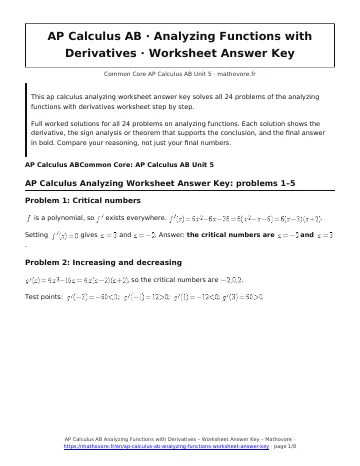
See every chapter on the AP Calculus AB math page.