This geometry modeling 3d lesson explains cross sections, solids of rotation and geometric modeling in one printable page, with definitions, a method and a worked example.
A cross section is the 2D shape made when a plane slices a 3D solid, and rotating a 2D shape about an axis builds a solid. Geometric modeling uses these solids to describe real objects, find density as amount per area or volume, and choose designs that meet constraints.
Geometry Modeling 3d Lesson: key facts
- Standards G-GMD.B.4, G-MG.A.1, G-MG.A.2 and G-MG.A.3 cover cross sections, rotations, modeling, density and design problems.
- A plane parallel to the base of a cylinder, cone or sphere makes a circle; through the axis it makes a rectangle or triangle.
- A rectangle spins into a cylinder, a right triangle into a cone, and a semicircle into a sphere.
- Density = amount ÷ area or volume, such as people per square mile or BTUs per cubic foot.
- Design problems pick the best option that satisfies constraints on size, material or cost.
What is a cross section of a solid?
A cross section is the flat shape you see where a plane slices through a solid. The shape depends on the solid and on the angle of the cut. A slanted cut through a cylinder or a cone makes an ellipse.
| Solid | Parallel to the base | Perpendicular to the base, through the center |
|---|---|---|
| Cylinder | Circle | Rectangle |
| Cone | Circle | Triangle |
| Sphere | Circle | Circle |
| Square pyramid | Smaller square | Triangle |
| Rectangular prism | Rectangle | Rectangle |
Which solids come from rotating a flat shape?
Spin a 2D shape about a line called the axis and it sweeps out a solid. A rectangle spun about one side makes a cylinder, a right triangle spun about a leg makes a cone, and a semicircle spun about its diameter makes a sphere. A \(3\text{ cm}\) by \(5\text{ cm}\) rectangle spun about its \(5\text{ cm}\) side makes a cylinder with radius \(3\text{ cm}\) and height \(5\text{ cm}\).
How do you model real objects with geometric shapes?
Choose the solid that best matches the object, measure the key lengths, and use that solid's formula. A tree trunk is close to a cylinder, a party hat is a cone, and a basketball is a sphere. The model gives an estimate, not an exact value.
What is density and how do you calculate it?
Density is an amount divided by a measure of space: \(\text{density}=\frac{\text{amount}}{\text{area or volume}}\). Examples: people per square mile, BTUs per cubic foot, grams per cubic centimeter.
Worked example. A town has 12,000 people in 8 square miles. The population density is \(12{,}000: 8=1{,}500\) people per square mile.
How do you solve a design problem with constraints?
- List the constraints, such as total fence length, required volume, or budget.
- Write formulas for the quantity to improve, such as area, surface area, or cost.
- Test several designs in a table.
- Choose the best design and check that it meets every constraint.
Worked example. Jamal has \(40\text{ ft}\) of fence for a rectangular garden. A \(5\text{ ft}\) by \(15\text{ ft}\) garden has area \(75\text{ ft}^{2}\), \(8\) by \(12\) has \(96\text{ ft}^{2}\), and \(10\) by \(10\) has \(100\text{ ft}^{2}\). The square garden gives the most room.
Cross Sections, Solids of Rotation and Geometric Modeling: frequently asked questions
What shape is a cross section of a cylinder?
A plane parallel to the bases gives a circle, and a plane through the axis gives a rectangle. A slanted plane gives an ellipse.
What solid is made by rotating a right triangle?
Spinning a right triangle about one of its legs makes a cone. The leg on the axis becomes the height and the other leg becomes the radius.
How do you find population density?
Divide the number of people by the land area. A county with 31,200 people on 40 square miles has a density of 780 people per square mile.
Why can two boxes with the same volume cost different amounts?
Cost depends on the material used, which is the surface area. Boxes with equal volume can have different surface areas, so one needs more cardboard.
What is a constraint in a design problem?
A constraint is a limit the design must meet, such as a fixed amount of fence, a required volume or a maximum cost. The best design meets every constraint.
How to use this geometry modeling 3d lesson
Use this geometry modeling 3d lesson before the worksheet, then check what you learned with the quiz.

Printable PDF · Lesson
Geometry Cross Sections, Solids of Rotation and Geometric Modeling lesson
Download the PDF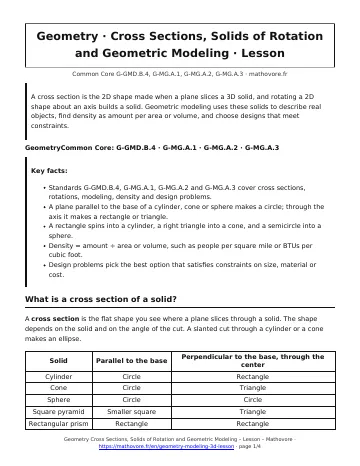
- Cross Sections, Solids of Rotation and Geometric Modeling worksheet (24 problems)
- Cross Sections, Solids of Rotation and Geometric Modeling quiz (10 questions)
- Cross Sections, Solids of Rotation and Geometric Modeling test (45 minutes)
- Previous lesson: Area and Volume Formulas
- Next lesson: Probability: Independence, Conditional Probability and Fair Decisions
See every chapter on the Geometry math page.