



This algebra 1 transformations worksheet answer key solves all 24 problems of the transformations, absolute value and piecewise functions worksheet step by step.
Every solution shows the rule used and the check. Compare your graphs with the figures, paying attention to vertices, open circles and closed circles, and rewrite any problem where your answer differs.
Algebra 1 Transformations Worksheet Answer Key: problems 1–5
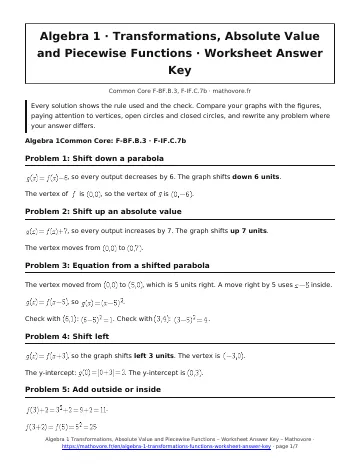
Problem 1: Shift down a parabola
\(g(x)=f(x)-6\), so every output decreases by 6. The graph shifts down 6 units.
The vertex of \(f\) is \((0,0)\), so the vertex of \(g\) is \((0,-6)\).
Problem 2: Shift up an absolute value
\(g(x)=f(x)+7\), so every output increases by 7. The graph shifts up 7 units.
The vertex moves from \((0,0)\) to \((0,7)\).
Problem 3: Equation from a shifted parabola
The vertex moved from \((0,0)\) to \((5,0)\), which is 5 units right. A move right by 5 uses \(x-5\) inside.
\(g(x)=f(x-5)\), so \(g(x)=(x-5)^{2}\).
Check with \((6,1)\): \((6-5)^{2}=1\). Check with \((3,4)\): \((3-5)^{2}=4\).
Problem 4: Shift left
\(g(x)=f(x+3)\), so the graph shifts left 3 units. The vertex is \((-3,0)\).
The y-intercept: \(g(0)=|0+3|=3\). The y-intercept is \((0,3)\).
Problem 5: Add outside or inside
\(f(3)+2=3^{2}+2=9+2=11\).
\(f(3+2)=f(5)=5^{2}=25\).
The results differ because the first adds 2 to the output (a vertical shift) and the second adds 2 to the input (a horizontal shift). 11 and 25
Algebra 1 Transformations Worksheet Answer Key: problems 6–10
Problem 6: Stretch table
Substitute each value:
| \(x\) | \(-2\) | \(-1\) | \(0\) | \(1\) | \(2\) |
|---|---|---|---|---|---|
| \(f(x)\) | 2 | 1 | 0 | 1 | 2 |
| \(g(x)\) | 6 | 3 | 0 | 3 | 6 |
Each y-value of \(g\) is 3 times the matching y-value of \(f\). The graph is a vertical stretch by a factor of 3; the vertex stays at \((0,0)\).
Problem 7: Equation from an absolute value graph
The vertex is \((2,-3)\), so \(h=2\) and \(k=-3\).
\(g(x)=|x-2|-3\)
Check with \((5,0)\): \(|5-2|-3=3-3=0\). Check with \((0,-1)\): \(|0-2|-3=2-3=-1\).
Problem 8: Reflect and shrink
Compare \((2,4)\) on \(f\) with \((2,-2)\) on \(g\): \(-2=-\frac{1}{2}\cdot 4\). Compare \(f(4)=16\) with \(g(4)=-8\): \(-8=-\frac{1}{2}\cdot 16\).
So \(g(x)=-\frac{1}{2}f(x)\), that is \(g(x)=-\frac{1}{2}x^{2}\).
The graph is flipped over the x-axis (the negative sign) and shrunk vertically by a factor of \(\frac{1}{2}\).
Problem 9: Transform a linear function
(a) \(g(x)=(2x+1)+3=2x+4\).
(b) \(h(x)=2(x+3)+1=2x+6+1=2x+7\).
(c) \(k(x)=-(2x+1)=-2x-1\).
Notice that shifting the line left 3 units gave the same line as shifting it up 6 units, because the slope is 2. (a) \(2x+4\); (b) \(2x+7\); (c) \(-2x-1\)
Problem 10: Vertex and range
Here \(h=4\) and \(k=2\). The vertex is \((4,2)\).
The axis of symmetry is the vertical line through the vertex: \(x=4\).
The graph opens up, so the minimum value is 2.
Domain: all real numbers. Range: \(y\ge 2\).
Algebra 1 Transformations Worksheet Answer Key: problems 11–15
Problem 11: Graph an absolute value function
Substitute each \(x\):
| \(x\) | \(-2\) | \(-1\) | \(0\) | \(1\) | \(2\) | \(3\) | \(4\) |
|---|---|---|---|---|---|---|---|
| \(y\) | 1 | 0 | -1 | -2 | -1 | 0 | 1 |
For example, \(x=-2\): \(|-2-1|-2=3-2=1\). Plot the points and draw two rays meeting at the vertex \((1,-2)\).
Problem 12: Intercepts of an absolute value graph
y-intercept: \(g(0)=2|0+1|-4=2-4=-2\), so \((0,-2)\).
x-intercepts: set \(2|x+1|-4=0\). Then \(2|x+1|=4\) and \(|x+1|=2\). So \(x+1=2\) or \(x+1=-2\), giving \(x=1\) or \(x=-3\).
x-intercepts \((1,0)\) and \((-3,0)\)
Problem 13: An absolute value that opens down
The vertex is \((3,5)\). Because \(a=-1 < 0\), the graph opens down and the maximum value is 5.
y-intercept: \(h(0)=-|0-3|+5=-3+5=2\), so \((0,2)\).
x-intercepts: \(-|x-3|+5=0\) gives \(|x-3|=5\), so \(x-3=5\) or \(x-3=-5\), and \(x=8\) or \(x=-2\). \((8,0)\) and \((-2,0)\)
Problem 14: Evaluate a piecewise function
\(-3 < 0\), so use \(x+4\): \(f(-3)=-3+4=1\).
\(-1 < 0\): \(f(-1)=-1+4=3\).
\(0\ge 0\), so use \(x^{2}\): \(f(0)=0^{2}=0\).
\(2\ge 0\): \(f(2)=2^{2}=4\). 1, 3, 0, 4
Problem 15: Graph a piecewise function
Left piece, \(x < 2\): \(f(-4)=-1\), \(f(0)=1\), and at \(x=2\) the rule gives \(\frac{1}{2}(2)+1=2\), an open circle at \((2,2)\).
Right piece, \(x\ge 2\): \(f(2)=-2+5=3\), a closed circle at \((2,3)\); then \(f(3)=2\) and \(f(6)=-1\).
Algebra 1 Transformations Worksheet Answer Key: problems 16–20
Problem 16: Write a piecewise function
Piece 1: horizontal at \(y=2\), with a closed circle at \(x=-1\): \(f(x)=2\) for \(-4\le x\le -1\).
Piece 2: from \((-1,0)\) (open) to \((3,4)\) (closed), slope \(\frac{4-0}{3-(-1)}=1\), so \(y=x+1\) for \(-1 < x\le 3\).
Piece 3: from \((3,3)\) (open) to \((6,0)\), slope \(\frac{0-3}{6-3}=-1\), so \(y=6-x\) for \(3 < x\le 6\).
\(f(-4)=2\); \(f(3)=3+1=4\) (piece 2, because 3 is included there); \(f(5)=6-5=1\). 2, 4, 1
Problem 17: Greatest integer step function
\(s(3.7)=3\), because 3 is the greatest integer not exceeding 3.7.
\(s(-1.2)=-2\), because \(-2\le -1.2\) but \(-1>-1.2\).
\(s(5)=5\) and \(s(-4)=-4\), since integers map to themselves.
\(s(0.99)=0\). 3, -2, 5, -4, 0
Problem 18: Check a point
\(g(4)=-2|4-1|+6=-2(3)+6=0\). The y-value is 0, so \((4,0)\) is on the graph.
\(g(-2)=-2|-2-1|+6=-2(3)+6=0\), not 2. So \((-2,2)\) is not on the graph (the point \((-2,0)\) is).
Problem 19: Ride-share booking fee
Adding 4 to every output shifts the graph up 4 units. \(g(m)=2m+4\).
\(g(7)=2(7)+4=14+4=18\). The 7-mile ride costs \(\$18\).
Problem 20: Starting to save later
Everything happens 3 weeks later, so replace \(w\) with \(w-3\): \(g(w)=f(w-3)=15(w-3)\) for \(w\ge 3\). The graph shifts right 3 units.
\(g(8)=15(8-3)=15(5)=75\). \(\$75\)
Algebra 1 Transformations Worksheet Answer Key: problems 21–24
Problem 21: Dropped ball
\(h(t)=-16f(t)+64\): stretch vertically by a factor of 16, flip over the t-axis, then shift up 64 units.
Starting height: \(h(0)=64\) feet.
Landing: \(-16t^{2}+64=0\), so \(t^{2}=4\) and \(t=2\) (time cannot be negative). The ball lands after 2 seconds.
Problem 22: Data plan
\(C(g)=20\) for \(0\le g\le 5\), and \(C(g)=20+4(g-5)\) for \(g>5\).
\(C(3)=20\). \(C(8)=20+4(3)=32\). \(C(12)=20+4(7)=48\).
\(\$20\), \(\$32\) and \(\$48\)
Problem 23: Parking garage
(a) 2.3 hours is in the interval from 2 to 3, where the height is 15. \(\$15\)
(b) At \(x=3\) the closed circle is at height 15. \(\$15\)
(c) Just past 3, the cost jumps to the next step. \(\$20\)
Check: \(5\times 3=15\) for 2.3 hours (3 started hours), and \(5\times 4=20\) for 3.01 hours.
Problem 24: Bottle tolerance
15.9 oz: \(E=|15.9-16|=|-0.1|=0.1\le 0.2\). Acceptable.
16.3 oz: \(E=|16.3-16|=0.3>0.2\). Not acceptable.
\(|x-16|\le 0.2\) means \(-0.2\le x-16\le 0.2\), so \(15.8\le x\le 16.2\).
How to use this algebra 1 transformations worksheet answer key
Read this algebra 1 transformations worksheet answer key after trying each problem yourself, and redo any problem you missed.

See every chapter on the Algebra 1 math page.