This algebra 1 sequences worksheet answer key solves all 22 problems of the arithmetic and geometric sequences worksheet step by step.
Each solution shows how the type of sequence is decided, the formula, and the arithmetic for the requested term, followed by a check. If your answer differs, compare the common difference or ratio first, since most errors start there.
Algebra 1 Sequences Worksheet Answer Key: problems 1–5
Problem 1: Arithmetic: next terms
\(9-5=4\), \(13-9=4\), \(17-13=4\). The common difference is \(d=4\). The next terms are \(21\) and \(25\).
Problem 2: Geometric: next terms
\(12: 4=3\), \(36: 12=3\), \(108: 36=3\). The common ratio is \(r=3\). Next: \(108\cdot 3=324\) and \(324\cdot 3=972\). The terms are \(324\) and \(972\).
Problem 3: Decreasing arithmetic
\(43-50=-7\) and \(36-43=-7\), so \(d=-7\). The next terms are \(36-7=29\), \(29-7=22\) and \(22-7=15\): \(29, 22, 15\).
Problem 4: A ratio less than 1
\(40: 80=\frac{1}{2}\) and \(20: 40=\frac{1}{2}\), so \(r=\frac{1}{2}\). Halve each term: \(10\), \(5\) and \(2.5\). The next terms are \(10, 5, 2.5\).
Problem 5: Arithmetic, geometric or neither
- Differences: \(2,4,6\) (not equal). Ratios: \(2,2,1.75\) (not equal). Neither.
- Ratios: \(\frac{-2}{1}=-2\), \(\frac{4}{-2}=-2\), \(\frac{-8}{4}=-2\). Geometric with \(r=-2\).
- Differences: \(-5,-5,-5\). Arithmetic with \(d=-5\).
Algebra 1 Sequences Worksheet Answer Key: problems 6–10
Problem 6: Explicit rule: arithmetic
\(a_{1}=6\) and \(d=5\). Then \(a_{n}=6+5(n-1)=5n+1\). The formula is \(a_{n}=6+5(n-1)\).
\(a_{20}=6+5(19)=6+95=101\). The 20th term is \(101\).
Problem 7: Explicit rule: geometric
\(a_{1}=5\) and \(r=2\). The formula is \(a_{n}=5\cdot 2^{n-1}\).
\(a_{8}=5\cdot 2^{7}=5\cdot 128=640\). The 8th term is \(640\).
Problem 8: Recursive: arithmetic
\(d=17-20=-3\). The recursive formula is \(a_{1}=20,\quad a_{n}=a_{n-1}-3\).
Continue: \(11-3=8\), \(8-3=5\). So \(a_{6}=5\). Check: \(20+5(-3)=5\).
Problem 9: Recursive: geometric
\(r=3: 1.5=2\). The recursive formula is \(a_{1}=1.5,\quad a_{n}=2\cdot a_{n-1}\).
The terms are \(1.5,3,6,12,24,48,96\), so \(a_{7}=96\). Check: \(1.5\cdot 2^{6}=1.5\cdot 64=96\).
Problem 10: Use a_1 and d
\(a_{n}=-8+6(n-1)=6n-14\). The formula is \(a_{n}=-8+6(n-1)\).
\(a_{15}=-8+6(14)=-8+84=76\). So \(a_{15}=76\).
Algebra 1 Sequences Worksheet Answer Key: problems 11–15
Problem 11: From a recursive rule
- \(a_{1}=4\), \(a_{2}=12\), \(a_{3}=36\), \(a_{4}=108\), \(a_{5}=324\).
- The sequence is geometric with \(r=3\): \(a_{n}=4\cdot 3^{n-1}\). Then \(a_{5}=4\cdot 3^{4}=4\cdot 81=324\), which matches.
Problem 12: Find the rule from two terms
From term 3 to term 7 there are 4 steps, so \(4d=27-11=16\) and \(d=4\). Then \(a_{1}=a_{3}-2d=11-8=3\). The formula is \(a_{n}=3+4(n-1)=4n-1\).
Check: \(a_{3}=4(3)-1=11\) and \(a_{7}=4(7)-1=27\).
Problem 13: Geometric from two terms
From term 2 to term 5 the ratio is used 3 times : \(r^{3}=\frac{162}{6}=27\), so \(r=3\). Then \(a_{1}=6: 3=2\). The formula is \(a_{n}=2\cdot 3^{n-1}\).
Check: \(a_{5}=2\cdot 3^{4}=2\cdot 81=162\).
Problem 14: Which term?
\(a_{n}=4+6(n-1)\). Set it equal to 154: \(4+6(n-1)=154\), so \(6(n-1)=150\) and \(n-1=25\). Then \(n=26\). The 26th term is 154.
Problem 15: Sequence from a graph
- The terms are \(10,7,4,1\). The differences are all \(-3\), so it is arithmetic with \(d=-3\).
- \(a_{n}=10-3(n-1)=13-3n\). Then \(a_{8}=13-3(8)=-11\), so \(a_{8}=-11\).
Algebra 1 Sequences Worksheet Answer Key: problems 16–20
Problem 16: Decay by a third
\(a_{n}=243(\frac{1}{3})^{n-1}\). So \(a_{6}=243(\frac{1}{3})^{5}=\frac{243}{243}=1\). The answer is \(a_{6}=1\). Check by listing: \(243,81,27,9,3,1\).
Problem 17: Weekly savings
- \(a_{n}=15+6(n-1)=6n+9\).
- \(a_{12}=15+6(11)=15+66=81\). He deposits $81.
- \(15+6(n-1)>100\) gives \(6(n-1)>85\), so \(n-1>14.17\) and \(n=16\). Check: \(a_{15}=99\) is too small and \(a_{16}=105\) works. It is week 16.
Problem 18: Doubling views
- Recursive: \(a_{1}=50,\quad a_{n}=2\cdot a_{n-1}\). Explicit: \(a_{n}=50\cdot 2^{n-1}\).
- \(a_{7}=50\cdot 2^{6}=50\cdot 64=3200\). The video gets 3,200 views on day 7.
Problem 19: Stadium rows
- \(a_{n}=18+2(n-1)=2n+16\).
- \(a_{25}=18+2(24)=66\). Row 25 has 66 seats.
- \(18+2(n-1)=50\), so \(2(n-1)=32\) and \(n=17\). It is row 17.
Problem 20: Car depreciation
- Losing 15% leaves 85%, so \(r=0.85\): \(a_{n}=20000(0.85)^{n-1}\).
- \(a_{4}=20000(0.85)^{3}=20000(0.614125)=12282.5\). The value is $12,282.50.
- \(a_{5}=20000(0.85)^{4}\approx 10440.13\) is still above $10,000, and \(a_{6}=20000(0.85)^{5}\approx 8874.11\) is below. It happens at the start of year 6.
Algebra 1 Sequences Worksheet Answer Key: problems 21–22
Problem 21: Two growth plans
- Plan A (arithmetic): \(A_{n}=100+25(n-1)\). Plan B (geometric): \(B_{n}=10\cdot 2^{n-1}\).
- Compare month by month. Month 5: \(A_{5}=200\) and \(B_{5}=160\). Month 6: \(A_{6}=225\) and \(B_{6}=320\). Plan B first exceeds Plan A in month 6.
Problem 22: Bouncing ball
- \(a_{n}=16(\frac{3}{4})^{n-1}\).
- \(a_{4}=16(\frac{3}{4})^{3}=16\cdot\frac{27}{64}=\frac{27}{4}=6.75\). The 4th bounce reaches 6.75 feet.
How to use this algebra 1 sequences worksheet answer key
Read this algebra 1 sequences worksheet answer key after trying each problem yourself, and redo any problem you missed.

Printable PDF · Worksheet Answer Key
Algebra 1 Arithmetic and Geometric Sequences worksheet answer key
Download the PDF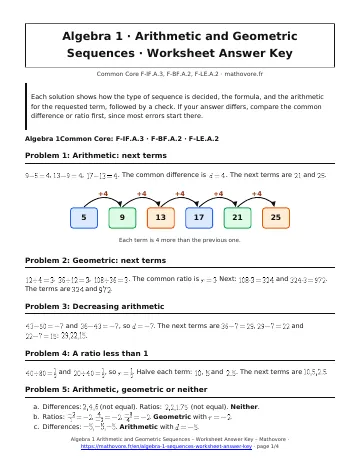
See every chapter on the Algebra 1 math page.